Robichaud Chiropractic
Chiropractor · ID: marquee-robichaud
Total Coordinates
639
21.3 months at 30/month
Unused
629
10 used so far
Draws Run
1
Total draws this client
Index Breakdown
Clinic
27
26 unused · 0 forced
Lifestyle
180
178 unused · 15 forced
Treatments
432
425 unused · 36 forced
Client Profile
Onboarded 2026-06-03 ▼Website URL
Not provided
Instagram Handle
Not provided
Client ID
marquee-robichaud
Onboarded
2026-06-03 09:54
Client Override
Headline font: Montserrat. Body font: Lato
Website Data
576,385 chars
=== WEBSITE DATA ===
--- https://docadrian.com/ ---
Oshawa Chiropractor ON | Robichaud Chiropractic & Orthotics
Oshawa Chiropractor Dr. Adrian Robichaud Can Help You Get Your Life Back!
Learn More About Us
Let Oshawa Chiropractor Robichaud Chiropractic & Orthotics Stop You from Living in Pain
Oshawa Chiropractor Dr. Adrian Robichaud Can Help You Get Your Life Back!
For more than 24 years, we’ve been helping patients just like you get well and stay well. Find out how our Chiropractor In Oshawa can help today!
Robichaud Chiropractic & Orthotics: The Trusted Chiropractor in Oshawa for Pain Relief and Wellness
When it comes to relieving pain, and improving your overall health, Robichaud Chiropractic & Orthotics stands out as a trusted clinic for exceptional chiropractic care. Dedicated to helping individuals live pain-free and active lives, Robichaud Chiropractic & Orthotics offers a patient-focused approach that addresses the root cause of discomfort, in addition to relieving your symptoms. Whether you’re dealing with back pain, neck stiffness, headaches, or posture issues, Robichaud Chiropractic & Orthotics is here to guide you toward wellness.
Robichaud Chiropractic & Orthotics combines 25 years of clinical experience with a genuine commitment to patient care. Each treatment plan is crafted to meet individual needs, ensuring that every patient receives the right care for his/her specific condition. Their team uses a variety of treatments to promote the body’s natural healing processes and relieve pain.
What We Can Do
Services to Meet Your Healthcare Needs
Our team strives to deliver the most suitable solution for your pain or issue. To meet that goal, we offer four core services: chiropractic care, massage therapy, acupuncture, and custom-made orthotics. We believe our variety of services complement one another, bringing you the best in healthcare strategies. And with this combination of services, we are able to address our patients’ unique needs and guide them toward a better life. Read more about our services below and learn how we can help you improve your overall health and wellness – naturally.
Live Painless
Oshawa chiropractor Dr. Robichaud is highly experienced, compassionate, and professional. He’ll take the time to listen to you and, with over two decades of experience, he will let you know what to expect from treatment and what your recovery will involve. And if we’re not the right fit for your condition, he’ll let you know that as well. With language options in both French and English, we are able to offer the best form of communication for all our clientele. That’s because our patients come first: we want you to get back to feeling your best as soon as safely possible.
What truly sets Robichaud Chiropractic & Orthotics apart from other clinics is their holistic approach and over 25 years of experience. They understand that pain is often a symptom of deeper imbalances in the body, and their goal is to restore harmony through gentle, precise, and evidence-based chiropractic techniques. Alongside spinal adjustments, they may incorporate lifestyle guidance, exercise recommendations, and ergonomic advice to support long-term results.
Patients also appreciate the clinic’s welcoming environment and professional service. From your first consultation, you’ll experience compassionate and confidential care from staff who will listen to your concerns, explain your treatment options, and work with you to develop a personalized care plan.
The Benefits of Choosing Robichaud Chiropractic & Orthotics
By choosing Robichaud Chiropractic & Orthotics, patients gain access to comprehensive care that prioritizes natural healing. Chiropractic treatments can:
Relieve chronic and acute pain
Improve posture and spinal alignment
Enhance mobility and flexibility
Reduce headaches and muscle tension
Support nervous system function
Boost overall wellness
Our Team
Our team can help alleviate many common types of neuromusculoskeletal conditions. As a sixth-degree black belt holder, Dr. Robichaud has a keen understanding of the demands that athletics place upon the body. Many of our patients are fellow martial arts practitioners and others who participate in all types of sports.
Trust Us
Our patients - athletes or not - know they can trust our efficient, friendly, results-oriented approach. Whether you are experiencing back pain or have suffered a recent automobile, work or sports injury, Robichaud Chiropractic & Orthotics is here to help. We can give you hope and, more importantly, we can give you results.
Chiropractic Care
Chiropractic care is a safe, hands-on approach to healing neuromusculoskeletal conditions. If you have an irritation of a joint or other area of your body for long enough, it can throw your body out of alignment and cause pain and dysfunction. Chiropractic gently restores the body’s natural position and the motion of the joints, alleviating pain and allowing you to get back to doing the things you love.
Massage Therapy
Massage therapy offers the perfect complement to chiropractic care by targeting the soft tissues. Massage can help reduce tension, decrease pain, reduce muscle spasms, improve circulation and blood flow, and relieve stress. Massage is a key component in recovering from automobile and other types of accidents, addressing the muscles and soft tissues while chiropractic care works on restoring the motion of the spine.
This team approach of chiropractic and massage therapy provides the comprehensive care you need to recover from your accident – all on-site.
Experts in Custom-Made Orthotics
Surprisingly, many pain problems can be traced back to your footwear or gait patterns. Your gait and foot patterns often have a huge impact on the rest of your musculoskeletal system because these patterns can create misalignments, and these misalignments cause pain. For example, if you have a collapsed arch or you tend to turn your foot outward when you walk or run, this can lead to pain or issues in the knees, hips, or back.
There’s no need to type in ‘orthotics near me’ when Oshawa chiropractor Dr. Robichaud and his team can offer you custom made orthotics. Most orthotics last about five to ten years. And they can significantly improve your quality of life, meaning they are absolutely worth the investment! Call us today to learn more. Our staff will gladly explain the process and help you book an appointment.
Testimonials
Our client getting happy & give the best feedback
Philippe B.
I enjoyed the informative and caring tone by Dr Robichaud. Things are looking up in relieving the pain in my shoulder.
Ashley C.
Doctor Adrian was very knowledgeable and helpful, will definitely be back!
Marilyn C.N.
No improvement is needed!! Such a great place..warm and friendly! And an amazing chiropractor. Thanks for all that you do!
Monique K.
Very comforting to know that if I could not be helped there that someone else can help. Relaxed atmosphere and perfect experience for a first timer!
- J H.
Since my first visit in October, I have received amazing chiropractic care! I can't believe how fast I'm healing. I'm very thankful for Dr. Adrian Robichaud's care and patience in my healing! I would say I was at 40% in my healing until my fall last week, when it dropped to 10-15%, but since my visit today, I'm back at 40%. I'm very blessed and thankful for such dedication from Robichaud Chiropractic & Orthotics towards my healing!
Mark P.
To-date, I have had 2 meetings with his practice and I have already felt the difference. I am self-employed, and with that being said, if I don't work, I don't get paid. 2 days after meeting with Dr. Robichaud, I am now able to get back to work. Thank you immensely.
Shelley P.
I experienced relief from pain I was experiencing after the first visit! I wish I had made the appointment months ago!
Tom G
A while back I was having such serious knee pain that a good nights sleep was not possible. I went to see Dr Robichaud and my problem was solved in one visit. More visits followed and the pain disappeared. Dr.Robichaud is a true professional and someone who really cares about his patients. So if you need a chiropractor don't give it any thought. Just call Dr. Robichaud. He has the magic touch.
Terry G.
I have a tendency to throw my back out every few years and I've been to a couple of other Chiropractors, but Adrian by far is the best. He finds out exactly where the issue is within 5 sec. and with a few manipulations everything is back in place, truly amazing. Also no pressure tactics like others who just go ahead and book you for more appointments, he says "just let me know if you feel you need another adjustment".
Shelley P
I experienced relief from pain I was experiencing after the first visit! I wish I had made the appointment months ago!
D. Byers
It's nice to be able to walk around the block and not have my back feel sore!
Geeta B.
Absolutely amazing experience. Both my nephew and I, suffering from chronic body pain due to sports, injuries, etc., could not have expected better results. Dr. R is professional, courteous, considerate, and very respectful. An absolute amazing experience. I now see him once a week.
Geeta B.
I just wanted to say thank you very much for seeing me today. I know there is still a ways to go in my treatment, but I'm feeling so much better. The pain has subsided substantially.
Experience Lasting Relief with Robichaud Chiropractic & Orthotics
If you’re searching for a chiropractor in the Durham Region who truly cares about your long-term well-being, Robichaud Chiropractic & Orthotics is an amazing clinic to trust. Their experienced team are committed to helping you move better, feel better, and live better. Without relying on medication or invasive treatments. Take the first step toward a healthier, pain-free life. Book with Robichaud Chiropractic & Orthotics at 905-571-0821 today to schedule your examination and treatment to discover how expert chiropractic care can make a lasting difference in your health and quality of life.
Ready to Start Feeling Better? Don't Wait!
You’ve taken the first step on your journey to health by visiting our website! Here, you can find more details about the variety of services we offer and what to expect when you book an appointment and visit us for the first time. Take the next step and contact us today!
We are always thrilled to meet new patients and offer them the hope they’ve been looking for – and we are eager to offer you that hope too!
--- https://docadrian.com/about-robichaud-chiropractic-orthotics/ ---
About Robichaud Chiropractic & Orthotics
About Us
For over 26 years, people in the Oshawa community have trusted Dr. Robichaud to help them relieve pain and restore health. Dr. Robichaud has the expertise and confidence to accurately evaluate your condition to help you recover.
Patients are surprised at how efficient and painless chiropractic care is, and they appreciate our honest, no-nonsense approach: we only prescribe treatment, test and exercises that you need. Your treatment plan is tailored specifically to you.
The Services You Need When You Need Them
Our practice is relaxed, calm and caring, with a positive, upbeat approach that puts our patients at ease and gives them hope as soon as they walk through the door. Dr. Robichaud assesses you on and, if you feel ready, we will start treatment the very same day.
We offer convenient same-day and evening appointments, and our comprehensive range of services includes chiropractic, massage therapy, acupuncture, laser theraphy, hot stone massage and custom-made orthotics. Whether you have a work or sports injury, a chronic condition, or have been involved in an auto accident, our mission is to help you achieve your health goals in the most compassionate and efficient manner possible.
Get Back to Enjoying Life
Like many of our patients, Dr. Robichaud lives in Oshawa and enjoys the climate and variety of activities offered in Southern Ontario. We know that pain can keep you from enjoying those activities, and we can’t wait to help you get back to doing the things you love!
Contact us today to schedule your first appointment. We accept and direct-bill most insurance to make it easier for you to get the care you need and start feeling better!
Ready to Start Feeling Better? Don't Wait!
You’ve taken the first step on your journey to health by visiting our website! Here, you can find more details about the variety of services we offer and what to expect when you book an appointment and visit us for the first time. Take the next step and contact us today!
We are always thrilled to meet new patients and offer them the hope they’ve been looking for – and we are eager to offer you that hope too!
--- https://docadrian.com/appointments/ ---
Contact Robichaud Chiropractic & Orthotics
Book An Appointment
Appointment for Massage Therapy
Ready to Start Feeling Better? Don't Wait!
You’ve taken the first step on your journey to health by visiting our website! Here, you can find more details about the variety of services we offer and what to expect when you book an appointment and visit us for the first time. Take the next step and contact us today!
We are always thrilled to meet new patients and offer them the hope they’ve been looking for – and we are eager to offer you that hope too!
--- https://docadrian.com/meet-dr-adrian-robichaud/ ---
Dr. Adrian Robichaud | Robichaud Chiropractic & Orthotics
Meet Dr. Adrian Robichaud
Dr. Robichaud became interested in chiropractic as a young boy, when he saw how quickly and efficiently it helped his father, who had been suffering from agonizing back pain. His father’s results left a lasting impression. While at University, Dr. Robichaud did a chiropractic internship and loved seeing how happy chiropractic patients were with the results of their care. That’s when he knew he wanted to become a chiropractor and help others receive those same benefits. These patient interactions are still his favorite part of being a chiropractor.
Chiropractic Philosophy
Dr. Robichaud believes that chiropractic care is an integral part of an overall healthy lifestyle, along with nutrition, exercise and, when appropriate, medication. He focuses on neuromusculoskeletal issues, which include the extremities as well as the neck and back. Besides treating acute and chronic conditions, we also provide maintenance care — because after we help you get healthy, we want to help you stay healthy.
A Compassionate Expert You Can Trust
Dr. Robichaud holds several certifications, including:
B.S. Human Kinetics, University of Ottawa
Doctor of Chiropractic, Canadian Memorial Chiropractic College
Custom Orthotic Therapy, Advanced Foot Biomechanics & Orthotic Therapy, Gait Analysis and Plaster Casting from The Orthotic Group, Markham, Ontario
Neurolinguistic Practitioner from Unique Perceptions, Orangeville, Ontario
Attuned as an Advanced Reiki Practitioner with Usui Shiki Ryoho
Shodan (first degree black belt) Okinawan Go Ju Ryu Meibukai Karate
Roku dan (sixth degree black belt) Shorin Shin Matsubayashi Ryu Karate
In addition, he is fluent in both English and French, so communicating your needs and goals will never be a problem.
Life in Oshawa
When he’s not at work, Dr. Robichaud enjoys spending time with his wife and three kids and taking advantage of local outdoor activities like walking and running. He also practices and teaches karate at a dojo not far from his chiropractic practice. And, like many people, he enjoys some down time with true crime or reality television shows.
Dr. Robichaud’s mission is to help people relieve their suffering and regain their health, and he would love to welcome you to the world of chiropractic care. Schedule your appointment today!
Ready to Start Feeling Better? Don't Wait!
You’ve taken the first step on your journey to health by visiting our website! Here, you can find more details about the variety of services we offer and what to expect when you book an appointment and visit us for the first time. Take the next step and contact us today!
We are always thrilled to meet new patients and offer them the hope they’ve been looking for – and we are eager to offer you that hope too!
--- https://docadrian.com/blog/ ---
Blog | Robichaud Chiropractic & Orthotics
Welcome to the Robichaud
Chiropractic & Orthotics Blog
A Guide to Custom Foot Orthotics
This guide to custom foot orthotics explains how they work, who they help, what to expect, and how proper support can reduce pain naturally.
Best Therapies for Auto Injuries
Learn the best therapies for auto injuries, from chiropractic care to massage and laser therapy, and how the right plan supports safer recovery.
Guide to Accident Recovery Treatment
A practical guide to accident recovery treatment, from early symptoms and diagnosis to personalized care that reduces pain and restores mobility.
8 Top Signs You Need Orthotics
Learn the top signs you need orthotics, from foot pain to poor posture, and when custom support may help you move better with less strain.
Chiropractic vs Physiotherapy Recovery
Compare chiropractic vs physiotherapy recovery for pain, injuries, and mobility. Learn which approach fits your goals and when combined care works best.
Neck Pain Relief That Actually Lasts
Need neck pain relief that lasts? Learn common causes, what helps, when to seek care, and how natural treatment can restore comfort and mobility.
Foot Pain Affecting Knee Alignment
Foot pain affecting knee alignment can change how you walk, strain your joints, and worsen pain. Learn the causes, signs, and treatment options.
How Long Does Whiplash Last?
How long does whiplash last? Learn typical recovery times, what affects healing, warning signs, and when to seek treatment for pain relief.
When Should You Get Orthotics?
When should you get orthotics? Learn the signs, who benefits, and when foot pain, posture, or gait issues mean it is time for support.
Acupuncture for Chronic Pain Relief
Learn how acupuncture for chronic pain relief may help reduce back, neck, and joint pain, improve mobility, and support recovery without drugs.
Suffering From A Disc Hernia?
Mechanical Spinal Depcompression compared with Cox Flexion Distraction Technique by: Dr. Adrian Robichaud, Chiropractor Spinal disc hernias are common. Pojskic, et al state that the “lifetime risk for symptomatic LDH is 1–3%;…
The Role of Neuro Emotional Technique in Health
Neuro Emotional Technique (NET) is a holistic approach to health that combines elements of homeopathy, neuroscience, and chiropractic principles. Its primary focus is on the connection between emotions and physical…
When To Choose Physiotherapy or Chiropractic
Deciding between physiotherapy and chiropractic care depends on your specific condition, and the recommendations of healthcare professionals. Here’s a general guideline: Physiotherapy (Physical Therapy): Ideal for a wide range of…
Healthy Pregnancy Exercise Tips for Mom-to-Be
Pregnancy is a beautiful and trans-formative time in a woman’s life, and maintaining a healthy lifestyle is crucial for both the mother and the developing baby. Regular exercise during pregnancy…
How to Choose the Perfect Shoes
Are you looking for a perfect pair of shoes? One of the most crucial factors to consider is choosing the right pair of shoes that not only provide comfort but…
Five Common Networking Mistakes
1. Failing to plan for an event. If you fail to plan, then you plan to fail. When getting ready for a networking event consider your goal(s), what type of…
Ready to Start Feeling Better? Don't Wait!
You’ve taken the first step on your journey to health by visiting our website! Here, you can find more details about the variety of services we offer and what to expect when you book an appointment and visit us for the first time. Take the next step and contact us today!
We are always thrilled to meet new patients and offer them the hope they’ve been looking for – and we are eager to offer you that hope too!
--- https://docadrian.com/chiropractic-treatment-in-oshawa/ ---
Chiropractic Treatment In Oshawa | Dr. Adrian Robichaud
Chiropractic Care
Chiropractic care is a safe, gentle, natural approach to help restore the body’s ability to function optimally by correcting issues in the nerves, muscles and joints — without drugs or surgery. In addition to the joints in the spine, we also treat issues in the joints of the extremities, including shoulders, elbows, wrists, hands, hips, knees, ankles and feet.
If you have an irritation in a joint for long enough, it can affect how your body is ‘set up,’ which results in pain and dysfunction. Chiropractic adjustments reset the body’s natural position and restore motion of the joints, relieving pain and letting you get on with life. Once the joints are working properly, the nerves and muscles follow suit.
Who Benefits from Chiropractic Care?
Chiropractic care benefits a wide range of individuals, from athletes and office workers to seniors and students. Many people seek chiropractic treatments to relieve back pain, neck pain, sciatica, headaches, shoulder tension, and many more ailments. Those with physically demanding jobs or sedentary lifestyles can greatly benefit from spinal cone to reduce strain and improve posture.
Athletes often rely on chiropractic care to enhance performance, improve mobility, and speed up recovery after injuries. For seniors, regular chiropractic adjustments can help maintain flexibility, reduce joint stiffness, and enhance balance. Even individuals without chronic pain can benefit from chiropractic maintenance care, similarly to an airplane, our bodies need regular maintenance to prevent future issues and support overall health and wellness.
Parents also turn to chiropractors for their children’s spinal health and posture development, especially in an age where cellphone use contributes to “text neck” and poor spinal alignment.
Techniques Used For Chiropractic Treatment In Oshawa
Dr. Robichaud offers both gentle, hands-on Diversified manual adjusting, Drop table adjusting, Cox flexion-distraction and the Chiropractic Adjusting Tool (CAT). Most patients prefer the hands-on approach, but some people prefer the adjusting tool (and some situations call for it). Either way, you can trust that Dr. Robichaud will tailor your care to your needs and preferences.
In order to achieve optimal pain relief, decrease in tension, increase range of motion and just get you feeling your best, we also offer the following:
Soft tissue work
IFC (electrotherapy)
Ultrasound
Cox Flexion Distraction
Moist heat
Ice
Accu-o-matic
Ready to Start Feeling Better? Don't Wait!
You’ve taken the first step on your journey to health by visiting our website! Here, you can find more details about the variety of services we offer and what to expect when you book an appointment and visit us for the first time. Take the next step and contact us today!
We are always thrilled to meet new patients and offer them the hope they’ve been looking for – and we are eager to offer you that hope too!
--- https://docadrian.com/our-services/ ---
Robichaud Chiropractic & Orthotics Services
Our Services
A Suite of Services to Care for You
Our team strives to deliver the most suitable solution for your pain or issue. To meet that goal, we offer four core services: chiropractic care, massage therapy, acupuncture, and custom-made orthotics. We believe our variety of services complement one another, bringing you the best in healthcare strategies. And with this combination of services, we are able to address our patients’ unique needs and guide them toward a better life. Read more about our services below and learn how we can help you improve your overall health and wellness – naturally.
Ready to Start Feeling Better? Don't Wait!
You’ve taken the first step on your journey to health by visiting our website! Here, you can find more details about the variety of services we offer and what to expect when you book an appointment and visit us for the first time. Take the next step and contact us today!
We are always thrilled to meet new patients and offer them the hope they’ve been looking for – and we are eager to offer you that hope too!
--- https://docadrian.com/auto-injury-treatment-in-oshawa/ ---
Auto Injury Treatment Oshawa | Robichaud Chiropractic & Orthotic
Auto Injury Treatment In Oshawa at Robichaud Chiropractic & Orthotics
When people are injured in an accident — whether at work or in an automobile accident — they often choose physiotherapy as a first course of treatment. At Robichaud Chiropractic & Orthotics, we know that’s usually not the best choice.
Chiropractic Care Addresses the Root of the Problem through Auto Injury Treatment In Oshawa
In an accident, the joints of the spine are affected. If you don’t treat the joints to get them moving properly, the muscles around them shrink or ‘atrophy.’ Physio treats the muscles without necessarily addressing the underlying spine problem. On the other hand, chiropractic care treats the joints of the spine to restore their natural motion and, if done soon enough after an accident, can prevent the muscle atrophy from occurring. This is important in preventing secondary problems like a weak neck that can result in chronic pain and the risk of re-injury.
Dr. Robichaud values your time, and he will never waste your time with treatment or exercises you don’t need. Therefore, you can trust that if he gives you an exercise to do, you need to do it! His approach is compassionate, no-nonsense and efficient, and recovery from an auto injury typically takes from 2 to 3 months.
Massage On-Site
We also offer massage therapy, which is a very important component in recovering from your injury. We know that after an accident, you have a lot on your mind, so we pride ourselves on the fact that we can take care of all your auto accident needs right here on site.
Acupuncture
As an ideal adjunct to chiropractic care, we use acupuncture when we see health problems that seem caused by disruption to energy pathways in your body called meridians. This centuries-old healing procedure focuses on the integrity of bodily systems, not specific conditions.
Insurance-Approved
We accept most insurance and in the vast majority of cases, we can direct bill your insurance provider so you’re not paying out of pocket for the care you need when you need it most.
Ready to Start Feeling Better? Don't Wait!
You’ve taken the first step on your journey to health by visiting our website! Here, you can find more details about the variety of services we offer and what to expect when you book an appointment and visit us for the first time. Take the next step and contact us today!
We are always thrilled to meet new patients and offer them the hope they’ve been looking for – and we are eager to offer you that hope too!
--- https://docadrian.com/massage-therapy-in-oshawa/ ---
Massage Therapy In Oshawa | Robichaud Chiropractic & Orthotics
Am I covered under my health benefits from work or extended health benefits?
Yes, we do direct billing as well.
Do you offer deep tissue massage?
Yes.
Do you provide exercises I can do at home?
Yes, we will show you remedial exercises you can perform outside the practice.
How long will my treatment plan be?
Generally, we will recommend a six-week treatment plan. We will try all of our techniques within the first six weeks. Our goal is to get you better as quickly as possible
--- https://docadrian.com/acupuncture-in-oshawa/ ---
Acupuncture In Oshawa | Robichaud Chiropractic & Orthotics
Acupuncture
As an ideal adjunct to chiropractic care, we use acupuncture when we see health problems that seem to be caused by disruption to energy pathways in your body called meridians. This centuries-old healing discipline is designed to focus on the integrity of bodily systems.
The best part? It’s extremely relaxing, comfortable and gentle.
How Does Acupuncture Work?
During a session, we’ll place extremely thin needles into various points of your body that require attention. We’ll identify these areas after speaking with you about the problems you’re experiencing. Most patients don’t ever feel the needles being inserted because they’re incredibly gentle and thin.
The best way to think about what’s happening as you undergo an acupuncture session is to imagine rivers of energy throughout your body, organized by meridians.
These meridians can experience a “traffic jam” and energy flow can become restricted. The needles help loosen the jam and allow energy to circulate properly.
The idea is that your body works better when your internal traffic (nerves and energy) are flowing freely.
Frequently Asked Questions About Acupuncture
Acupuncture visits can take up to 15-20 minutes.
Most people experience a variety of post-session feelings, which range from energized to a deep sense of relaxation and well-being.
There’s no right or wrong schedule for acupuncture. Some patients enjoy it weekly or monthly. We recommend listening to your body as to how often it may help you. We’ll also recommend a care plan once we know more about your goals.
Ready to Start Feeling Better? Don't Wait!
You’ve taken the first step on your journey to health by visiting our website! Here, you can find more details about the variety of services we offer and what to expect when you book an appointment and visit us for the first time. Take the next step and contact us today!
We are always thrilled to meet new patients and offer them the hope they’ve been looking for – and we are eager to offer you that hope too!
--- https://docadrian.com/orthotics-in-oshawa/ ---
Orthotics In Oshawa | Robichaud Chiropractic & Orthotics
Custom Orthotics in Oshawa from Robichaud Chiropractic & Orthotics: Comfort, Balance, and Pain Relief
If you’re experiencing foot pain, knee discomfort, or lower back strain, the problem might start from the ground up. Custom orthotics from Robichaud Chiropractic & Orthotics provide a proven, personalized solution to help restore proper alignment, improve comfort, and prevent chronic pain. Designed to support the specific structure of your feet, custom orthotics can make a significant improvement in how you move, feel, and perform every day.
Plantar fasciitis
Achilles tendonitis
Arthritis conditions
Diabetes
Metatarsalgia
Knee pain
Shin splints
What Are Custom Orthotics?
Expertise You Can Trust
Happy and Pain Free
What Are Custom Orthotics?
Expertise You Can Trust
Happy and Pain Free
Dr. Robichaud loves the feedback he gets from his orthotics patients. Typically, they’re delighted with the results and feel happy and pain-free within a couple of weeks. Helping people feel better and get back to doing the things they love is our mission at Robichaud Chiropractic & Orthotics, so it’s very rewarding to hear our patients’ positive feedback.
Who Can Benefit from Custom Orthotics?
Many individuals can benefit from custom orthotics, especially those who spend long hours on their feet or suffer from recurring joint or muscle pain. Orthotics are highly effective for people with:
Foot pain such as plantar fasciitis, bunions, or heel spurs
Knee, hip, or lower back pain
Flat feet or high arches
Sports-related injuries or repetitive strain from running or walking
Occupational strain for workers who stand for extended periods
Even if you don’t currently experience pain, custom orthotics can help prevent future flare ups. Children, athletes, seniors, and people with chronic pain can all experience long-term benefits from wearing orthotics made specifically for their feet.
Why Choose Robichaud Chiropractic & Orthotics for Custom Orthotics In Oshawa and surrounding areas?
Robichaud Chiropractic & Orthotics is a trusted provider of custom orthotics in Oshawa, with 25 years of experience Dr. Robichaud is known for his expertise in biomechanics and personalized patient care. He understands that every person’s body mechanics are different and that proper foot support plays a crucial role in overall health.
Dr. Robichaud uses advanced assessment tools to analyze gait, posture, and weight distribution. This allows him to design orthotics that not only maintain and improve foot comfort but also correct alignment issues that can lead to pain in other parts of the body.
What sets Robichaud Chiropractic & Orthotics apart is their experience and holistic approach to care. Dr. Robichaud doesn’t just treat symptoms, also he identifies the underlying causes of discomfort and creates custom plans that combine chiropractic care with orthotics support for long-term relief and wellness.
Ready to Start Feeling Better? Don't Wait!
You’ve taken the first step on your journey to health by visiting our website! Here, you can find more details about the variety of services we offer and what to expect when you book an appointment and visit us for the first time. Take the next step and contact us today!
We are always thrilled to meet new patients and offer them the hope they’ve been looking for – and we are eager to offer you that hope too!
--- https://docadrian.com/bioflex-laser-therapy-in-oshawa/ ---
Laser Therapy in Oshawa | Robichaud Chiropractic & Orthotics
BioFlex laser therapy, also known as low-level laser therapy (LLLT) or photobiomodulation, is a treatment that uses low-intensity laser light to stimulate healing and reduce pain and inflammation in various conditions.
This therapy is non-invasive and involves applying laser light to specific areas of the body to penetrate the skin and underlying tissues.
How BioFlex Laser Therapy Works
The laser light used in BioFlex therapy penetrates the skin and interacts with the cells to trigger biological processes that promote healing. The primary mechanisms include:
Cellular Stimulation: The light energy is absorbed by the mitochondria in the cells, increasing ATP (adenosine triphosphate) production. This boost in cellular energy helps repair and regenerate damaged tissues.
Reduced Inflammation: LLLT modulates inflammatory responses, reducing the production of pro-inflammatory cytokines and increasing anti-inflammatory cytokines.
Pain Relief: It helps in the release of endorphins and other pain-relieving compounds, reducing the perception of pain.
Enhanced Circulation: The therapy improves blood flow to the treated areas, delivering more oxygen and nutrients to the tissues and removing waste products.
Conditions Treated with BioFlex Laser Therapy In Oshawa
BioFlex laser therapy can be used to treat a variety of conditions, including:
Plantar Fasciitis
Muscle Strains
Heel Spurs
Ligament Sprains
Tendonitis
Carpal Tunnel Syndrome
Knee Osteoarthritis
Back and Neck Pain
Plus many more..
Benefits of BioFlex Laser Therapy
BioFlex laser therapy in Oshawa has several benefits:
Non-invasive and painless:
The therapy does not involve any surgical procedures or medications.
Minimal side effects:
It is generally considered safe with few reported side effects.
Quick and convenient:
Sessions are typically short, often lasting between 15-30 minutes, depending on the condition being treated.
Complementary to other treatments:
It can be used alongside other treatments to enhance overall effectiveness.
Treatment Process
Assessment: Angela Petrovic RMT will assesses the condition and determine the appropriate treatment plan.
Application: The laser device is applied to the targeted area, and the light is delivered in specific wavelengths and dosages.
Post-Treatment: After the session, patients can usually resume their normal activities without any downtime.
Billing
As it is performed by a registered massage therapist, it will be billed under your massage therapy benefits. Direct billing is available for most insurance providers. Check with your provider to determine your amount coverage and if a doctor’s note is required. The client is responsible for any unpaid fees not covered by their insurance provider.
Safety and Efficacy
BioFlex laser therapy is considered safe when performed by trained professionals. Clinical studies have shown positive results in reducing pain and promoting healing for various conditions, although the effectiveness can vary depending on the specific condition and individual response.
Ready to Start Feeling Better? Don't Wait!
You’ve taken the first step on your journey to health by visiting our website! Here, you can find more details about the variety of services we offer and what to expect when you book an appointment and visit us for the first time. Take the next step and contact us today!
We are always thrilled to meet new patients and offer them the hope they’ve been looking for – and we are eager to offer you that hope too!
--- https://docadrian.com/new-patients/ ---
New Patients at Robichaud Chiropractic & Orthotics
New Patients at Robichaud Chiropractic & Orthotics
We pride ourselves on providing a calm, laid back, relaxed atmosphere to reduce the worry you feel about your pain. Usually, Dr. Robichaud will greet you personally and, if that’s not the case, his caring, upbeat staff will make you feel welcome. You’ll fill out our new patient forms, and then you’ll be on your way.
Getting Started
Once in the treatment room, Dr. Robichaud will listen as you explain your symptoms and history. Then, with your permission, he will conduct an examination to pinpoint specific issues. This exam will be based on your unique symptoms; it’s not a ‘one size fits all’ exam. Most cases do not require X-rays, but if you do need them, our practice is conveniently located near an x-ray facility.
After the exam, Dr. Robichaud will explain his findings and lay out his plan for treatment. He’ll answer any questions you may have and then, if you feel ready to begin, you’ll have your first treatment. There’s no need to come back again another day to start feeling better!
With Dr. Robichaud’s decades of experience and expertise, you can trust that he will recommend the best approach for your situation, and he will never recommend tests, treatment or exercise that you don’t need. So, if he says you need to do a particular exercise, you know that you really do need to do it to get better — he’ll never leave you guessing.
Ready to Start Feeling Better? Don't Wait!
You’ve taken the first step on your journey to health by visiting our website! Here, you can find more details about the variety of services we offer and what to expect when you book an appointment and visit us for the first time. Take the next step and contact us today!
We are always thrilled to meet new patients and offer them the hope they’ve been looking for – and we are eager to offer you that hope too!
--- https://docadrian.com/fees/ ---
Fee Schedule | Robichaud Chiropractic & Orthotics
Fees for Robichaud
Chiropractic & Orthotics
Adult
Initial History & Examination (Includes
treatment when appropriate) $85
X-rays (taken at an outside X-ray Facility)* covered by Ontario Health
Insurance with a valid OHIP card
Regular Visit $48
Regular Visit – Seniors (65+) students, children, ODSP/Ontario Works $40
Custom made orthotics (examination, orthotics, fitting and follow-up visits, a lifetime warranty and one re-covering at no extra cost) $500
--- https://docadrian.com/what-our-patients-say/ ---
Reviews | Robichaud Chiropractic & Orthotics
Robichaud Chiropractic & Orthotics Reviews
With over 80 New Patient Surveys submitted, we average 5 out of 5 stars!
At Robichaud Chiropractic & Orthotics we love when patients share with us their feedback and comments after chiropractic care. Please read our patient testimonials below to see what other people have achieved through their tailored treatment plans with us.
Share your stories too! Click here to send us your feedback so that we can help to spread the word about the benefits of natural Robichaud Chiropractic & Orthotics care.
For more information, or to schedule an appointment contact us today.
Consumers Choice Award 2026
EXCELLENT
Based on 247 reviews
Posted on Google
Rob Comeau
2 years ago
Trustindex verifies that the original source of the review is Google.
This user only left a rating.
Posted on Google
Rajesh Nambiar
2 years ago
Trustindex verifies that the original source of the review is Google.
Dr Adrian has been fantastic in releivung my pain on multiple occasions - once at my lower back and once at my neck-shoulder region. Very experienced and does a fantastic job. Thanks Dr.Adrian for your service.
Read more
Posted on Google
Dave Wilton
2 years ago
Trustindex verifies that the original source of the review is Google.
I've found adjustments to be quick and really feel the difference to my every day life. Dr Robichaud was recommended to me by a friend that was serious about fitness and l would highly recommend him to anyone wanting to improve their overall health.
Read more
Posted on Google
Mark Chambers
2 years ago
Trustindex verifies that the original source of the review is Google.
Dr. Robichaud and his staff provide impeccable services. Starting with their phone services for booking appointments as Dr. Robichaud will personally connect with you. I highly recommend Dr. Robichaud for your chiropractic needs.
Read more
Posted on Google
Zelle Lorenzo
2 years ago
Trustindex verifies that the original source of the review is Google.
My fiancé and I have been under the care of Dr. Robichaud for years, and the positive impact on both of our back pain has been truly remarkable. Following just one visit, we noticed a significant improvement, highlighting Dr. Robichaud's exceptional skills and expertise. His positive and open demeanor, along with his attentive listening and strong assessment skills, contribute to a professional and welcoming environment. We deeply appreciate the consistent care and the positive results, making our experience with Dr. Robichaud truly outstanding.
Read more
Posted on Google
Nicola Haw
2 years ago
Trustindex verifies that the original source of the review is Google.
This was my first ever experience with chiropractic care, and I had a great first visit with Dr. Robichaud. He guided me through the whole process and explained everything to me in ways that I could understand. The adjustments were very effective and provided immediate relief. Will definitely be recommending him to my friends and family!
Read more
Posted on Google
Kennedy Osemede
2 years ago
Trustindex verifies that the original source of the review is Google.
This user only left a rating.
Posted on Google
Sidhardha Puttala
2 years ago
Trustindex verifies that the original source of the review is Google.
This user only left a rating.
Posted on Google
Sathya “Kalakal chat”
2 years ago
Trustindex verifies that the original source of the review is Google.
Friendly staff and got a very good experience about the way they explained the issue and all possible solutions. Definitely will refer my friends.
Read more
Posted on Google
Pat Monka
2 years ago
Trustindex verifies that the original source of the review is Google.
This user only left a rating.
Testimonials
Our client getting happy & give the best feedback
Peter F.
Booking a appointment with Dr Robichaud was easy and prompt. On the first appointment he made adjustments that gave me relief Dr Robichaud what was going on with my back and has put me onto the road for recovery.
Giselle D.
I wish I could express with words the amazing treatment I have received from Doctor Adrian Robichaud. I had an injury which stretched my hand, arm, shoulder (bursitis) and left my neck slightly dislocated…Beyond my expectations and in excruciating pain, I trusted the most recommended Chiropractor in Oshawa. The Clinic in general, the kindness of the staff and the medical equipment is excellent. Treatment has been not only physical, but in my opinion there is a deep sense of compassion synchronized with a pair of strong but gentle hands which can “read” where the discomfort and pain are. The relaxation, the muscles losing up tension, the spinal cord and bones aligning and the realization of healing is priceless…Just to say thank you, is not enough! I say like my Senior Clients in the Caregiver service I offer.”How could I ever repay you for your Kindness!” and the answer is here, I am writing this letter with the intention that someone would Edit it accordingly and place it on a Public Platform such as Social Media, brochures and even Oshawa This Week News Paper.
Pat P.
I recently received treatment from Dr. Robichaud for a strained achilles tendon and with just one treatment I felt some notable improvement. He advised that a long term treatment could include orthotics. Once my injury is healed I will revisit for assessment. With massage and some exercises I feel confident I will be feeling better soon. He was very professional and his hours aligned with my work schedule, I was appreciative of his flexible hours so I’ll be able to continue with my treatments. I highly recommend Dr. Adrian Robichaud
Penny A.
Dr. Robichaud is very professional with his clients. He is always on time and makes you feel comfortable in his presence. He’s very knowledgeable in his profession and dedicated to correcting your issues. I have even trusted my ten-year-old son in his care. I would have no issues recommending him to family and friends.
Denise
I was so anxious to see a chiropractor but Dr. Robichaud was highly recommended to me. Dr. Robichaud was very patient, listened to all of my concerns, answered all my questions and made me feel very comfortable. I felt relief immediately after my 1st appointment. During one of my appointments, Dr. Robichaud allowed my children to observe my treatment and took the time to explain what he was doing and answered their questions. I’m grateful for the recommendation and will definitely refer him to anyone in need of an excellent chiropractor. Thanks Dr. Robichaud!
Lucas
Great environment. Dr. Adrian was very patient and easy to follow. I didn’t get confused once. Recommended for sure.
Paul P.
Just came back from a two week vacation full of long hikes with climbs and descents. No muscle aches or chronic pain in my lower back and no sciatica pain suffrage at the end of each day. I owe all of this enjoyment to a great chiropractor. Thank you Dr. Adrian Robichaud. The orthopedic inserts you fitted me with and my monthly adjustment sessions have really paid off.
Monique K., Omemee, Ontario.
I have been very pleased and impressed with the work that Dr. Robichaud does for me. I am never disappointed. Recently I have had two visits that had different pains and when I explained where they were he went straight to work and I had walked out without pain both times! I will continue to go and continue to recommend! Thanks again!
Kaylen G., Oshawa, Ontario
“Robichaud Chiropractic is Fantastic. Dr Adrian is so good at what he does and understanding to patients needs and schedules. We would never go anywhere else and recommend him always.”
Charles (Chuck) B., Whitby, Ontario.
Dear Dr. Robichaud, I would like to thank you for your adjustments recently. The kink in my neck and back disappeared quite soon after. It was prevalent for almost two months prior to my visit and did not go away. In addition to feeling better, I also have felt greater mobility in my neck and general movement. Once again, thank you!
Julia S., Oshawa, Ontario.
Adrian helped my friend Natasha with her custom orthotics, her feet are very very happy!
Bonnie R., Ottawa, ON
I have gone to chiropractors in the past who only want you to keep coming, … I have been fortunate to have Dr. Robichaud treat me and eliminated my pain.
Billy O., Courtice, ON
Went to Dr Adrian Robichaud and he fixed my hip. Well worth the investment to relieve me of the pain in the hip.
Shelley T., Oshawa, ON
Dr. Adrian Robichaud did amazing work on my shoulder. I went from very little range to full range in a short period of time. He is very knowledgeable and friendly. If you need a chiropractor, look no further!!!
Melissa P.
Dr. Robichaud was able to see me within days of me reaching out to him for an appointment. He was very thorough, knowledgeable and friendly during my initial appointment. Within 24 hours I experienced relief from just one adjustment. Chiropractic works! I’m looking forward to continuing this journey with Dr. Robichaud.
Bill H.
Dr Robichaud is very soft spoken and listened while I described how I came to be sitting in his office.. Once I was finished with my “story” , we got into the meat of an evaluation of my physical condition. Dr. Robichaud., met every one of my expectations for professionalism and knowledge. After a comprehensive examination he explained the issues he found and made a number of adjustments and I left his office feeling the same as when I arrived. What amazed me was later in the day I noticed that the usual pain that I would experience and accompanying fatigue did not appear at its usual afternoon time. Rather I continued well into the evening feeling quite well I am very hopeful Dr. Robichaud will prove to have “magic hands” for me. So far I’m very impressed.
Pedro B.
Informative first visit and good experience so far. Problem areas identified and treatment plan suggested. Looking forward to seeing an improvement in my condition over subsequent appointments. Thank you
Dale C.
I have been to many different medical doctors and surgeons and have had little improvement with my lower back pain. However after getting treatments from Dr. Adrian Robichaud I have experienced great success as he has made a huge improvement to my pain and mobility. His practical knowledge and skill in treating my condition has giving me back the quality of life that I have not experienced in years. Thank you Dr. Robichaud.
Maureen G.
Thank you so much for looking after my mom. She is fine today and pain free–first time in a long time.
Ready to Start Feeling Better? Don't Wait!
You’ve taken the first step on your journey to health by visiting our website! Here, you can find more details about the variety of services we offer and what to expect when you book an appointment and visit us for the first time. Take the next step and contact us today!
We are always thrilled to meet new patients and offer them the hope they’ve been looking for – and we are eager to offer you that hope too!
--- https://docadrian.com/contact-us/ ---
Contact Robichaud Chiropractic & Orthotics
Contact Robichaud Chiropractic & Orthotics
Office Hours
Monday 1:00 PM to 7:00 PM
Tuesday 9:00 AM to 1:00 PM
Wednesday 1:00 PM to 7:00 PM
Thursday 9:00 AM to 12:00 PM
Thursday 3:00 PM to 6:00 PM
Ready to Start Feeling Better? Don't Wait!
You’ve taken the first step on your journey to health by visiting our website! Here, you can find more details about the variety of services we offer and what to expect when you book an appointment and visit us for the first time. Take the next step and contact us today!
We are always thrilled to meet new patients and offer them the hope they’ve been looking for – and we are eager to offer you that hope too!
--- https://docadrian.com/copyright/ ---
Acupuncture In Oshawa | Robichaud Chiropractic & Orthotics
Copyright Statement
Copyright
Content on this website (including text, graphics and multi-media) is used under license from third party suppliers or is copyright to Robichaud Chiropractic & Orthotics.
Content on this site may not be reproduced for any commercial purposes. Copyright authority is asserted by the following organizations:
© Canva.com– All Rights Reserved.
Ready to Start Feeling Better? Don't Wait!
You’ve taken the first step on your journey to health by visiting our website! Here, you can find more details about the variety of services we offer and what to expect when you book an appointment and visit us for the first time. Take the next step and contact us today!
We are always thrilled to meet new patients and offer them the hope they’ve been looking for – and we are eager to offer you that hope too!
--- https://docadrian.com/legal/ ---
Acupuncture In Oshawa | Robichaud Chiropractic & Orthotics
The information contained in this Site is for general guidance on matters of health interest only. While we have made every attempt to ensure that the information contained in this Site has been obtained from reliable sources, Robichaud Chiropractic & Orthotics is not responsible for any errors or omissions, or for the results obtained from the use of this information.
All information in this Site is provided “as is”, with no guarantee of completeness, accuracy, timeliness or of the results obtained from the use of this information, and without warranty of any kind, express or implied, including, but not limited to warranties of performance, merchantability and fitness for a particular purpose.
In no event will Robichaud Chiropractic & Orthotics, its related partnerships or corporations, or the partners, agents or employees thereof be liable to you or anyone else for any decision made or action taken in reliance on the information in this Site or for any consequential, special or similar damages, even if advised of the possibility of such damages.
Certain links in this Site connect to other Web Sites maintained by third parties over whom Robichaud Chiropractic & Orthotics has no control. Robichaud Chiropractic & Orthotics makes no representations as to the accuracy or any other aspect of information contained in other Web Sites.
--- https://docadrian.com/accessibility-2/ ---
Acupuncture In Oshawa | Robichaud Chiropractic & Orthotics
Accessibility Statement
Robichaud Chiropractic & Orthotics Web Accessibility Statement
We are committed to making the Robichaud Chiropractic & Orthotics website available to all users, including those with disabilities. As part of this commitment, we are continually improving our website to ensure we provide equal access to all of our users.
General
Robichaud Chiropractic & Orthotics has invested a significant amount of resources to help ensure that our website is made easier to use and more accessible to people with special needs, including those with visual, hearing, cognitive and motor impairments. We are updating our site regularly to make it as accessible as possible.
Accessibility
Robichaud Chiropractic & Orthotics makes available the UserWay Website Accessibility Widget that is powered by a dedicated accessibility server. The software allows Robichaud Chiropractic & Orthotics to improve its compliance with the Web Content Accessibility Guidelines (WCAG 2.0).
Our team also uses tools such as, WAVE by WebAIM, Web Accessibility by Monsido, and other color contrast analyzers to ensure the best experience possible for all visitors.
The site is being designed to meet Level AA Success Criteria of the Web Content Accessibility Guidelines 2.0 to the greatest extent feasible.
Enabling the Accessibility Menu on Robichaud Chiropractic & Orthotics
The accessibility menu can be enabled by clicking the accessibility menu icon that appears on the corner of the page. After triggering the accessibility menu, please wait a moment for the accessibility menu to load in its entirety.
Disclaimer
Robichaud Chiropractic & Orthotics continues its efforts to constantly improve the accessibility of its site and services in the belief that it is our collective moral obligation to allow seamless, accessible and unhindered use also for those of us with disabilities.
Despite our efforts to make all pages and content fully accessible, some content may not have yet been fully adapted to the strictest accessibility standards. This may be a result of not having found or identified the most appropriate technological solution.
We make reasonable efforts to ensure that PDF files posted on our website are accessible.
Work to Do
We are in the process of improving our Alternative Text (Alt Text) for images so that only images that present valuable information include meaningful alternative text for screenreader users; any decorative images will not include alt text.
We’re Here For You
If you are experiencing difficulty with any content, require assistance with any part of our website, or would like to request any information in an accessible alternative format, please contact us at (289) 312-3178 during normal business hours and we will be happy to assist.
Accessibility Problem or Suggestion
If you have any concerns or suggestions regarding the accessibility of the Robichaud Chiropractic & Orthotics website, please use this form to provide your feedback. We value your feedback and will consider all suggestions as we evaluate ways to accommodate all users of our website and our overall accessibility policies.
Last Updated: January 2018
Ready to Start Feeling Better? Don't Wait!
You’ve taken the first step on your journey to health by visiting our website! Here, you can find more details about the variety of services we offer and what to expect when you book an appointment and visit us for the first time. Take the next step and contact us today!
We are always thrilled to meet new patients and offer them the hope they’ve been looking for – and we are eager to offer you that hope too!
--- https://docadrian.com/massage-therapy-for-muscle-recovery/ ---
Massage Therapy for Muscle Recovery Works
Massage therapy for muscle recovery can ease soreness, improve mobility, and support healing after work, sports, or injury.
You feel it the day after a hard workout, a long shift, or an injury that changed how you move. Muscles tighten up, simple movements feel restricted, and the soreness lingers longer than it should. That is where massage therapy for muscle recovery can make a real difference – not as a luxury, but as a practical part of getting pain down, movement back, and healing on track.
For many adults, muscle soreness is not just about exercise. It can come from repetitive work, poor posture, long hours at a desk, weekend sports, martial arts training, or compensation patterns after a car accident. When muscles stay tight and irritated, they can pull on joints, limit range of motion, and keep the body stuck in a cycle of strain. The right treatment helps interrupt that cycle.
Massage therapy works on soft tissue – muscles, fascia, tendons, and other structures that support movement. When these tissues are overworked or injured, they often develop tension, small areas of irritation, and guarding patterns that make the body feel stiff or painful. A skilled massage therapist uses targeted hands-on techniques to reduce that tension and improve how the tissue moves.
One of the biggest benefits is improved circulation. Better blood flow helps deliver oxygen and nutrients to stressed tissue while supporting the removal of metabolic waste that can build up after physical activity. That does not mean massage magically repairs an injury overnight. It means the body is often in a better position to recover when tight, overloaded tissue is treated properly.
Massage can also calm the nervous system. This matters more than many people realize. When pain is present, muscles tend to stay guarded. The body braces, movement changes, and recovery may slow down. By helping muscles relax and reducing protective tension, massage can make movement feel easier and less threatening.
What it can help with
Muscle recovery is not one-size-fits-all. Some patients come in after intense training sessions. Others are dealing with recurring tension in the neck, low back, shoulders, or hips that builds up over weeks and months. Massage therapy may be helpful for delayed onset muscle soreness, sports-related strain, postural tension, repetitive stress from work, and soft tissue discomfort after an accident.
It can also support people who are returning to activity after time away. If you have been less active because of pain, illness, or a previous injury, muscles often lose flexibility and endurance. Starting up again can trigger soreness quickly. Massage may help manage that transition so recovery feels more manageable and less discouraging.
There are limits, though. If pain is sharp, swelling is significant, or a serious tear or fracture is possible, massage is not the first step. In those cases, proper assessment comes first. Good care is not about pushing through every symptom. It is about choosing the right treatment at the right time.
Massage therapy for muscle recovery after sports and training
Active adults and athletes often assume soreness is just part of the deal. Some soreness is normal. Persistent tightness, reduced mobility, and recurring strain are different. Those signs often point to muscles that are not recovering well between training sessions.
Massage can help reduce the carryover tension that changes mechanics and increases the risk of overload. A runner with tight calves and hips, for example, may start changing stride without realizing it. A weightlifter with stiff shoulders may compensate through the neck or low back. A martial arts practitioner with lingering hip tension may lose power and control during movement. In each case, the issue is not just discomfort. It is how that discomfort affects performance and increases stress elsewhere.
Timing matters. Deep work right before competition may leave some people feeling heavy or irritated, while lighter recovery-focused treatment after activity may feel more beneficial. It depends on the person, the sport, and the current state of the tissue. That is why individualized care matters more than a standard routine.
Recovery after injury is different from recovery after exercise
There is a difference between normal post-workout soreness and muscle pain linked to an injury. After a strain, whiplash, or work-related overuse problem, the body often develops compensation patterns that persist long after the initial event. You may notice one side working harder, a reduced ability to turn or bend, or muscles that always seem to tighten back up.
In these cases, massage is often most effective when it is part of a broader recovery plan. At Robichaud Chiropractic & Orthotics, that may mean combining massage therapy with chiropractic care, exercise guidance, acupuncture, or other conservative treatments based on the patient’s needs. The goal is not only to loosen a tight muscle for a day or two. The goal is to address why that muscle keeps overworking in the first place.
This root-cause approach matters. If a foot imbalance is affecting gait, custom orthotics may be part of the answer. If joint restriction is forcing nearby muscles to compensate, chiropractic treatment may help restore better motion. If a patient is recovering from an auto injury, several tissues and movement patterns may need attention together. Massage is valuable, but it is even more effective when it fits into a clear plan.
What a good treatment plan looks like
Effective muscle recovery usually involves more than one appointment and more than one strategy. A good plan starts with listening carefully to the patient, understanding how the problem developed, and identifying the factors that keep it going.
Treatment should match the stage of recovery. In the early stage, the focus may be reducing pain, calming muscle guarding, and improving comfort with basic movement. Later, the focus may shift toward restoring tissue mobility, improving joint function, and helping the patient return to work, exercise, or sport safely.
Home care often matters just as much as in-office treatment. That may include stretching, mobility work, hydration, activity modification, or simple exercises to keep muscles from tightening back up between visits. Patients usually do best when they understand what is happening and what they can do to support the process.
What massage can and cannot do
Massage therapy is helpful, but honest guidance matters. It can reduce muscle tension, ease soreness, improve mobility, and support recovery. It cannot correct every underlying cause by itself.
If your pain is being driven by poor lifting mechanics, training errors, posture-related strain, joint dysfunction, or structural imbalance, massage may provide relief without fully solving the issue. That does not make it less useful. It means the best results often come from combining symptom relief with corrective care.
This is especially true for people with recurring pain. If the same shoulder tightness, low back tension, or headache pattern keeps returning, it is worth looking beyond the muscle itself. Repeated temporary relief is frustrating. A more complete assessment can point to what needs to change for longer-lasting results.
When to consider care
If muscle soreness is lasting longer than expected, restricting movement, affecting sleep, or interfering with work and exercise, it is time to pay attention. The same is true if you are recovering from an injury and feel stuck, or if one area keeps tightening up no matter how much you stretch.
You do not have to wait until pain becomes severe. Early treatment often helps prevent a short-term problem from becoming a longer-term one. For many patients, that means less downtime, better mobility, and a faster return to normal routines.
The right care should feel purposeful. You should understand why treatment is being recommended, what it is intended to improve, and what progress should look like over time. That clarity builds trust and helps patients stay engaged in recovery.
Muscle recovery is not just about feeling better for an hour after treatment. It is about helping your body move better, heal better, and handle the demands of daily life with less pain and less restriction. When massage therapy is used thoughtfully, it can be a powerful part of that process. If your muscles are not bouncing back the way they should, getting the right support now can save you a lot of frustration later.
--- https://docadrian.com/acupuncture-for-chronic-pain-relief/ ---
Acupuncture for Chronic Pain Relief
Learn how acupuncture for chronic pain relief may help reduce back, neck, and joint pain, improve mobility, and support recovery without drugs.
When pain keeps showing up at work, in the car, during workouts, or when you are trying to sleep, it starts to wear down more than just your body. Acupuncture for chronic pain relief is often one of the options people consider when they want real improvement without relying on medication alone. For many patients, the goal is simple – move better, hurt less, and get back to normal life with a plan that makes sense.
Why chronic pain is so difficult to treat
Chronic pain is rarely just one thing. A sore lower back may involve tight muscles, joint irritation, old injuries, poor posture, repetitive strain, and compensation patterns that developed over time. Neck pain can trigger headaches. Foot imbalance can travel up into the knees, hips, and spine. That is why quick fixes often fall short.
Pain also changes behavior. When something hurts, people naturally guard the area, move less, or shift weight in ways that protect one part of the body while overloading another. Over weeks or months, that can turn a local problem into a broader mobility issue. Effective care needs to look beyond the symptom and pay attention to function, movement, and the source of strain.
This is where acupuncture can fit well into a conservative treatment plan. It is not about masking discomfort for a few hours. The aim is to calm irritated tissues, reduce muscle tension, support circulation, and help the nervous system settle so the body can move and recover more efficiently.
Acupuncture involves placing very fine sterile needles at specific points in the body. Most patients are surprised by how gentle it feels. Depending on the area being treated, you may notice a mild ache, warmth, heaviness, or twitch in the muscle, but it is usually brief.
From a modern clinical perspective, acupuncture may help by influencing pain signaling, encouraging the release of natural pain-relieving chemicals, improving local blood flow, and reducing muscle guarding. It can also help downshift the stress response that often keeps painful conditions cycling. When the body is constantly tense and reactive, pain tends to feel louder. When that cycle is interrupted, movement often becomes easier.
That does not mean acupuncture is magic or that it works the same way for everyone. Results depend on the condition, how long it has been present, how inflamed or restricted the area is, and what else is contributing to the problem. Someone with a recent flare-up may respond faster than someone who has dealt with pain for years and has multiple mechanical issues involved.
Conditions that often respond well
Acupuncture is commonly used as part of care for lower back pain, neck pain, tension headaches, shoulder pain, sciatica, hip pain, knee pain, arthritis-related discomfort, and muscle tightness from overuse or injury. It can also be helpful during recovery after a car accident, sports injury, or repetitive work strain when pain and muscle guarding are slowing progress.
For active adults and athletes, acupuncture may help reduce the muscle tightness that keeps interfering with training and recovery. For working professionals, it can be especially useful when desk posture, long commutes, and stress are feeding into chronic neck, shoulder, or back pain. In each case, the goal is not just to feel better for the day, but to create enough pain reduction that normal movement can return.
What acupuncture can and cannot do
A realistic conversation matters. Acupuncture can be very helpful for pain relief, but it is not a cure-all. If chronic pain is being driven by poor biomechanics, weakness, repetitive strain, or footwear issues, those factors also need attention. If there is severe structural damage or a condition that requires medical intervention, acupuncture should be part of a broader care strategy, not the only step.
What it often does well is lower the intensity of pain, reduce muscle spasm, improve range of motion, and make other treatments more effective. When a patient is less guarded and can move with less discomfort, chiropractic care, rehab exercises, soft tissue treatment, and daily activity changes tend to work better. That is one reason integrated care can be so valuable.
At a multidisciplinary clinic such as Robichaud Chiropractic & Orthotics, acupuncture can be used alongside other conservative therapies to support a more complete recovery plan. That matters when pain has more than one driver.
What to expect during treatment
Your first visit should start with a clear assessment, not a rushed procedure. A good provider will ask where the pain is, how long it has been there, what aggravates it, what eases it, and how it is affecting your work, sleep, exercise, and daily routine. They should also look at movement, posture, tension patterns, and related joints or muscles that may be part of the problem.
The treatment itself is usually calm and straightforward. Needles are placed in selected areas based on your condition and goals. Some points may be near the painful area, while others may support the broader muscular or neurological pattern involved. The needles typically stay in place for a short period while your body relaxes.
After treatment, some people feel immediate relief. Others notice gradual improvement over the next day or two. Mild soreness can happen, especially if tight muscles were involved, but it tends to pass quickly. Chronic conditions usually need a series of visits rather than a single session.
How many sessions are needed?
That depends on the problem. A mild strain or recent flare-up may improve in a few visits. Longstanding pain often takes more consistency. Frequency matters early on because the body usually responds better to a steady treatment rhythm than to occasional appointments spaced too far apart.
Progress should still be measurable. You should notice changes such as lower pain levels, fewer headaches, less stiffness in the morning, better sleep, improved mobility, or an easier time getting through your normal routine. If treatment is helping, those gains tend to build over time.
Is acupuncture safe?
When performed by a qualified provider using sterile single-use needles, acupuncture is generally very safe. Most side effects are minor and temporary, such as slight bruising, tenderness, or brief fatigue after treatment. Patients who are nervous about needles are often relieved to find that acupuncture needles are much finer than the ones used for injections.
That said, safety also comes from proper screening. Your provider should ask about medications, bleeding concerns, pregnancy, medical conditions, and recent injuries before starting care. The best treatment plans are never one-size-fits-all.
Acupuncture works best when the plan matches the cause
This is the part many people miss. Chronic pain relief is not only about reducing symptoms. It is about understanding why the pain keeps returning. If your lower back pain is tied to poor spinal mechanics, a weak core, or standing all day on unsupportive feet, those pieces need to be addressed. If your headaches are linked to neck tension and posture strain, treatment should reflect that.
That is why individualized care matters so much. One patient may need acupuncture to calm muscle tension while also receiving chiropractic treatment to improve joint motion. Another may benefit from orthotic support to reduce ongoing stress from the ground up. Someone recovering from an auto injury may need a combination of pain relief, mobility work, and guided rehab to restore function safely.
Acupuncture is often most effective when it is part of a larger strategy built around your actual condition, not just your pain level on a bad day.
When should you consider acupuncture for chronic pain relief?
If pain has been lingering for weeks or months, if you are relying too heavily on medication, or if your current approach is not giving you enough progress, it may be time to consider another option. The same is true if pain is interfering with sleep, work, exercise, or your ability to enjoy normal daily activities.
You do not have to wait until things become severe. In many cases, starting care earlier can help prevent compensation patterns and mobility loss from becoming more entrenched. The sooner the problem is assessed properly, the better the chance of building a treatment plan that actually changes the trajectory.
Pain has a way of shrinking your world little by little. The right treatment should help expand it again. If acupuncture for chronic pain relief fits your condition, it can be a practical and effective step toward moving with more confidence and getting more of your life back.
--- https://docadrian.com/the-role-of-neuro-emotional-technique-in-health/ ---
Physiotherapy or Chiropractics - Doc Adrian
Skip to content
Neuro Emotional Technique (NET) is a holistic approach to health that combines elements of homeopathy, neuroscience, and chiropractic principles. Its primary focus is on the connection between emotions and physical health. Here’s how NET is believed to play a role in health:
Emotional Health: NET posits that unresolved emotional issues can manifest as physical symptoms or contribute to chronic health problems. By addressing these emotions, NET aims to relieve emotional stress and potentially alleviate physical ailments.
Bioenergetic Balance: NET practitioners use muscle testing to identify specific emotions or “neuro-emotional complexes” that may be contributing to a person’s health issues. Through this process, they aim to restore balance to the body’s bioenergetic field, promoting overall well-being.
Integration of Mind and Body: By addressing emotional stressors, NET seeks to promote harmony between the mind and body. This integration is thought to support the body’s natural healing mechanisms and enhance overall health.
Complementary Approach: NET is often used alongside other conventional and alternative therapies to support overall health and well-being. It may be used as a standalone treatment but more often is used as part of a comprehensive approach to health.
Individualized Treatment: Each NET session is tailored to the individual, focusing on their unique emotional and physical health challenges. This personalized approach aims to uncover and address specific emotional blocks that may be hindering health improvement. It is not a form of talk therapy or psychotherapy.
The ‘Home Run Formula’
To address the many possible factors that can influence health, we use a Home Run Formula model as a way of generally categorizing areas that may need to be addressed.
1st base – Emotional/stress
2nd base – Toxic influences
3rd base – Nutritional needs
4th base – Physical/structure
We know any problem can include multiple factors from any of the other bases, and it is important to address all factors related to one’s health to reach our optimum health potential.
‘Body-oriented’ practitioners such as chiropractors may often start with a 4th base (Physical/structure) approach and then check 1st base (Emotional/stress) when a stress-related component is suspected to be a factor. Of course, 2nd base (Toxic factors) can influence how we think and feel, and 3rd base (Nutrition) is clearly an essential piece for balanced mind and body health. For example, it is well known that there is a link between physiological and behavioural interactions related to stress, food intake and emotional state.
Visit https://www.ncbi.nlm.nih.gov/pmc/articles/PMC4843770/ for a paper titled Stress Exposure, Food Intake, and Emotional State.
--- https://docadrian.com/suffering-from-a-disc-hernia/ ---
Physiotherapy or Chiropractics - Doc Adrian
Mechanical Spinal Depcompression compared with Cox Flexion Distraction Technique
by: Dr. Adrian Robichaud, Chiropractor
Spinal disc hernias are common. Pojskic, et al state that the “lifetime risk for symptomatic LDH is 1–3%; of these, 60–90% resolve spontaneously. Risk factors for LDH include genetic and environmental factors, strenuous activity, and smoking. LDH is more common in males and in 30–50 year olds. A set of clinical tests, including manual muscle testing, sensory testing, Lasegue sign, and crossed Lasegue sign are recommended to diagnose LDH. Magnetic resonance imaging (MRI) is the gold standard for confirming suspected LDH.”i (i).
Disc hernias that are treated resolve faster than those that are not. There are many treatment options that vary from simply relieving symptoms to correcting the hernia. There is medication, spinal adjusting, mechanical disc decompression and manual disc decompression. Lastly there is surgery. What option is best depends on the severity of the hernia and if conservative treatments have worked or not.
The most popular option for disc hernias is mechanical decompression. It is the most popular not necessarily due to results, but due to marketing.
Here are the differences:
1. Cost: Typically mechanical (machine) decompression costs about $200.00 per session in southern Ontario. Cox flexion distraction is normally charged at the same price as a chiropractic visit, which in my office is $42.00. Prices for a chiropractic session range from about $40.00 to $60.00 for most clinics.
2. Time Consumption: A typical mechanical decompression session is about 20 minutes. Cox flexion distraction takes about three minutes.
3. Specificity: Mechanical traction is non-specific. The person is strapped into the machine and the entire lower back is tractioned. With the Cox technique the doctor can specifically isolate the herniated disc in exactly the right way to optimize recovery.
4. Sessions: In 2024, a typical mechanical traction care plan is 20 sessions costing about $4,000.00. A typical Cox technique series in my office is about 12 sessions at $80.00 for the first session then $42.00 per visit, costing $542.00.
A herniated disc is a challenging condition that usually causes a lot of pain and discomfort. Waiting for spontaneous resolution may not be something a person is willing to tolerate, when getting treatment dramatically speeds up the healing process and thus reduces pain and any other related symptoms such as numbness, weakness, burning or tingling.
If you think that you or someone you care about is suffering from a disc hernia, we would love to talk to them about our approach and see how we can help them.
iMirza Pojskic a, Erica Bisson b, Joachim Oertel c, Toshihiro Takami d, Corinna Zygourakis e, Francesco Costa f , Lumbar disc herniation: Epidemiology, clinical and radiologic diagnosis WFNS spine committee recommendations,World Neurosurgery: X,Volume 22, April 2024, 100279
--- https://docadrian.com/when-to-choose-physiotherapy-or-chiropractic/ ---
Physiotherapy or Chiropractics - Doc Adrian
Deciding between physiotherapy and chiropractic care depends on your specific condition, and the recommendations of healthcare professionals. Here’s a general guideline:
Physiotherapy (Physical Therapy):
Ideal for a wide range of musculoskeletal conditions, sports injuries, and post-surgery rehabilitation.
One situation when you should choose physiotherapy over chiropractic is post-surgical rehab. Most physiotherapy clinics have the necessary equipment that most chiropractic clinics do not to properly rehabilitate you. Physiotherapist are generally better trained to handle post-surgical rehabilitation.
Focuses on improving mobility, function, and quality of life through exercises, manual therapy, and modalities like ultrasound, laser or electrical stimulation. Most physiotherapists do not adjust the spine or other joints of the body, so if you need this chiropractic is a must.
Physiotherapists often work on strengthening muscles, improving flexibility, and correcting movement patterns to prevent future injuries.
Chiropractic Care:
Suitable for conditions related to the spine, joints, and nervous system, such as back pain, neck pain, headaches, and sciatica. In my practice I also help conditions involving the joints of the extremities, such as shoulder, elbow, wrist and hand injuries. I also help with hip, knee, ankle and foot problems.
Primarily involves manual adjustments or manipulations to restore alignment and mobility in the spine and other joints in order to restore optimal nervous system function and relieve pain. In my office I also use electrical stimulation, Accu-o-matic, moist heat and ice when helpful.
Chiropractors also use exercise when useful to help you recover and prevent future injuries.
Chiropractors often focus on the relationship between the spine and the nervous system, since spinal dysfunctions (subluxations) can cause various health issues and pain.
Here are some considerations to help you choose:
Diagnosis: You can see a chiropractor right from the start as they are able to diagnose your condition. The chiropractor will then recommend the best course of action.
Condition Severity: For severe or acute conditions, such as fractures or severe sprains, you might initially require medical attention before starting physiotherapy or chiropractic care. Other severe or acute conditions such as sever back pain or a disc herniation can be seen right away by either a physiotherapist or a chiropractor.
Cost and Insurance Coverage: Check your insurance coverage and consider the cost of treatment. Physiotherapy is about twice the cost of chiropractic care per visit. Usually there is better coverage for physiotherapy in most plans. You usually require a prescription from your medical doctor to be covered for physiotherapy. Most plans also cover chiropractic care up to $500.00 per year in 2024 (without a prescription). It is best to check your plan to know what you can afford. Only you can decide what your health is worth.
Collaborative Approach: In some cases, a combination of physiotherapy and chiropractic care, along with other treatments like massage therapy or acupuncture, may provide the best results. Discussing this possibility with healthcare providers can help create a comprehensive treatment plan.
Ultimately, the choice between physiotherapy and chiropractic care should be made based on your specific needs, and the advice of healthcare professionals.
--- https://docadrian.com/x-rays-when-are-they-necessary-for-chiropractic-care/ ---
"X-rays: When Are They Necessary for Chiropractic Care?"
As a chiropractor, I understand the importance of using natural and holistic methods to promote overall health and wellness. This includes avoiding unnecessary medical procedures, such as x-rays. While x-rays can be helpful in certain situations, they are not always needed and should not be used as a routine practice. In fact, many doctors x-ray every patient, which is not necessary. In this blog post, I will discuss when x-rays may be necessary for chiropractic care, and how you can determine if they are needed for your specific situation.
Understanding When X-rays May Be Necessary
The majority of chiropractic patients will not need x-rays. However, there are certain circumstances in which they may be necessary. These include:
– Severe pain after trauma: If you have been involved in a car accident or experienced a significant injury, x-rays may be necessary to assess the extent of damage to your spine or joints.
– Lack of response to treatment: If you have been receiving chiropractic care for a specific issue, but are not seeing improvements, x-rays may be needed to identify any underlying issues that may be hindering your progress.
– Suspected scoliosis: If you or your child have symptoms of scoliosis, such as uneven shoulders or hips, x-rays may be necessary to confirm the diagnosis and guide treatment.
– Unusual symptoms: If you are experiencing uncommon symptoms, such as numbness or tingling, x-rays may be needed to rule out any serious conditions.
The Importance of Informed Decision Making
While x-rays can be helpful in certain situations, they also come with potential risks, such as exposure to radiation. Therefore, it is important to make an informed decision before undergoing any x-ray procedures. As a chiropractor, I always discuss the potential benefits and risks with my patients before recommending x-rays. This allows them to make an informed decision based on their individual needs and concerns.
Alternative Diagnostic Techniques
In some cases, x-rays may not be necessary at all. Chiropractors are trained to use a variety of diagnostic techniques, such as physical exams and medical history evaluations, to assess your condition and develop a treatment plan. These methods are non-invasive and do not involve exposure to radiation, making them a safer option.
Trust Your Chiropractor
As a professional chiropractor, I am committed to providing the best care for my patients. If I recommend x-rays, it is because I believe they are necessary for your specific situation. However, if you have any concerns or questions, do not hesitate to discuss them with me. Your trust and comfort are important to me, and I am always happy to address any concerns you may have.
In conclusion, x-rays are not always needed for chiropractic care. They should only be used in specific circumstances where they can provide valuable information to guide treatment. As a chiropractor, I am dedicated to using natural and holistic methods to promote your overall health and wellness, and will always make informed decisions with your best interests in mind. Trust your chiropractor and make informed decisions about your health.
--- https://docadrian.com/healthy-pregnancy-exercise-tips-for-mom-to-be/ ---
Pregnancy Exercises - Doc Adrian
Pregnancy is a beautiful and trans-formative time in a woman’s life, and maintaining a healthy lifestyle is crucial for both the mother and the developing baby. Regular exercise during pregnancy has numerous benefits, such as improved mood, reduced discomfort, and better overall health. However, it’s essential to approach exercise with caution and make modifications based on individual health and the stage of pregnancy. Here are some helpful pregnancy exercise tips to ensure a safe and enjoyable experience:
1. Consult with your healthcare provider: Before starting any exercise routine during pregnancy, it’s crucial to consult with your healthcare provider. They can provide personalized advice based on your medical history and the specific needs of your pregnancy.
2. First trimester: During the first trimester normally no modifications are necessary. A woman’s body hasn’t changed that much yet.
3. During the second trimester and beyond choose low-impact activities: Opt for low-impact exercises to minimize stress on your joints and reduce the risk of injury. Swimming, walking, stationary cycling, and prenatal yoga are excellent choices. These activities provide cardiovascular benefits without putting excessive strain on your body.
4. Listen to your body: Pay close attention to your body’s signals and modify or stop any activity that causes discomfort, pain, or shortness of breath. Be mindful of your energy levels, and don’t push yourself too hard. Pregnancy is not the time to set personal records or engage in intense workouts.
5. Warm-up and cool down: Start each exercise session with a gentle warm-up to prepare your body for activity. This could include five to ten minutes of light aerobic exercise. Similarly, finish your workout with a cool-down routine to help your heart rate and breathing return to normal gradually.
6. Stay hydrated: Proper hydration is essential during pregnancy, especially when exercising. Drink water before, during, and after your workout to prevent dehydration. Dehydration can lead to overheating, which can be harmful to both you and your baby.
7. Focus on core and pelvic floor exercises: Strengthening your core and pelvic floor muscles can help support your growing belly and reduce the risk of back pain. Gentle exercises such as Kegels and pelvic tilts can be incorporated into your routine. Dr. Robichaud can provide you with safe exercises.
8. Avoid lying on your back after the first trimester: After the first trimester, it’s advisable to avoid exercises that involve lying flat on your back for an extended period. This position can reduce blood flow to the uterus and may cause dizziness or discomfort. Opt for side-lying positions or exercises in an inclined position instead. Very short periods like when doing abdominal exercises are OK.
9. Wear good shoes: Invest in comfortable and supportive athletic shoes, as your feet may experience changes during pregnancy. Wear a supportive bra to minimize breast discomfort, and choose loose, breathable clothing to regulate body temperature. If advised you may need to wear a pelvic belt to help stabilize your pelvis and prevent pain.
10. Incorporate strength training: Include light to moderate strength training in your routine to maintain muscle tone and strength. Focus on exercises that target major muscle groups, using proper form.
11. Modify as needed: As your pregnancy progresses, your body will undergo various changes. Be prepared to modify your exercise routine accordingly. This might involve adjusting the intensity, duration, or type of exercise to accommodate your changing needs.
Staying active during pregnancy is beneficial for both physical and mental well-being. By following these exercise tips and maintaining open communication with your healthcare provider, you can enjoy a healthy and fit pregnancy journey. Remember, every pregnancy is unique, so tailor your exercise routine to suit your individual circumstances. For more exercise tips speak to Dr. Robichaud at your next appointment.
--- https://docadrian.com/the-ultimate-guide-to-choosing-the-perfect-mattress-for-a-good-nights-sleep/ ---
The Ultimate Guide to Choosing the Perfect Mattress for a Good Night's Sleep
Introduction:
A good night’s sleep is essential for overall well-being, and the key to achieving that lies in the mattress you choose. With countless options available in the market, finding the perfect mattress can be overwhelming. This comprehensive guide will walk you through everything you need to know to make an informed decision and invest in a mattress that suits your unique needs.
Types of Mattresses:
Innerspring Mattresses: Known for their traditional coil support system, these mattresses offer a bouncy feel and excellent airflow. Offered as a full spring base or pocket coil.
Memory Foam Mattresses: Contouring to the shape of your body, memory foam mattresses provide exceptional support and can be ideal for those with joint pain.
Latex Mattresses: Made from natural or synthetic latex, these mattresses are known for their durability and hypoallergenic properties.
Hybrid Mattresses: Combining features of innerspring and memory foam mattresses, hybrids aim to offer the best of both worlds.
Firmness Level:
Soft: Ideal for side sleepers as they provide cushioning for shoulders and hips.
Medium: Research shows that this is the best mattress for most people, offering a balance of support and comfort.
Firm: Recommended for stomach and back sleepers, providing a more stable surface.
Temperature Regualtion:
Gel-infused Memory Foam: Designed to dissipate body heat, keeping you cool throughout the night.
Breathable Materials: Look for mattresses with breathable covers and materials that promote airflow.
Separate heater/air conditioners: Not part of a mattress, but available to keep you warm or cool you off.
Motion Isolation:
If you share your bed, consider a mattress with excellent motion isolation to minimize disruptions when your partner moves during the night. A sleep number bed with each side having its own firmness. It is two separate mattresses, so you won’t have any motion transfer.
Durability and Longevity:
Pay attention to the mattress’s construction and materials to ensure it withstands the test of time. Keep in mind that most mattresses last seven to 10 years, even with a 25 year warranty.
Trial Periods and Warranties:
Many mattress brands offer trial periods allowing you to test the mattress at home. Also, check the warranty terms to understand the coverage and duration. Online companies are often offering a one year trial period.
budget Considerations:
While quality mattresses can be an investment, consider your budget and explore options that offer the best value for your money.
Conclusion:
Choosing the right mattress is a personal decision that requires careful consideration of various factors. By understanding your sleep needs, exploring different mattress types, and considering features like firmness, temperature regulation, and durability, you can make an informed choice that contributes to better sleep and overall well-being. Sweet dreams await with the perfect mattress tailored to your preferences.
--- https://docadrian.com/four-factors-to-consider-when-choosing-a-pillow/ ---
Four Factors to Consider When Choosing a Pillow
When selecting a pillow, there are a few key factors to keep in mind to ensure you get the best one for your needs.
1. Sleeping Position
Back Sleepers: Look for a medium thickness pillow that supports the natural curve of your neck.
Side Sleepers: Opt for a thick firm pillow to keep your neck and spine aligned.
Stomach Sleepers: Choose a soft, flat pillow to prevent strain on your neck.
2. Material
Memory Foam: Conforms to your shape and offers great support. Be sure to get firm memory foam that doesn’t soften too much from body heat, as if it does you will lose its support.
Down: Soft and mould-able, perfect for those who like a plush feel.
Micro-beads: Soft and Mould-able like down, but without the allergens.
Water Bag: These pillows come with a fill-able bladder so you can adjust the firmness and thickness of the pillow.
3. Allergies
If you suffer from allergies, consider hypoallergenic pillows to prevent any reactions during the night.
4. Spend What Is Necessary
Pillows come in a wide range of prices. Cheaper pillows don’t support you properly. Considering that you are going to spend hundreds of hours lying on your pillow be prepared to spend between $70.00 and $250.00 for a good pillow.
Signs You Need a New Pillow
It’s crucial to know when it’s time to replace your pillow to ensure you’re getting the best quality sleep possible. If you are waking up with neck or upper back pain, you probably need a new pillow. Most low-end pillows last one to two years. High-end pillows last up to five years.
Conclusion
Choosing the right pillow is crucial for a good night’s sleep and overall health. By considering factors like your sleeping position and material preferences, you can find the perfect pillow to suit your needs and ensure you wake up feeling refreshed and rejuvenated.
If you have more questions about the right pillow, and/or if you are still waking up with pain after getting a new pillow contact our office for an evaluation.
--- https://docadrian.com/how-to-choose-the-perfect-shoes/ ---
How to Choose the Perfect Shoes
Skip to content
Are you looking for a perfect pair of shoes? One of the most crucial factors to consider is choosing the right pair of shoes that not only provide comfort but also support your feet while wearing them. When looking for the ideal pair shoes, there are several essential factors to take into consideration.
Factors to Consider When Choosing Shoes:
Support: The foremost consideration when selecting shoes is support. In particular look for three things. 1. That when you try to press against the back of the shoe it is hard to press it down; 2. when you bend the shoe at the toe box, it bends where the toes bend and not in the middle of the shoe; 3. when you try to twist the shoe it is difficult to twist. An example of a poorly supportive shoe is the classic Converse shoe. A good shoe would be a high-end running shoe by New Balance.
Comfort: One consideration when selecting shoes is comfort. Your shoes should feel good from the moment you try them on, with enough room in the toe box and a snug fit around the heel.
Cushioning: Look for shoes with ample cushioning to absorb the impact of each step and reduce the strain on your joints.
Fit: It’s essential to ensure that your shoes fit correctly. Visit a store with knowledgeable staff who can help you find the perfect fit.
Breath-ability: Opt for shoes with breathable materials to keep your feet cool and dry, reducing the risk of blisters and discomfort.
Durability: Invest in quality shoes that are built to last, especially if you’re a regular runner or walker or will be on your feet in these shoes many hours a day.
If you aren’t sure if you have selected the right pair of shoes, feel free to stop by our office and we will do a free evaluation. If your shoes don’t support you enough and you are still getting foot, knee, hip or lower back pain consider a gait analysis by Dr. Robichaud. He will let you know if orthotics are needed. Feel free to contact us at 905-571-0821 or by email at info@docadrian.com.
--- https://docadrian.com/five-common-networking-mistakes/ ---
Five Common Networking Mistakes - Robichaud Chiropractic & Orthotics
Skip to content
1. Failing to plan for an event. If you fail to plan, then you plan to fail. When getting ready for a networking event consider your goal(s), what type of business people you want to meet, how many and so on. Going in without a plan may result in a poor outcome. Consider what business people are likely to be able to help you and vice-versa.
2. Following up too aggressively. Networking is like building any relationship. If you follow up too aggressively by say emailing someone every day for a week after meeting them (to exaggerate) you will likely scare them away.
3. Failing to follow up. While you don’t want to be too aggressive, don’t forget to follow up. If you discussed meeting with someone, for example, follow up. People are busy and have multiple things to remember, so send the person a reminder email of your meeting and perhaps what you plan to discuss (like a mini-agenda). Your meeting is more likely to occur and be more productive.
4. Thinking only of yourself. This will come across in how you speak to someone and focusing only on yourself can lead to disappointment and unrealistic expectations of a networking relationship. I see this often when someone joins a networking group only to quit after a couple of months because they weren’t getting enough business quickly enough and fail to consider that the relationship is not just about what they get, but is also about what they give.
5. Thinking only of others. It’s great to be all out for others and seek to help and build others’ businesses, but don’t forget to consider that you are in business and need to consider your return on investment from any marketing initiative and networking is a marketing initiative. If you have given a networking relationship sufficient time and effort and it’s not working out, put that effort somewhere else. Your time, energy and money are finite.
--- https://docadrian.com/best-treatments-for-joint-stiffness/ ---
Best Treatments for Joint Stiffness
Learn the best treatments for joint stiffness, from movement and therapy to chiropractic care, orthotics, and when to seek help.
You notice it when you get out of bed, stand up from your desk, or try to turn your neck in the car. Joint stiffness has a way of making ordinary movements feel harder than they should. When people ask about the best treatments for joint stiffness, the right answer depends on why the joint feels tight in the first place, how long it has been happening, and what other symptoms are showing up.
Sometimes stiffness comes from overuse, poor posture, old injuries, or too much time sitting. Other times it is tied to arthritis, inflammation, gait problems, or compensation patterns that place extra stress on the knees, hips, feet, shoulders, or spine. The goal is not just to loosen the joint for a day. The real goal is to improve how the body moves so stiffness becomes less frequent, less intense, and less limiting.
What causes joint stiffness in the first place?
A stiff joint is usually a sign that something in the system is not moving well. That could mean the joint itself is irritated, the surrounding muscles are tight and protective, or nearby structures are not doing their job properly. For example, a foot imbalance can change how you walk, which can then affect the knees, hips, and lower back. A neck injury can leave muscles guarding the area long after the initial pain settles down.
Inflammation is another common factor. If the joint is irritated from arthritis, repetitive strain, or an unresolved injury, the body may respond with swelling and reduced range of motion. In those cases, forcing movement aggressively can backfire. Gentle, guided care usually works better than pushing through pain.
This is why a one-size-fits-all approach rarely gives lasting relief. Heat may help one person. Another may need hands-on treatment, better footwear support, or a recovery plan that addresses mobility and strength together.
Best treatments for joint stiffness start with movement
It sounds simple, but controlled movement is often one of the best treatments for joint stiffness. Joints are designed to move, and long periods of inactivity can make them feel tighter. That is especially true in the morning, after travel, or after hours at a computer.
The key is choosing the right type of movement. Gentle range-of-motion exercises, walking, light stretching, and mobility work can help lubricate the joint and reduce that locked-up feeling. If the stiffness is mild and comes from inactivity, this alone may make a noticeable difference.
That said, there is a difference between helpful movement and irritated movement. If a joint becomes sharper, more swollen, or less stable during activity, it is worth getting evaluated. Good treatment should improve function, not leave you guessing whether you are making the problem worse.
Heat, cold, and simple home care
For many people, heat is useful when stiffness feels dull, achy, and muscular. A warm shower, heating pad, or warm compress can relax surrounding tissues and make it easier to move. Cold can be more helpful when the joint feels inflamed, swollen, or irritated after activity.
These strategies can reduce symptoms, but they are usually supportive rather than corrective. If stiffness keeps returning, there is often a deeper mechanical or inflammatory issue that needs attention.
Stretching can help, but technique matters
Stretching is often recommended, and for good reason. Tight muscles around a joint can limit motion and keep the area under constant tension. But stretching needs to be specific. Random stretches found online may not target the true problem, and overstretching an already irritated area can make symptoms worse.
A better plan is to identify which muscles are actually restricted and whether weakness or poor joint mechanics are part of the picture. In many cases, patients need a combination of mobility work and stabilization, not stretching alone.
Hands-on care for stiff joints
When stiffness is tied to restricted joint motion, poor alignment, or muscle guarding, hands-on treatment can be one of the most effective options. This is where a careful clinical assessment matters.
Chiropractic care may help restore motion in joints that are not moving properly, particularly in the spine, neck, pelvis, and some extremity joints. Gentle adjustments or mobilization techniques can reduce restriction and improve how the surrounding muscles function. For patients who want a non-drug, non-surgical approach, this can be an important part of care.
Massage therapy can also be valuable, especially when stiffness is strongly influenced by muscle tension, trigger points, or compensation from stress and posture. Loosening overworked tissues may reduce pulling on the joint and make movement feel more natural.
Acupuncture is another option some patients find helpful for reducing pain, calming muscle tension, and supporting recovery. It is not the answer for every case, but it can fit well into a broader treatment plan when stiffness has both pain and muscle tension components.
The best treatments for joint stiffness often address the root cause
If the same joint keeps stiffening up, the question becomes why. That is where personalized care makes a difference.
A knee may feel stiff because of mild arthritis, but the real driver could be poor foot mechanics. A shoulder may feel restricted because the upper back is not moving well. A lower back that keeps tightening may be reacting to hip immobility or an old car accident injury that never fully resolved. Treating only the sore area may give temporary relief, but it often misses the source of the problem.
Custom orthotics can help when stiffness is related to walking patterns, foot imbalance, or uneven loading through the lower body. By improving support and alignment from the ground up, they may reduce stress on the ankles, knees, hips, and lower back. This is especially relevant for people who spend long hours standing, active adults, and athletes who put repeated load through their joints.
Laser therapy may also be considered in some cases, particularly when inflammation and soft tissue irritation are contributing to limited motion. The goal is to support healing and reduce irritation so the joint can move more comfortably.
When arthritis is part of the picture
Many adults assume stiffness automatically means arthritis, but that is not always true. Even when arthritis is involved, the answer is not simply to stop moving. In fact, carefully guided activity is often one of the best ways to maintain mobility.
For arthritic joints, the best treatments usually combine several strategies: gentle movement, inflammation management, joint support, and hands-on care when appropriate. The focus shifts from forcing a damaged joint to act like a new one to helping it move as well as possible, with less pain and better day-to-day function.
Weight management, strength work, supportive footwear, and pacing daily activity can all play a role. What matters most is consistency. Small, regular improvements in movement tend to help more than occasional intense efforts.
When to seek professional help
Joint stiffness should not be ignored if it is getting worse, lasting longer, or interfering with normal life. If you cannot move a joint normally, if the stiffness is paired with swelling or weakness, or if it started after an injury, it is worth having it assessed.
The same goes for stiffness that keeps returning despite home care. Recurring symptoms often point to an underlying biomechanical problem, unresolved inflammation, or a movement pattern that needs correction. A proper exam can help separate temporary tightness from a problem that needs structured treatment.
At a clinic like Robichaud Chiropractic & Orthotics, that process looks at more than just where it hurts. It looks at how you move, what may be overloading the joint, and which combination of conservative therapies is most likely to help you recover safely.
What effective treatment should feel like
Good care should leave you feeling that there is a plan. Not just symptom relief for a day or two, but a clear path toward better motion, less irritation, and more confidence in your body.
For some people, the best treatment is straightforward – move more, stretch correctly, and improve posture. For others, it takes a mix of chiropractic care, massage therapy, acupuncture, orthotics, or targeted rehab strategies. The difference comes down to accuracy. When treatment matches the cause, progress tends to follow.
If your joints feel stiff often enough that you plan your day around it, that is your cue to take it seriously. The sooner you address the cause, the easier it is to protect your mobility and get back to moving with less effort and less pain.
--- https://docadrian.com/guide-to-custom-foot-orthotics/ ---
A Guide to Custom Foot Orthotics
This guide to custom foot orthotics explains how they work, who they help, what to expect, and how proper support can reduce pain naturally.
If your feet ache by the end of the day, or your knees, hips, and lower back seem to carry more strain than they should, this guide to custom foot orthotics is a good place to start. Many people live with daily discomfort without realizing that poor foot mechanics can affect the way the entire body moves. When the foundation is off, everything above it has to compensate.
Custom foot orthotics are not just padded inserts. They are medical devices designed to support how your feet function during standing, walking, and activity. For the right person, they can reduce stress on joints, improve alignment, and make everyday movement feel easier and more stable.
What custom foot orthotics actually do
Your feet absorb force, adapt to uneven surfaces, and help propel you forward. That is a big job for a structure made of many small bones, joints, ligaments, and muscles. If the foot rolls inward too much, stays too rigid, or does not distribute pressure well, it can create a chain reaction through the ankles, knees, hips, and spine.
Custom orthotics are made to address those movement patterns. They help guide the foot into a more efficient position and reduce excessive strain during gait. Depending on the design, they may improve shock absorption, offload pressure from painful areas, or support arches that collapse under load.
That does not mean orthotics “fix” every condition on their own. In many cases, they work best as part of a broader treatment plan that may also include chiropractic care, soft tissue therapy, stretching, strengthening, footwear changes, and activity modifications. The goal is not just symptom relief. It is better function.
A practical guide to custom foot orthotics and who benefits most
Some people assume orthotics are only for severe flat feet. Others think they are just for runners. In reality, they can help a wide range of adults, especially when pain is linked to foot mechanics or repetitive stress.
You may be a good candidate if you deal with plantar fasciitis, heel pain, arch pain, bunion-related stress, shin splints, Achilles tension, knee discomfort, hip strain, or low back pain that worsens with prolonged standing or walking. Orthotics can also be useful for active adults, workers who spend long hours on hard floors, and people recovering from sports injuries or auto injuries where gait has changed.
There are also cases where orthotics are helpful for prevention. If you know your feet fatigue quickly, your shoes wear unevenly, or one side of your body always seems tighter than the other, early support can reduce the wear and tear that builds over time.
At the same time, orthotics are not the answer for everyone. If your pain is coming from a fracture, nerve issue, inflammatory condition, or shoe fit problem alone, the solution may look different. That is why an assessment matters.
Why over-the-counter inserts are not the same thing
Store-bought insoles can be helpful for mild support or cushioning. For some people, that is enough. They are easy to buy, less expensive, and worth trying when symptoms are minor or occasional.
But over-the-counter inserts are built for the average foot, and there is no average foot in real life. They cannot account for your arch shape, pressure points, injury history, leg length differences, gait mechanics, or how your feet behave under load. A device that feels soft in the store can still fail to control the movement pattern driving your pain.
Custom orthotics are prescribed based on your body, your symptoms, and your daily demands. Someone who stands all day at work needs something different from a distance runner, and both need something different from a patient recovering from a car accident. The device has to match the person.
What happens during an orthotics assessment
A proper orthotics assessment should look beyond the feet. Foot mechanics influence the whole kinetic chain, so a thorough provider will assess posture, gait, joint movement, and the areas where you actually feel pain.
That process often includes a health history, discussion of symptoms, examination of the feet and lower limbs, and analysis of how you stand and walk. In some clinics, digital scanning or casting is used to capture the shape and mechanics of your feet. Just as important, your provider should ask about your work, exercise habits, footwear, past injuries, and goals.
This is where custom care makes a real difference. If your issue is pressure under the forefoot, the orthotic has to address that. If the bigger problem is excessive pronation leading to knee and hip strain, the prescription has to reflect that instead. Good orthotics are not generic. They are built around a clinical reason.
What custom orthotics feel like at first
A common concern is whether orthotics will feel awkward. The honest answer is sometimes, yes – at first. Even when a device is made correctly, your body may need time to adapt to a new position and better support.
Most patients adjust over a short break-in period. You may notice that your feet feel more supported, your balance feels steadier, or certain muscles work differently. Mild awareness is normal in the beginning. Sharp pain is not. If an orthotic causes significant discomfort, it should be reassessed rather than ignored.
The shoe matters here too. Even the best orthotic will not perform well inside footwear that is too worn out, too flexible, or too shallow to accommodate it properly. Supportive shoes and properly fitted orthotics work together.
How long does it take to notice results?
That depends on the problem being treated. Some people feel a difference quickly, especially if their pain is clearly linked to standing, walking, or repetitive load. Others improve more gradually over several weeks as irritated tissues calm down and movement patterns change.
The severity and duration of your symptoms matter. If you have been compensating for years, your body may need more than one tool to fully improve. Orthotics can reduce the mechanical stress, but tight muscles, weak stabilizers, and irritated joints may still need direct treatment.
This is often why an integrated approach works well. In a clinic such as Robichaud Chiropractic & Orthotics, custom orthotics can be combined with hands-on care and other conservative therapies to support both pain relief and long-term function. That kind of coordination can be especially helpful when symptoms involve the feet and the spine together.
A guide to custom foot orthotics for common conditions
Plantar fasciitis is one of the most common reasons people seek orthotics. When the arch collapses too much or the foot does not absorb force efficiently, the plantar fascia can become overloaded. Orthotics help reduce that repeated strain.
For knee pain, especially when the knee tracks poorly due to excessive inward foot motion, orthotics may improve alignment from the ground up. They are not a cure-all for every knee issue, but they can be a meaningful piece of the puzzle.
For low back pain, the connection is less obvious to many patients. Yet if one or both feet are not moving well, that altered mechanics can travel upward into the pelvis and lumbar spine. In the right case, improving foot support can reduce stress higher in the body.
Athletes often benefit for a different reason. Sports place repeated load on the same patterns. A small mechanical inefficiency done thousands of times can become a major source of irritation. Orthotics may help improve efficiency, reduce fatigue, and support recovery, though they should be tailored to the sport and the shoe.
How to get the most from your orthotics
Wear them as directed, not all day on day one unless your provider tells you to. Give your body time to adapt. Use them in the shoes you wear most often, especially work shoes and athletic shoes, and replace footwear that has already broken down.
Pay attention to the bigger picture. If you were also given exercises, stretches, or recommendations for posture and activity, follow them. Orthotics can change how force moves through your body, but lasting improvement often comes from combining support with better mobility and strength.
It also helps to monitor wear over time. Orthotics do not last forever. Materials compress, your activity level changes, and your needs may change after injury, weight changes, or shifts in training volume. Periodic reassessment keeps them working the way they should.
The best orthotics are not the hardest ones or the most expensive-looking ones. They are the ones prescribed for your body, your condition, and your goals. When your feet are supported properly, movement can become less painful, more efficient, and more confident. If walking, standing, or training has started to feel harder than it should, getting the right assessment may be the step that helps you get your life back.
--- https://docadrian.com/pinched-nerve-natural-treatment/ ---
Pinched Nerve Natural Treatment That Helps
Learn pinched nerve natural treatment options that reduce pain, ease numbness, and support recovery without drugs or surgery.
That sharp pain shooting from your neck into your shoulder, or the numbness running down your leg when you sit too long, is not something to just push through. If you are searching for pinched nerve natural treatment, you are probably looking for relief that feels safe, practical, and focused on fixing the real problem instead of covering it up.
A pinched nerve happens when surrounding tissues such as joints, muscles, discs, or inflammation put pressure on a nerve. That pressure can change how the nerve works. For some people, it feels like burning pain. For others, it is tingling, weakness, numbness, or a deep ache that does not seem to go away. The symptoms can be mild and short-lived, or they can interfere with work, sleep, exercise, and simple daily tasks.
What a pinched nerve really means
The phrase pinched nerve sounds simple, but the cause is not always simple. In the neck, pressure on a nerve can send symptoms into the shoulder, arm, or hand. In the low back, it can create pain, tingling, or weakness into the hip, leg, or foot. Sometimes the issue comes from poor posture and joint restriction. Sometimes a disc is involved. Sometimes tight muscles and inflammation are the main reason symptoms keep getting triggered.
That is why effective care starts with a proper assessment. If you treat every pinched nerve the same way, you can miss the real driver. One person may need to reduce strain from desk posture. Another may need hands-on care to improve spinal movement. Another may need to calm irritated tissue before exercise becomes helpful.
Pinched nerve natural treatment starts with reducing pressure
The goal of pinched nerve natural treatment is not only to lessen pain. It is to reduce stress on the affected nerve, restore healthier movement, and help the surrounding tissues heal. That usually takes a combination approach rather than one single trick.
In many cases, gentle chiropractic care can help improve joint motion and reduce mechanical irritation around the spine. When joints are not moving well, nearby muscles often tighten to protect the area, which can add even more pressure. Restoring movement can help break that cycle.
Soft tissue treatment also matters. Massage therapy can help relax overworked muscles, improve circulation, and reduce tension patterns that keep pulling the body out of balance. If inflammation is a major part of the problem, other non-invasive therapies may help calm the area so recovery can move forward more comfortably.
Natural treatment does not mean passive treatment alone. The best results usually come when hands-on care is paired with clear guidance on posture, movement, sleep position, and home exercises. That is how you create lasting change instead of temporary relief.
What helps naturally at home
Home care can make a real difference, especially in the early stages. The key is to avoid anything that increases nerve irritation while giving the body a better environment to heal.
Relative rest is often useful, but complete bed rest usually is not. If you stop moving altogether, joints can stiffen and muscles can tighten further. Gentle, comfortable movement tends to be better than total inactivity. Short walks, position changes, and avoiding prolonged sitting or awkward bending can reduce flare-ups.
Ice may help if symptoms feel hot, sharp, or recently aggravated. Heat may feel better if the main issue is muscle tightness and guarding. It depends on the person and the stage of irritation. Some people respond best to brief icing early on and heat later as the area settles down.
Posture changes are another major piece. If your symptoms increase while looking down at a phone, working at a laptop, driving, or sitting on a soft couch, your daily habits may be feeding the problem. Small changes in desk setup, chair support, monitor height, and sleeping position can reduce repeated stress on the nerve.
Gentle stretching can help, but only when it is matched to the right condition. Stretching too aggressively, especially when a nerve is highly irritated, can make symptoms worse. This is one reason guided care matters. The right exercise can calm a pinched nerve. The wrong one can keep it angry.
Treatments that support recovery without drugs or surgery
A conservative care plan often works best when it addresses several layers of the problem at once. For example, spinal dysfunction, muscle tension, inflammation, and altered movement patterns can all exist together.
Chiropractic care is often used to improve spinal and joint mechanics, particularly when restricted movement is contributing to nerve pressure. When performed appropriately, gentle adjustments or mobilization can help reduce strain and improve how the body moves.
Massage therapy may support recovery by reducing muscle tension and helping patients move more comfortably. Acupuncture is another option some patients find helpful for easing pain and promoting relaxation in irritated tissues. Laser therapy may also be considered in some cases to support healing and reduce inflammation without invasive procedures.
If foot mechanics, standing posture, or walking patterns are part of the issue, custom orthotics can also play a role. This is especially relevant when poor alignment from the ground up contributes to recurring low back, hip, or leg symptoms.
At Robichaud Chiropractic & Orthotics, this kind of integrated thinking is central to treatment planning. Instead of forcing every patient into the same path, care is tailored to the source of the problem and the person dealing with it.
When natural treatment works well – and when it needs a closer look
Many people respond very well to conservative care, especially when symptoms are addressed early. Mild to moderate nerve irritation from posture strain, joint restriction, soft tissue tension, or minor disc involvement often improves with the right treatment plan.
Still, there are times when a pinched nerve needs more urgent medical evaluation. Severe weakness, loss of coordination, changes in bowel or bladder control, worsening numbness, or pain following significant trauma should not be ignored. Those symptoms may point to a more serious issue.
There is also an it depends factor with timeline. Some pinched nerves calm down quickly. Others take longer because the irritation has been building for months, or because work demands and daily habits keep re-aggravating the area. Recovery is often faster when the cause is identified early and treatment is specific.
Why people often stay stuck
One common problem is waiting too long and hoping the issue will just disappear. Another is trying random stretches, online tips, or workout modifications without understanding what is actually being compressed or inflamed. A third is focusing only on pain relief while ignoring the movement problem that keeps bringing symptoms back.
That is why a personalized plan matters. If you have a desk job, your recovery plan should account for sitting posture and workstation habits. If you are an athlete or martial artist, it should reflect training demands and movement patterns. If you were injured in a car accident or at work, treatment should consider how trauma changed the way your body is functioning.
The best natural treatment is not the most trendy one. It is the one that matches your condition, your body, and your goals.
A practical approach to pinched nerve natural treatment
For most people, the most effective approach starts with a clear diagnosis, followed by a treatment plan that combines symptom relief with correction of the underlying stress. That may include chiropractic care, soft tissue work, targeted exercise, posture correction, and supportive therapies that reduce inflammation and improve healing.
It should also include honest guidance. Sometimes the body needs rest from certain activities. Sometimes staying active in a modified way is better. Sometimes improvement is quick, and sometimes progress comes in stages. Good care sets realistic expectations while still moving you toward measurable results.
If you have had recurring numbness, tingling, burning pain, or weakness, getting checked sooner can help prevent a short-term irritation from becoming a longer, more stubborn problem. The sooner pressure on the nerve is reduced, the better the chance of restoring comfortable movement and getting back to normal routines.
Living with a pinched nerve can make even basic tasks feel frustrating, but it does not always require medication or invasive procedures. With the right diagnosis, a personalized plan, and consistent support, natural treatment can help you move better, feel better, and start getting your life back.
--- https://docadrian.com/best-therapies-for-auto-injuries/ ---
Best Therapies for Auto Injuries
Learn the best therapies for auto injuries, from chiropractic care to massage and laser therapy, and how the right plan supports safer recovery.
A car accident does not have to look dramatic to leave you hurting. Many people walk away thinking they are fine, only to wake up the next day with neck stiffness, back pain, headaches, shoulder tension, or pain shooting into the arms or legs. When that happens, one of the first questions is simple: what are the best therapies for auto injuries, and which ones actually help you recover instead of just covering up symptoms?
The answer depends on the type of injury, how soon treatment begins, and how your body responds. There is no single therapy that fits every patient. The most effective approach is usually a personalized plan that reduces pain, restores movement, and supports healing in the tissues that were strained, irritated, or inflamed during the crash.
What makes auto injuries tricky to treat
Auto injuries often involve more than one problem at once. A rear-end collision can create whiplash in the neck, muscle guarding through the shoulders, irritation in the low back, and headaches that seem unrelated at first. Even a lower-speed accident can jolt the joints, muscles, ligaments, and nerves enough to cause pain that builds over time.
That is why waiting it out is not always the best move. Some soreness does improve naturally, but untreated joint restriction, soft tissue strain, and poor movement patterns can linger. Patients often compensate without realizing it. They turn their body instead of their neck, shift their weight unevenly, or move less because it hurts. Those habits can slow recovery and sometimes create new problems.
Best therapies for auto injuries: what tends to work best
When people ask about the best therapies for auto injuries, they are usually looking for relief that is safe, practical, and focused on long-term function. In most cases, conservative care is the right starting point.
Chiropractic care for joint motion and pain relief
After an accident, the spine and surrounding joints can lose normal movement. That restriction can contribute to pain, stiffness, headaches, and muscle tension. Chiropractic care focuses on restoring healthier motion in the neck, back, and related joints so the body can move more normally again.
For many patients with whiplash, mid-back pain, or low back discomfort, gentle chiropractic treatment can reduce mechanical stress and improve mobility. This is especially useful when pain is linked to restricted joints rather than only inflammation. The key is that care should be tailored to the stage of recovery. Early on, treatment may need to be lighter and more protective. As healing progresses, the focus can shift toward restoring fuller movement and function.
Massage therapy for muscle tension and soft tissue strain
Muscles often tighten up after a collision as the body tries to protect injured areas. That tension can become part of the problem, especially in the neck, shoulders, and low back. Massage therapy helps by addressing soft tissue irritation, reducing tightness, and improving circulation in areas that feel guarded or sore.
This can be especially helpful for patients who describe aching, knots, reduced range of motion, or pain that worsens with stress and prolonged sitting. Massage is not a stand-alone answer for every injury, but it can be a strong part of a broader recovery plan. When combined with chiropractic care or guided rehab, it often helps patients move more comfortably and recover more efficiently.
Acupuncture for pain modulation and nervous system support
Some auto injury patients do well with acupuncture, particularly when pain is persistent, muscular, or associated with tension headaches. Acupuncture may help calm irritated tissues, reduce pain sensitivity, and relax overactive muscles.
It is not the first choice for every case, and some patients prefer other hands-on approaches. Still, for the right patient, it can be a valuable option. This is one of those areas where the answer really is, it depends. If pain feels diffuse, stubborn, or stress-sensitive, acupuncture may offer meaningful relief alongside other therapies.
Laser therapy for tissue healing and inflammation
Laser therapy is often used when the goal is to support healing in injured soft tissues while reducing inflammation and pain. After an accident, ligaments, muscles, and tendons may be strained even when imaging does not show a major structural injury. That does not mean the pain is minor. Soft tissue injuries can be slow and frustrating.
Laser therapy can be a good fit when a patient has localized tenderness, inflammation, or lingering pain that is not resolving as quickly as expected. It is non-invasive and usually well tolerated. Like other treatments, though, it works best when used as part of a broader plan rather than as the only strategy.
Movement-based rehab and home care
One of the most overlooked therapies after a car accident is the right kind of movement. Rest has a place, especially in the very early phase, but too much rest can prolong stiffness and weakness. Simple mobility work, posture correction, and guided exercises can help the body regain stability and confidence.
This matters because pain relief alone is not the same as recovery. If your neck feels better but you still cannot turn fully while driving, or your back pain settles down but returns every time you sit at work, the job is not done. Rehab bridges that gap. It helps you get back to daily tasks, work demands, and exercise with less risk of setbacks.
Why combination care is often the best choice
The best therapies for auto injuries are often not a single therapy at all. Many patients improve faster with a combination approach because accident injuries tend to involve both joints and soft tissues.
For example, someone with whiplash may benefit from chiropractic care to improve joint motion, massage therapy to reduce protective muscle tension, and targeted exercises to restore strength and coordination. Another patient with low back pain and inflammation may respond well to laser therapy plus manual care and mobility work. The right mix depends on your symptoms, exam findings, and recovery goals.
This is where an integrated clinic setting can make a real difference. Instead of trying one thing, then another, then starting over somewhere else, patients can receive coordinated care that adjusts as they improve.
How to know which therapy is right for your injury
Choosing the right treatment starts with a proper assessment. Neck pain after an accident is not always just whiplash. Headaches may be coming from the neck, the jaw, muscle tension, or more than one source. Back pain may involve joints, discs, muscles, or nerve irritation. If treatment is based on guesswork, results are often inconsistent.
A thorough evaluation should look at pain patterns, range of motion, neurological signs, posture, muscle tension, and how the injury is affecting daily life. From there, the treatment plan should be specific. Not aggressive for the sake of being aggressive. Not generic. Specific.
Patients should also expect their plan to change over time. What helps in week one may not be what you need in week four. Early care often focuses on calming pain and protecting irritated tissues. Later care may emphasize mobility, strength, endurance, and prevention.
When to start treatment after an accident
Sooner is usually better, even if symptoms seem manageable at first. Delayed pain is common after a collision. Adrenaline can mask discomfort in the beginning, and inflammation may build over the next day or two.
Getting checked early helps identify injuries before compensation patterns settle in. It also creates a clearer baseline for care. That said, even if some time has passed since the accident, it is still worth being evaluated. Many patients seek help only after realizing their symptoms are not going away on their own.
What good auto injury care should feel like
Good care should feel organized, personalized, and focused on measurable progress. You should understand what is being treated, why a certain therapy is recommended, and what improvement should look like over time. You should also feel heard.
At Robichaud Chiropractic & Orthotics, that patient-centered approach matters because auto injuries are not just about pain on a chart. They affect sleep, work, concentration, driving, exercise, and peace of mind. The goal is not simply to get you through the week. It is to help you move better, heal properly, and return to normal life with confidence.
If you are trying to decide on the best next step after a car accident, do not focus only on what feels fastest. The best therapies are the ones that match your injury, respect the healing process, and help you regain lasting function. A careful, conservative plan today can make a real difference in how you feel weeks and months from now.
--- https://docadrian.com/custom-orthotics-better-daily-movement/ ---
Custom Orthotics for Better Daily Movement
Custom orthotics can reduce foot, knee, hip, and back pain by improving support and alignment. Learn who benefits and what to expect.
A lot of people blame their back, knees, or hips when the real problem starts lower down. If your feet are not supporting your body properly, every step can place extra stress on the joints above them. That is why custom orthotics are often part of a larger plan to reduce pain, improve movement, and help you get back to normal daily life.
Orthotics are not just cushioned inserts picked up from a store shelf. They are medical-grade supports made for the way your body moves. For some people, they make a noticeable difference in comfort, posture, balance, and endurance. For others, they are one useful piece of care that works best alongside chiropractic treatment, exercise, and soft tissue therapy. The right approach depends on the cause of your symptoms.
What custom orthotics actually do
Custom orthotics are designed to support the foot in a way that matches your individual biomechanics. When your foot rolls too far inward, stays too rigid, or does not absorb force well, the stress does not stay in the foot. It can travel into the ankle, shin, knee, hip, and lower back.
A properly fitted orthotic helps guide motion, improve weight distribution, and reduce abnormal strain during walking and standing. That can ease pressure on painful tissues and help your body move more efficiently. The goal is not to force the foot into a perfect shape. The goal is to improve function and reduce stress where your body is struggling.
This matters because many painful patterns build slowly. You may notice heel pain first thing in the morning, tired feet by the end of the day, knee discomfort on stairs, or lower back stiffness after standing at work. Those symptoms can seem unrelated, but they often share a mechanical cause.
Signs you may benefit from custom orthotics
Not everyone with foot pain needs orthotics, and not everyone who needs orthotics has foot pain. That is one reason assessment matters.
You may be a good candidate if you deal with plantar fasciitis, flat feet, high arches, bunion-related strain, shin splints, recurring ankle discomfort, knee pain that flares with walking or running, or low back pain that seems worse after long periods on your feet. Athletes and active adults sometimes benefit when repeated training loads expose small biomechanical problems that become bigger over time.
People in physically demanding jobs often benefit too. If you spend hours walking on hard floors, lifting, climbing, or standing in one place, poor foot mechanics can wear you down gradually. Even if the pain feels manageable now, ongoing strain can change how you move and create compensation patterns elsewhere.
There is also an injury-recovery side to orthotics. After an auto injury, sports injury, or work-related strain, support at the foot can sometimes help reduce stress during healing. It is not a cure-all, but it can make movement more comfortable and protect against repeated aggravation.
Why store-bought inserts are not the same
Over-the-counter inserts can be helpful in mild cases. They are easy to access, less expensive, and may provide short-term cushioning. For some people, that is enough.
The limitation is that store-bought products are made for the average foot, not your foot. They do not account for your arch type, gait pattern, leg alignment, pressure points, injury history, or the way one side of your body may work differently from the other. If your problem is truly biomechanical, a generic insert may feel better for a while without addressing the root cause.
Custom orthotics are prescribed based on an exam. They are built around how your feet function under load, which is what matters most in real life. That tailored support is often the difference between temporary relief and meaningful long-term improvement.
How custom orthotics fit into whole-body care
Feet do not work in isolation. If your arches collapse inward, your knees may track differently. If your gait changes to avoid foot pain, your hips may tighten and your lower back may take on more stress. Over time, one small imbalance can affect the entire kinetic chain.
That is why custom orthotics are often most effective when they are part of a broader treatment plan. In a patient-centered clinic, the focus is not simply on giving you an insert and sending you home. The focus is understanding why the problem developed and what else your body needs to recover well.
For one person, orthotics may be combined with chiropractic adjustments to improve joint motion and reduce compensations. For another, massage therapy or acupuncture may help calm irritated tissues while the orthotics improve support. Someone recovering from a sports or auto injury may also need mobility work, strengthening, and guidance on activity modification.
This kind of integrated care matters because pain is rarely caused by one factor alone. Good treatment looks at structure, movement, habits, workload, and healing capacity together.
What to expect from a custom orthotics assessment
A proper orthotics assessment should be more than a quick glance at your shoes. It should include a conversation about your symptoms, activity level, work demands, past injuries, and goals. It should also involve an exam of your feet, posture, gait, and the joints above the feet that may be affected.
In many cases, the provider will assess how you stand, how you walk, and where your body is compensating. If one foot collapses more than the other, if your knees rotate inward, or if your pelvis shifts to compensate, those details help guide the prescription.
This is also the point where honest guidance matters. Sometimes custom orthotics are clearly indicated. Sometimes supportive footwear, exercises, or short-term conservative care may be the better first step. A good provider will explain the difference and recommend what makes sense for your case rather than pushing a one-size-fits-all solution.
How long does it take to notice a difference?
Some patients feel a positive change quickly, especially if their pain is closely tied to poor support or pressure distribution. Others improve more gradually as irritated tissues calm down and movement patterns begin to change.
There can be an adjustment period. Your body has adapted to moving a certain way, even if that pattern was not ideal. When support changes, the muscles and joints above the feet sometimes need time to adapt. Mild soreness early on does not always mean the orthotics are wrong, but persistent discomfort should be reassessed.
Results also depend on consistency. Wearing custom orthotics only occasionally may limit their benefit, especially if most of your pain is triggered by work shoes or daily walking. Footwear choice matters too. Even the best orthotic cannot do its job well in a shoe that is unstable, worn out, or poorly fitted.
Who gets the best results?
The best outcomes usually happen when the diagnosis is clear and the treatment plan matches the person. Patients with recurring foot fatigue, plantar fascia strain, posture-related discomfort, and gait-driven knee or back pain often do well. People who are active, on their feet for long hours, or trying to prevent repeated flare-ups also tend to appreciate the long-term support.
That said, orthotics are not magic. If your pain is coming mostly from a disc injury, inflammatory condition, severe arthritis, or a mobility problem higher up the chain, orthotics alone may only help a little. They can still play a role, but they need to be part of a more complete strategy.
This is where experience matters. A clinic that regularly treats musculoskeletal pain can look beyond the foot and connect the dots. At Robichaud Chiropractic & Orthotics, that kind of practical, individualized care is central to helping patients move better and stay active without relying on drugs or surgery.
Choosing custom orthotics with confidence
If you have been living with recurring pain, it is easy to normalize it. You may assume sore feet, aching knees, or end-of-day back tension are just part of getting older or working hard. Sometimes they are signs that your body needs better support.
Custom orthotics are not about chasing perfection. They are about making daily movement less stressful, more efficient, and more comfortable. For the right patient, that can mean fewer flare-ups, better endurance, and a clearer path back to normal routines.
If your symptoms seem to build from the ground up, it is worth getting assessed properly. The sooner the underlying mechanics are addressed, the easier it is to stop small problems from turning into bigger ones.
--- https://docadrian.com/guide-to-accident-recovery-treatment/ ---
Guide to Accident Recovery Treatment
A practical guide to accident recovery treatment, from early symptoms and diagnosis to personalized care that reduces pain and restores mobility.
The days after an accident can feel confusing. You may be relieved that nothing seems broken, but then the stiffness starts, your neck tightens, your back aches, or headaches begin to show up out of nowhere. A clear guide to accident recovery treatment matters because many injuries do not fully appear in the first few hours, and waiting too long can make recovery slower and more frustrating.
Whether the injury came from a car accident, a workplace incident, or a sports impact, the goal is not just to get through the pain. The goal is to help your body heal properly, restore movement, and reduce the risk of lingering problems that interfere with work, sleep, exercise, and everyday life.
What accident recovery treatment really involves
Accident recovery treatment is not one single therapy. It is a structured plan based on your symptoms, the type of injury, your health history, and how your body responds in the days and weeks after the event. For some people, recovery is straightforward. For others, pain spreads, inflammation lingers, or compensation patterns develop that affect posture, gait, and muscle balance.
That is why a personalized approach matters. A treatment plan may include chiropractic care, soft tissue therapy, acupuncture, laser therapy, or custom orthotics if the injury has changed the way you walk or distribute weight. The right combination depends on the root cause of your pain, not just where you feel it.
A common mistake is assuming that if you can still move, the injury is minor. In reality, whiplash, joint irritation, muscle strain, ligament sprain, and nerve irritation can all worsen when left untreated. Pain is only one part of the picture. Restricted motion, instability, inflammation, and poor movement mechanics can continue long after the initial shock has passed.
The first stage of a guide to accident recovery treatment
The first stage is evaluation. Before any meaningful treatment begins, you need a clear understanding of what was injured and how it is affecting your function. This includes discussing how the accident happened, when symptoms began, what movements trigger pain, and whether there are signs such as dizziness, numbness, headaches, or radiating discomfort.
A proper musculoskeletal assessment looks beyond the sore spot. Neck pain after a collision may involve the shoulders, upper back, jaw, or even balance issues. Low back pain may be tied to pelvic alignment, hip restriction, or altered walking patterns. If one area is forced to compensate for another, symptoms can spread quickly.
This early stage also helps establish priorities. Some patients need pain relief first because they cannot sleep comfortably or sit through a workday. Others need mobility restored because stiffness is the main barrier. In more complex cases, treatment must start gently so the injured tissues are not aggravated.
Why early care can make a difference
When people delay care, they often do it for understandable reasons. They are busy, they hope the pain will pass, or they are trying to avoid a long recovery process. The problem is that untreated injuries can become harder to correct. Muscles tighten to protect the area, joints lose normal range of motion, and the body starts adapting around the problem instead of healing it.
Early treatment can help reduce inflammation, improve circulation, support normal joint mechanics, and calm irritated tissues before compensation patterns become more entrenched. That does not mean every injury needs the same intensity of care right away. It means early professional guidance helps you avoid guessing.
It also provides documentation of your symptoms and progress, which can be important after an auto injury or work-related accident. More importantly, it helps you understand what recovery should realistically look like. Some people improve within weeks. Others need a longer plan with gradual progression.
Common symptoms after an accident
Not every accident injury looks dramatic at first. Some of the most common symptoms are subtle in the beginning and build over time. Neck stiffness, mid-back tension, low back pain, shoulder restriction, headaches, tingling, jaw discomfort, hip pain, and fatigue are all common after-impact complaints.
Whiplash is one of the best-known examples. It is often associated with rear-end collisions, but the issue is not limited to the neck alone. A rapid force can strain muscles, joints, and connective tissue while also affecting posture and movement patterns. Patients may notice pain between the shoulder blades, headaches at the base of the skull, or discomfort when turning the head while driving.
Lower body symptoms also deserve attention. If you start limping, favoring one leg, or feeling foot and knee discomfort after an accident, your body may be shifting weight to protect another injured area. Over time, that can create a second layer of pain that did not exist on day one.
Treatment options that support recovery
The best accident recovery plans are practical and coordinated. They should reduce pain, improve movement, and help you return safely to daily activities.
Chiropractic care can play an important role when joints are restricted, spinal mechanics are altered, or posture has changed after an injury. Gentle, evidence-based treatment may help improve mobility, reduce tension, and support better function without relying on medication.
Massage therapy is often useful when muscle guarding, tightness, or trigger points are contributing to pain. When tissues are under constant strain, it becomes harder for the body to move normally. Soft tissue treatment can help reduce that pattern and make other therapies more effective.
Acupuncture may be recommended to help calm pain, reduce tension, and support the body’s healing response. Laser therapy can be helpful in certain cases where tissue healing and inflammation control are a priority. Custom orthotics may be part of the plan if the accident has exposed or worsened foot mechanics that affect the knees, hips, or lower back.
The trade-off is that no single treatment fixes every case. Some patients respond quickly to hands-on care. Others need a broader combination and more time. The right plan should evolve based on your progress, not follow a rigid formula.
A guide to accident recovery treatment for long-term results
Short-term pain relief is valuable, but long-term recovery depends on function. That means looking at how you sit, stand, walk, lift, sleep, and return to exercise. If those patterns are not addressed, symptoms often come back once daily stress increases.
This is where rehabilitation advice matters. You may need movement strategies, posture correction, stretching, strengthening, or simple modifications at work and home. A desk worker recovering from whiplash has different demands than a warehouse employee, runner, or martial arts practitioner. Treatment should reflect that.
At Robichaud Chiropractic & Orthotics, that kind of individualized care is central to the recovery process. When services such as chiropractic care, massage therapy, acupuncture, laser therapy, and orthotics are available in one place, it becomes easier to build a plan around the patient rather than around a single technique.
What to expect during recovery
Recovery is rarely perfectly linear. You may feel much better for several days, then notice soreness after a longer drive, a poor night’s sleep, or your first return to the gym. That does not always mean you are back at the beginning. Often, it means your body is still rebuilding tolerance.
A good treatment plan accounts for those ups and downs. It should give you a clear sense of what is improving, what still needs work, and when the approach should change. If pain is decreasing but mobility remains poor, the focus may shift. If symptoms return with activity, your body may need more support before you resume full intensity.
Honest communication matters here. Patients do best when they understand what treatment is meant to accomplish and what their role is between visits. Recovery is a team effort. Professional care helps guide the process, but your daily habits influence the result.
When to seek help
If pain, stiffness, headaches, numbness, limited motion, or walking changes appear after an accident, it is worth getting assessed promptly. Even mild symptoms can point to an underlying issue that will not resolve well on its own. The earlier the problem is identified, the easier it often is to create a focused, conservative treatment plan.
You do not need to wait until the pain becomes severe to take it seriously. If an accident has changed how you move or how you feel, that is enough reason to get answers and start the right care.
The most helpful next step is often the simplest one: listen to what your body is telling you, and act before a manageable injury turns into a long-term limitation.
--- https://docadrian.com/how-chiropractic-adjustments-improve-mobility/ ---
How Chiropractic Adjustments Improve Mobility
Learn how chiropractic adjustments improve mobility by reducing joint restriction, easing pain, and helping your body move more comfortably.
Stiff getting out of the car. Tight turning your head. Sore after sitting at your desk or finishing a workout. For many people, these small movement problems add up fast. Understanding how chiropractic adjustments improve mobility starts with a simple idea: when joints are not moving well, the rest of the body has to compensate.
That compensation can show up as pain, muscle tension, poor posture, slower recovery, and a growing sense that your body is harder to trust. Mobility is not just about being flexible. It is about moving through daily life with less restriction, better control, and less discomfort. When a joint is not functioning properly, even basic tasks can feel harder than they should.
What mobility really means
Mobility is your ability to move a joint through its intended range with control and comfort. It is different from flexibility. Flexibility describes how far a muscle can stretch. Mobility includes joint motion, muscle balance, coordination, stability, and nervous system function.
That is why someone can stretch regularly and still feel stiff. The issue may not be a short muscle alone. It may be a restricted spinal joint, irritation in nearby tissues, postural strain, or a movement pattern that keeps overloading the same area.
When mobility is limited, your body often shifts work somewhere else. If your mid-back is not moving well, your neck or low back may do too much. If your pelvis is not moving properly, your hips, knees, or feet may take on stress they were never meant to handle alone. Over time, those compensations can lead to recurring pain and reduced performance.
A chiropractic adjustment is a precise, controlled force applied to a joint that is not moving as well as it should. The goal is not simply to make a sound. The goal is to restore healthier joint motion, reduce mechanical restriction, and help the surrounding muscles and nerves function more normally.
When a joint is restricted, the tissues around it often become irritated. Muscles may tighten to protect the area. Inflammation can develop. The nervous system may become more sensitive, which can make movement feel guarded or painful. An adjustment can help interrupt that cycle.
For many patients, the first noticeable change is that movement feels easier. Turning the head may require less effort. Standing upright may feel more natural. Walking may become smoother. That improvement happens because the adjustment can reduce stiffness in the joint itself while also calming the protective muscle tension around it.
There is also a nervous system component. Joints contain receptors that constantly send information to the brain about position and movement. When a joint is restricted, that signaling may become less efficient. Restoring better motion can improve the quality of that feedback, which may support coordination and body awareness.
Why restricted joints affect more than one area
The body works as a connected system. A problem in one region can create strain somewhere else, especially during repetitive tasks like sitting, lifting, running, or training.
Take the neck and upper back as an example. If the upper back becomes stiff from desk work or driving, the neck often has to move more to make up for it. That can contribute to neck pain, tension headaches, and shoulder tightness. In that case, improving mobility is not only about the painful spot. It is about addressing the chain of motion that supports it.
The same principle applies to the low back, hips, knees, and feet. If foot mechanics are poor, the knee and hip may not track efficiently. If the pelvis is restricted, the low back can become overloaded. This is one reason a full assessment matters. The area that hurts is not always the area causing the problem.
Common ways patients notice better mobility
Patients rarely describe progress in technical terms. They notice it in everyday moments. They can look over their shoulder more easily while driving. They get out of bed with less stiffness. They finish a shift, a workout, or a long walk without the same lingering tightness.
Athletes and active adults often notice smoother mechanics. A golfer may rotate more freely. A runner may feel less restriction through the hips. Someone returning after an auto or work injury may feel more stable and confident with movement again.
These changes matter because mobility affects more than comfort. It influences posture, balance, efficiency, and the ability to stay active without repeated flare-ups.
How chiropractic adjustments improve mobility when pain is involved
Pain changes movement. When something hurts, the body naturally tries to protect itself. That protection is useful in the short term, but if it continues too long, it can create stiffness, weakness, and compensation patterns that slow recovery.
This is where chiropractic care can play an important role. By improving joint motion and reducing irritation, adjustments may help patients move with less guarding. Once movement is less painful, it becomes easier to rebuild strength, improve posture, and return to normal activities.
That said, pain and mobility do not always improve at the same speed. Some patients feel looser quickly but still need time for irritated tissues to settle. Others notice pain relief first and then gradually regain fuller range of motion. It depends on the cause of the problem, how long it has been present, age, activity level, and whether other tissues like muscles, discs, or ligaments are involved.
Why adjustments work best as part of a plan
An adjustment can be powerful, but lasting mobility usually requires more than one appointment and more than one tool. If poor posture, repetitive strain, weak stabilizing muscles, or gait issues are part of the problem, those factors need attention too.
That is why personalized care matters. A patient recovering from a sports injury needs a different plan than someone with years of desk-related neck tension. A person with foot imbalance may benefit from orthotic support. Someone with major muscle tightness may respond best when chiropractic care is combined with massage therapy or other supportive treatments.
At a clinic like Robichaud Chiropractic & Orthotics, that integrated approach helps address not only where movement is limited, but why it became limited in the first place. The goal is practical: help patients move better, feel better, and stay better.
What to expect during care
A good chiropractic visit should begin with listening. Your provider should ask where you feel restricted, what activities are difficult, how the issue started, and what your goals are. A proper exam may include posture assessment, range-of-motion testing, orthopedic evaluation, and sometimes gait or movement analysis.
From there, treatment should be tailored to your needs. Some patients need gentle spinal or extremity adjustments. Others need a broader plan that includes soft tissue work, stretching, strengthening, ergonomic guidance, or recovery support after an accident.
This is especially important because not all mobility limitations come from the same source. Joint restriction, arthritis, muscle guarding, acute injury, chronic overuse, and nerve irritation can all reduce movement, but they do not respond in exactly the same way. Honest guidance matters. Sometimes chiropractic care is highly appropriate. Sometimes it should be combined with other therapies. Occasionally, a patient needs a referral for further medical evaluation.
When to consider chiropractic care for mobility problems
If you feel stiff more often than not, if your range of motion has noticeably decreased, or if certain movements keep triggering pain, it is worth getting assessed. The earlier a mobility issue is addressed, the easier it often is to correct the pattern before compensation spreads.
This applies to office workers, parents lifting children, tradespeople, athletes, and anyone recovering from an injury. Reduced mobility is not only frustrating. It can quietly limit exercise, sleep, work tolerance, and daily confidence.
You do not have to wait until movement becomes severely painful. Many patients get better results when they seek care at the stage of recurring tightness, minor restriction, or early functional loss rather than pushing through until the problem becomes harder to manage.
Better mobility can change the rhythm of your day. It can make walking easier, workouts more productive, and simple tasks less draining. If your body feels restricted, paying attention now may help you avoid a longer, more frustrating recovery later.
--- https://docadrian.com/top-signs-you-need-orthotics/ ---
8 Top Signs You Need Orthotics
Learn the top signs you need orthotics, from foot pain to poor posture, and when custom support may help you move better with less strain.
You may not think much about your feet until every step starts sending a message upward – into your ankles, knees, hips, or lower back. Many people live with ongoing discomfort for months or even years without realizing the problem may begin at ground level. If you have been searching for the top signs you need orthotics, the issue is often less about your shoes alone and more about how your feet are supporting your body through daily movement.
Orthotics are not just inserts for sore feet. When prescribed properly, they are designed to improve alignment, reduce abnormal stress, and support the way your body moves. For some people, that means less heel pain. For others, it means fewer headaches, better posture, or less fatigue at the end of the day. The key is knowing when your symptoms point to a support problem rather than a short-term flare-up.
What orthotics actually do
Custom orthotics are medical devices made to match the shape, mechanics, and needs of your feet. Their job is not to make every foot perfectly flat or force the body into one ideal pattern. Their job is to improve how force travels through your feet and legs so the rest of your body does not have to compensate as much.
That matters because poor foot mechanics can create a chain reaction. If your arches collapse too much, if one foot rolls inward more than the other, or if pressure is being placed unevenly, your body may adapt in ways that overload muscles and joints higher up. Sometimes the result is foot pain. Sometimes it shows up as shin splints, knee discomfort, tight hips, or recurring lower back pain.
1. Your feet hurt during normal daily activity
Pain in the feet is the most obvious sign, but it is not always the simplest. If you regularly feel aching in the arch, burning in the ball of the foot, soreness in the heel, or fatigue after standing, your feet may not be absorbing and distributing force well.
Some people notice the pain first thing in the morning. Others feel it after work, exercise, or long walks. Either pattern can point to poor support. Occasional soreness after a demanding day is one thing. Pain that keeps coming back during regular activity deserves a closer look.
2. You have recurring heel pain or plantar fasciitis symptoms
Heel pain is one of the most common reasons people are evaluated for orthotics. If the band of tissue under your foot is repeatedly irritated, there is often an underlying mechanical reason. Tight calves can play a role, and so can overuse, but foot structure and gait are often major contributors.
Orthotics are not a magic fix on their own. In many cases, they work best as part of a broader plan that may include stretching, soft tissue work, footwear changes, and activity modification. Still, when the heel keeps flaring up, support under the foot can make a meaningful difference.
3. Your knees, hips, or back hurt without a clear injury
This is one of the most overlooked signs. Not every knee or back problem starts in the feet, but some do. If your foot mechanics are off, the joints above them may be forced to absorb stress they were not meant to handle repeatedly.
For example, excessive rolling inward can affect how the knees track. Uneven weight distribution can alter hip motion. Over time, those small changes can contribute to pain patterns that seem unrelated to your feet at first. If treatment focused only on the painful area has not fully solved the problem, it makes sense to assess the foundation underneath it.
4. You wear out your shoes unevenly
Take a look at the bottoms of your shoes. If one side is much more worn than the other, or if one shoe breaks down faster than its match, your walking pattern may be placing repeated stress through the same areas.
Shoe wear is not a diagnosis by itself, but it can be a useful clue. It suggests that your body is loading unevenly, and that may help explain why certain muscles or joints are working harder than they should. When that pattern continues day after day, the strain can build.
5. Standing for long periods leaves you unusually tired
A lot of people assume standing fatigue is just part of getting older or having a busy job. Sometimes that is true. But if your feet, legs, or lower back feel disproportionately tired after routine standing, poor support may be part of the picture.
This is especially common in people who work on hard floors, spend long hours moving between tasks, or have naturally low or unstable arches. When the feet are not providing efficient support, the body has to spend more energy stabilizing itself. That can leave you feeling drained, sore, or stiff by the end of the day.
6. You have flat feet, high arches, or visible alignment issues
Not every foot shape causes symptoms, and not every person with flat feet needs orthotics. The same goes for high arches. But when a structural pattern is paired with pain, instability, or repeated strain, support may help.
Flat feet can sometimes allow too much inward movement, while high arches may be less effective at absorbing shock. In both cases, the question is not just what your feet look like. It is how they function when you walk, stand, turn, and exercise. That is why a proper assessment matters more than choosing an insert based on appearance alone.
7. You keep dealing with overuse injuries
If shin splints, Achilles tension, forefoot pain, or recurring stress-related symptoms keep interrupting your routine, it may be time to look at biomechanics. Active adults and athletes often push through discomfort, especially if the pain eases with rest. But repeated overuse injuries are often a sign that your movement pattern is placing too much strain in the same areas.
Orthotics can sometimes reduce that repeated load by improving alignment and pressure distribution. They are not always necessary, and they are not a replacement for strength, mobility, or recovery habits. But when the same issue keeps returning, support under the foot can be a practical part of the solution.
8. Store-bought insoles have not solved the problem
Over-the-counter inserts can be helpful for mild fatigue or short-term comfort. They are more affordable and easier to access, and for some people that is enough. But they are made for the general public, not for your specific foot shape, gait, or injury history.
If you have already tried better shoes and generic insoles and you are still dealing with pain, instability, or posture-related strain, custom orthotics may be worth considering. The difference is personalization. A device built around your biomechanics can address problems a generic insert simply cannot.
When it depends
Not every ache means you need orthotics. Some cases respond best to exercise-based rehab, changes in training load, manual care, or different footwear. In other cases, orthotics help most when paired with those treatments rather than used alone.
That is why a thorough assessment is so important. The goal is not to hand every patient an insert. The goal is to understand why the pain is happening and what combination of care gives you the best long-term result. For some people, custom orthotics are central. For others, they are just one piece of a larger recovery plan.
How a proper evaluation helps
A useful orthotics assessment looks beyond the feet. It should consider how you stand, how you walk, where pressure is building, what your injury history looks like, and how the rest of your body is compensating. Symptoms in the foot can be linked to tight calves, weak hip control, old ankle injuries, or poor movement habits.
That broader view is especially valuable if your pain has been stubborn or keeps returning. At Robichaud Chiropractic & Orthotics, integrated care can help connect those dots so treatment is not just focused on temporary relief, but on improving how you move every day.
If your body has been giving you the same warning signs for a while, listen to them. Better support under your feet can change more than comfort – it can help you move with less strain, recover more fully, and get back to the life that pain has been interrupting.
--- https://docadrian.com/chiropractic-vs-physiotherapy-recovery/ ---
Chiropractic vs Physiotherapy Recovery - Robichaud Chiropractic & Orthotics
Compare chiropractic vs physiotherapy recovery for pain, injuries, and mobility. Learn which approach fits your goals and when combined care works best.
When your back locks up after lifting something wrong, or your neck still hurts weeks after a car accident, the question gets real fast: chiropractic vs physiotherapy recovery – which one is actually going to help you feel better and function normally again? For many people, the answer is not about picking a winner. It is about understanding what each approach is designed to do, how your body is responding, and what kind of recovery plan gives you the best chance at lasting results.
Both chiropractic care and physiotherapy are conservative, non-surgical treatment options used for pain, injury recovery, and mobility problems. Both can help. But they are not identical, and if you choose care based only on a quick online description, you may miss the treatment style that fits your condition best.
Understanding chiropractic vs physiotherapy recovery
Chiropractic care focuses on the relationship between spinal and joint movement, the nervous system, posture, and musculoskeletal function. In practice, that often means hands-on treatment to improve joint motion, reduce mechanical stress, and help the body move more comfortably. A chiropractor may use spinal adjustments, joint mobilization, soft tissue techniques, posture correction, rehab exercises, and other supportive therapies depending on the case.
Physiotherapy tends to focus more heavily on restoring strength, flexibility, coordination, and functional movement after injury, pain, or surgery. Treatment may include guided exercise, manual therapy, stretching, mobility work, balance training, and activity-specific rehab.
That distinction matters because recovery is not just about pain relief. It is also about why the pain started, what movements are restricted, what tissues are overloaded, and what your body needs to return to work, sport, driving, sleep, or daily life without flare-ups.
How the recovery experience often differs
One of the biggest differences in chiropractic vs physiotherapy recovery is how treatment begins and how progress is measured.
Chiropractic care often provides earlier relief when joint restriction, spinal irritation, posture strain, tension headaches, or movement-related neck and back pain are major drivers. Many patients come in because they cannot turn their head properly, stand comfortably, or get through the workday without pain. When the problem involves poor joint mechanics, a carefully targeted chiropractic approach can help reduce pain and improve movement quickly.
Physiotherapy often plays a strong role when the main issue is weakness, muscle imbalance, poor stability, reconditioning, or recovery after a more significant injury or surgery. If your ankle keeps giving out, your shoulder is weak after immobilization, or your knee pain worsens because the surrounding muscles are not supporting the joint well, exercise-based rehab may be central to recovery.
That said, the overlap is substantial. Chiropractors often prescribe exercises. Physiotherapists often use hands-on techniques. Good care in either setting should include an assessment, a clear explanation of the problem, a treatment plan, and measurable goals.
When chiropractic care may be the better fit
Chiropractic care may be especially helpful when pain is closely tied to joint stiffness, restricted spinal movement, postural stress, headaches originating from the neck, or recurring flare-ups that seem mechanical in nature. This is common in adults who sit for long hours, commute daily, lift at work, train hard in the gym, or develop neck and low back pain after repetitive strain.
It can also be a strong option after auto injuries and sports injuries, particularly when pain, muscle guarding, and reduced range of motion are limiting recovery. Early treatment aimed at restoring motion and reducing stress on irritated structures can make it easier to tolerate daily activity and progress into rehab.
For patients looking for natural pain relief without medication or surgery, chiropractic care is often appealing because it is hands-on, personalized, and focused on the root cause of dysfunction rather than simply dulling symptoms.
When physiotherapy may be the better fit
Physiotherapy may be the better fit when recovery depends heavily on retraining movement patterns and rebuilding physical capacity over time. This is often the case after ligament injuries, tendon issues, post-surgical rehabilitation, major muscle strains, chronic instability, or deconditioning.
If the biggest barrier is not just pain but a loss of strength, endurance, or confidence in movement, physiotherapy can be extremely valuable. The same is true when a patient needs graded progression back to running, lifting, sport, or workplace tasks.
For some conditions, especially more advanced or complex injuries, exercise progression is not optional. It is the treatment. In those cases, a physiotherapy-led plan may be the clearest path forward.
Why combined care can improve results
This is where the debate around chiropractic vs physiotherapy recovery often becomes too simplistic. In real life, many patients benefit from both.
A person with whiplash may need chiropractic care to improve neck and upper back mobility, while also needing rehabilitative exercises to rebuild strength and control. Someone with chronic low back pain may respond well to manual treatment that reduces stiffness, but still need guided strengthening to keep the problem from returning. An athlete with shoulder pain may need soft tissue treatment and joint work first, then progressive rehab to return to training safely.
Integrated care can be especially useful when pain, mobility loss, muscle tension, and functional weakness are all present at the same time. That is why multidisciplinary clinics can make a difference. When your treatment plan is built around your actual condition instead of a one-size-fits-all model, recovery tends to be more efficient and more complete.
What matters more than the label
People often ask whether chiropractic or physiotherapy works faster. The honest answer is: it depends.
Recovery speed depends on the diagnosis, the severity of the injury, how long the problem has been there, your age, daily physical demands, stress levels, sleep, and how consistently you follow the plan. It also depends on the provider. A thorough assessment and the right treatment strategy matter more than the title on the clinic door.
Good care should answer a few basic questions clearly. What is likely causing the pain? What structures or movement patterns are involved? What is the treatment trying to change? How long should improvement take? What should you do at home to support recovery?
If those questions are not being answered, patients often feel stuck, even if they are attending treatment regularly.
Choosing the right option for your condition
If you are trying to decide between chiropractic care and physiotherapy, start with the nature of your problem rather than assumptions about the profession.
If your main issue is stiffness, spinal or joint pain, poor posture, headaches linked to neck tension, reduced range of motion, or pain after a minor collision or repetitive strain, chiropractic care may be a strong starting point.
If your main issue is weakness, post-surgical rehab, chronic instability, muscle reconditioning, or return-to-sport progression, physiotherapy may be the better first step.
If you are dealing with both pain and reduced function, which is common, you may benefit most from a clinic that can combine approaches and adjust treatment as you improve.
At Robichaud Chiropractic & Orthotics, this kind of patient-centered thinking matters. The goal is not to push one method for every person. The goal is to understand what is slowing your recovery and build a plan that helps you move better, feel better, and get back to normal life as safely as possible.
Signs you need a more personalized recovery plan
If you have been resting, stretching, or trying generic online exercises without real progress, it may be time for a more individualized assessment. The same goes for pain that keeps returning, pain that changes how you walk or sleep, or an injury that seems improved but never fully resolved.
A personalized plan should look at the full picture – your pain pattern, work demands, training habits, gait, posture, mobility, strength, and recovery goals. For some people, that means a short course of care to calm an acute problem. For others, it means a longer plan that moves from pain relief into corrective rehab and maintenance.
There is no prize for waiting until a manageable issue becomes a long-term limitation. Getting the right guidance early can shorten recovery, reduce frustration, and help prevent compensation patterns that create new problems later.
The best choice in chiropractic vs physiotherapy recovery is the one that matches your body, your injury, and your goals right now. If you are not sure where to start, that uncertainty is exactly why a careful, experienced assessment matters. A good provider will help you understand your options and give you a realistic path forward – so you can stop guessing and start recovering.
--- https://docadrian.com/can-orthotics-help-plantar-fasciitis/ ---
Can Orthotics Help Plantar Fasciitis?
Can orthotics help plantar fasciitis? Learn when they reduce strain, who benefits most, and how custom support fits a full recovery plan.
That first sharp step out of bed in the morning is often the giveaway. If your heel feels tight, bruised, or painfully stiff until you walk a bit, plantar fasciitis is a likely cause. A question we hear often is: can orthotics help plantar fasciitis? In many cases, yes – but the real answer depends on why the tissue is being overloaded in the first place.
Plantar fasciitis happens when the thick band of tissue along the bottom of the foot becomes irritated where it attaches near the heel. For some people, the problem builds slowly from long hours on hard floors, worn-out footwear, or a sudden increase in walking or exercise. For others, it is tied to foot mechanics, posture, ankle mobility, or the way force travels up and down the body with each step.
That is why orthotics can be helpful, but they are not magic. They work best when they match the cause of the problem and are part of a broader treatment plan aimed at reducing strain, calming inflammation, and improving how your foot functions over time.
Orthotics are inserts designed to support the foot and influence how pressure is distributed during standing, walking, and running. If your plantar fascia is being overstretched or overloaded, the right support can reduce that tension and give irritated tissue a better chance to settle down.
For many patients, the issue is not simply that the foot hurts. It is that the foot is rolling inward too much, collapsing under load, or failing to absorb and transfer force efficiently. In that situation, an orthotic can help guide the foot into a more stable position. That may lower the repeated pull on the plantar fascia with every step.
Orthotics can also improve shock absorption and reduce pressure on the heel. This matters if your symptoms are worse after long shifts, workouts, or time spent on concrete. Even a modest reduction in strain, repeated thousands of times a day, can make a real difference in pain levels.
Still, there is a trade-off. Orthotics can reduce stress on the irritated tissue, but they do not automatically restore strength, ankle mobility, calf flexibility, or walking mechanics. If those issues are left alone, the pain may improve for a while and then return.
Can orthotics help plantar fasciitis in every case?
Not every case. That is the part many people are not told.
If your pain is truly coming from plantar fasciitis and faulty foot mechanics are a contributor, orthotics can be very effective. If your pain is actually related to a heel spur irritation, nerve involvement, Achilles tightness, poor hip control, or a training error, orthotics may help only partially or not enough on their own.
The timing also matters. In newer cases, support may calm symptoms faster because the tissue has not been irritated for as long. In stubborn, long-term cases, orthotics may still help, but recovery usually takes a more complete approach.
Foot type matters too. Someone with very flat feet may benefit from support that helps control excessive motion. Someone with high arches may need cushioning and pressure redistribution more than heavy control. A one-size-fits-all insert may feel better than nothing, but it is not always precise enough for lasting change.
That is why a proper assessment is important. The goal is not just to hand you an insert. The goal is to understand what your foot is doing, what your gait is doing, and what is keeping the tissue irritated.
Custom orthotics vs. store-bought inserts
This is where many people get stuck. They buy an over-the-counter insert, wear it for a week, and decide orthotics do not work.
Store-bought inserts can be useful for mild cases, short-term support, or people whose symptoms are mostly related to poor cushioning in their shoes. They are affordable and easy to try. For some patients, they provide enough relief to get through the day more comfortably.
But over-the-counter products are generic by design. They are made for the average foot, not your foot. If your mechanics are more complex, if one side is different from the other, or if your pain has been ongoing for months, a generic insert may not address the real problem.
Custom orthotics are built around your individual structure and movement patterns. They can be shaped to support specific areas of the foot, control excessive motion where needed, and accommodate pressure points more accurately. That precision can matter when symptoms are persistent or when the problem is affecting the knees, hips, or low back as well.
The downside is cost. Custom devices are a bigger investment, so they should be recommended for the right reasons, not as an automatic upsell. A good provider should explain why custom support makes sense for you and what results you can realistically expect.
Orthotics work better when paired with the right treatment
If you want the best chance at lasting relief, orthotics should be viewed as one part of the plan, not the whole plan.
Plantar fasciitis often responds best when support is combined with hands-on care, mobility work, and gradual tissue loading. That may include treatment to the foot and calf, stretching for the plantar fascia and Achilles tendon, and exercises that improve foot strength and ankle control. In some cases, addressing gait, posture, or even hip function helps reduce the stress that keeps feeding the problem.
Footwear matters too. Even the best orthotic has limited value if it is placed inside a shoe that is broken down, too flexible, or unsupportive through the heel and arch. A supportive shoe and a properly fitted orthotic often work together.
Activity modification is another piece people sometimes resist. If your heel is flaring because of a sudden jump in running volume, standing all day without recovery, or returning to sport too quickly, the tissue may need a temporary reduction in load. That is not giving up activity. It is giving the area a fair chance to heal.
At Robichaud Chiropractic & Orthotics, this kind of integrated approach is often what helps patients move from short-term relief to more stable recovery. The focus is not just on easing pain, but on identifying why the problem started and what will help keep it from coming back.
Signs you may benefit from orthotics
Orthotics may be worth considering if your heel pain is worse with standing, walking, or the first few steps in the morning and you also notice that your shoes wear unevenly, your arches collapse, or your feet feel tired by the end of the day.
They may also help if you have recurring plantar fasciitis, if your job keeps you on hard surfaces for hours, or if you have a history of gait-related issues affecting the ankles, knees, hips, or back. Athletes and active adults often benefit when small mechanical problems are adding up under repeated training loads.
If your pain is severe, if you have numbness or burning, or if symptoms are not improving despite rest and home care, it is worth getting checked properly. Heel pain is common, but not all heel pain is plantar fasciitis.
What to expect if orthotics are prescribed
A well-made orthotic should feel supportive, not punishing. Some people notice relief quickly, while others need a break-in period as the body adapts to a new loading pattern. Mild awareness at first can be normal. Sharp pain, pressure spots, or worsening symptoms are not.
You should also expect guidance, not just the device itself. That includes how long to wear them at first, what shoes they work best in, and what exercises or treatment should happen alongside them. Orthotics are most useful when they are part of a clear recovery strategy.
Relief is rarely instant and complete. More often, patients notice that the morning pain fades sooner, standing becomes easier, or walking feels less aggravating over a few weeks. That kind of steady improvement is usually a better sign than a dramatic overnight change.
If you are asking can orthotics help plantar fasciitis, the honest answer is yes – often very well – when the right support is matched to the right diagnosis. The key is not just putting something under the arch. It is understanding how your body is moving, reducing the stress on irritated tissue, and giving your feet the support they need to carry you comfortably again. If heel pain is starting to limit your work, workouts, or daily routine, getting a professional assessment can be the step that gets you moving in the right direction.
--- https://docadrian.com/back-pain-treatment-that-helps-you-move-again/ ---
Back Pain Treatment That Helps You Move Again
Back pain treatment should relieve pain and improve movement. Learn what causes back pain, what works, and when to seek personalized care.
You wake up stiff, bend to tie your shoes, and feel that familiar pull in your lower back again. For many adults, back pain treatment becomes a priority only after pain starts interfering with work, sleep, exercise, or even simple daily tasks. The good news is that most back pain does improve with the right conservative care, especially when treatment is matched to the real cause rather than just the symptom.
Back pain is common, but it is not all the same. A desk worker with tight hips and poor posture needs a different plan than someone recovering from a car accident, and both need something different from a runner whose mechanics are off. That is why a careful assessment matters. The goal is not simply to reduce pain for a few days. The goal is to help you move better, heal properly, and lower the chance that the problem keeps coming back.
Why back pain happens in the first place
Back pain can come from muscles, joints, discs, nerves, ligaments, or movement patterns that put repeated stress on the body. In many cases, it is not one dramatic injury. It is a buildup of strain from sitting too long, lifting poorly, repetitive work, old injuries, weak core support, or changes in gait and posture.
Lower back pain is especially common because the lumbar spine handles a great deal of load while also needing to stay mobile. If the hips are restricted, the core is not supporting well, or the feet are not absorbing force properly, the lower back often takes the hit. Neck tension and headaches can also be part of the picture, especially when posture and spinal mechanics are involved.
Pain may feel sharp, dull, tight, burning, or achy. It may stay local or travel into the hip, buttock, or leg. Some people notice stiffness first thing in the morning. Others feel worse after long periods of sitting, driving, training, or standing. These details matter because they help identify what structures are irritated and what kind of care is likely to help.
What effective back pain treatment should actually do
Good back pain treatment does more than chase pain. It should reduce irritation, restore motion, improve function, and address the factors that contributed to the problem in the first place. That often means using more than one approach.
For example, if a joint is not moving well, gentle chiropractic care may help restore motion. If the surrounding muscles are in spasm or overloaded, massage therapy or acupuncture may help calm the area and improve tissue quality. If inflammation and healing support are needed, laser therapy may be a useful addition. If poor foot mechanics are feeding stress up the chain into the knees, hips, and lower back, custom orthotics may be part of the solution.
This is where personalized care matters. Two people can both say, “My back hurts,” while needing very different treatment plans. One may improve quickly with a few visits and home exercises. Another may need a more structured program because the pain is tied to a work injury, a sports injury, a motor vehicle accident, or a long-standing mechanical problem.
Back pain treatment options that work together
A conservative care plan often works best when it combines hands-on treatment with a clear recovery strategy. Chiropractic care can help improve spinal and joint movement, reduce mechanical stress, and support better alignment. When delivered gently and appropriately, it can be an effective option for many types of back pain, especially when stiffness and restricted motion are major factors.
Massage therapy is often helpful when muscle tension, trigger points, and soft tissue overload are contributing to discomfort. It can also make other treatments more effective by reducing guarding and improving circulation. Acupuncture may help decrease pain sensitivity and support the body’s natural healing response. Some patients respond especially well when acupuncture is used alongside manual care.
Laser therapy is another non-invasive option used to support tissue healing and reduce inflammation. It is not the right fit for every case, but for certain strains, sprains, and irritated soft tissues, it can be a helpful part of care. Orthotics can also play an important role when foot instability, collapsed arches, or uneven mechanics are affecting how force moves through the body.
At a multidisciplinary clinic like Robichaud Chiropractic & Orthotics, the benefit is coordination. Instead of guessing which service to try first, patients can receive a treatment plan built around their exam findings, goals, and response to care.
When back pain is more than a simple strain
Not all back pain is routine. Sometimes pain points to a disc irritation, nerve involvement, joint injury, or a more complex recovery process after an accident. If pain shoots down the leg, causes numbness or tingling, or is paired with significant weakness, that changes the clinical picture. Persistent pain that does not improve, repeated flare-ups, or pain that limits normal movement also deserves a closer look.
There are also times when back pain needs prompt medical attention. Loss of bladder or bowel control, severe progressive weakness, fever with back pain, unexplained weight loss, or pain after major trauma should never be ignored. Conservative care is highly valuable, but good providers also know when further investigation or referral is appropriate.
That balanced approach matters. Patients want natural treatment options, but they also want honest guidance. A trustworthy provider does not force every case into the same plan. They assess carefully, explain clearly, and recommend what makes sense.
What to expect from a personalized plan
A strong treatment plan starts with listening. Your provider should ask when the pain began, what makes it better or worse, whether it travels, how it affects sleep and activity, and whether there was an injury involved. A physical exam can then look at posture, range of motion, joint restriction, muscle balance, gait, and nerve-related findings.
From there, treatment should be practical and goal-based. In the early phase, the focus may be calming pain and restoring basic movement. Once that begins to improve, attention often shifts to correcting mechanics, improving stability, and preventing recurrence. This is where home recommendations matter. Stretching, mobility drills, posture changes, lifting strategies, and simple strengthening exercises can make a major difference between short-term relief and lasting progress.
It also helps to set realistic expectations. Some cases improve quickly. Others take time, especially if the problem has been building for months or years. There is no single timeline that fits everyone. What matters is whether the plan is moving you in the right direction and being adjusted based on how your body responds.
What patients can do between visits
One of the biggest mistakes people make is doing too little or too much. Complete bed rest usually slows recovery, but pushing through intense pain can make things worse. Most people do better with guided movement, smart activity modification, and treatment that supports healing.
If your back pain is aggravated by sitting, short movement breaks during the day can help. If it is triggered by lifting, learning better body mechanics is essential. If it flares after workouts, training form and recovery habits may need attention. Sleep position, footwear, workstation setup, and even how you stand can all influence your back more than you might think.
This is why root-cause care matters. Pain medication may temporarily dull symptoms, but it does not correct poor mechanics, restricted joints, unstable feet, or repetitive strain patterns. For many patients, real improvement starts when those underlying issues are finally addressed.
Choosing the right help for back pain treatment
If you are looking for back pain treatment, choose a provider who takes the time to assess the full picture and offers more than a one-size-fits-all answer. Experience matters. So does communication. You should feel heard, understand your options, and know what the plan is trying to accomplish.
The best care is not just about getting you through this week. It is about helping you return to work, training, family activities, and the routines that make life feel normal again. When treatment is individualized, conservative, and focused on both pain relief and function, patients often regain more than comfort. They regain confidence in their bodies.
If back pain has been limiting how you live, do not wait for it to become your new normal. The right care can help you move with less pain, recover with more confidence, and get back to the life you want to live.
--- https://docadrian.com/neck-pain-relief-that-actually-lasts/ ---
Neck Pain Relief That Actually Lasts
Need neck pain relief that lasts? Learn common causes, what helps, when to seek care, and how natural treatment can restore comfort and mobility.
That stiff, aching feeling when you turn your head to check traffic or look down at your phone is more than a minor annoyance. For many people, neck pain relief becomes urgent when the pain starts affecting sleep, work, workouts, or even simple daily tasks like driving and concentrating.
Neck pain can show up suddenly after a poor night’s sleep or build gradually over months of desk work, stress, and repetitive strain. Sometimes it stays local. Other times it travels into the shoulders, causes headaches, or creates tingling and weakness in the arms. The good news is that many cases respond well to conservative care, especially when the real cause is identified early instead of being ignored until it gets worse.
Why neck pain happens in the first place
The neck is designed for movement, but that flexibility comes with a trade-off. It supports the weight of your head while allowing you to turn, tilt, and look up and down all day. Muscles, joints, discs, ligaments, and nerves all work together in a relatively small area. When one part is overloaded, the whole system can become irritated.
A few common triggers show up again and again. Posture is a major one, especially for people who spend long hours at a computer, on a phone, or behind the wheel. Forward head posture increases strain on the muscles and joints of the neck. Stress is another factor because it often leads to constant muscle tension through the neck and shoulders. Injuries, including sports injuries, workplace strain, and auto accidents, can also create lasting dysfunction even after the initial event seems to have passed.
Age-related wear can play a role too, but it should not be used as a catch-all explanation. Many people are told they have “degeneration” on imaging, yet their symptoms are more closely tied to joint restriction, muscle imbalance, inflammation, or poor movement patterns. That matters because effective care should match what is actually driving your pain.
What real neck pain relief should address
Quick fixes can help for a day or two, but lasting improvement usually comes from treating both symptoms and cause. If the area is inflamed and guarded, pain relief matters. But if you stop there, the problem often returns.
Good neck pain relief should improve how the neck moves, reduce stress on irritated tissues, and support healthier posture and muscle function. Depending on the person, that may mean addressing spinal joint restriction, tight muscles, nerve irritation, poor workstation setup, old injury patterns, or even problems lower in the body that affect overall posture.
This is where individualized care makes a difference. Two people can both say, “My neck hurts,” and need very different treatment plans. One may need gentle chiropractic adjustments and mobility work. Another may benefit more from soft tissue therapy, laser therapy, or a focused recovery plan after a collision. The best approach depends on the history, exam findings, and how the pain behaves.
Neck pain relief at home: what helps and what does not
If your pain is mild and recent, a few simple measures may help settle it down. Changing positions often is one of the most underrated strategies. Long periods in one posture, even a decent one, can make the neck tighten up. Brief movement breaks throughout the day are often more useful than trying to sit perfectly for hours.
Ice may help when pain feels sharp, hot, or inflamed, especially after a recent strain. Heat tends to feel better for stiffness and muscle tightness. Neither is magic, and sometimes people do better with alternating the two. Gentle range-of-motion movements can also help, but forcing aggressive stretches into a painful neck usually backfires.
Pillow choice matters more than many people realize. A pillow that pushes the head too far forward or lets it drop too low can keep the neck under stress all night. The right support depends partly on whether you sleep on your back or side, so there is no single perfect pillow for everyone.
Pain medication may reduce symptoms temporarily, but it does not correct the underlying mechanical issue. That does not mean medication is always wrong. It means it should not be mistaken for a complete solution when the pain keeps returning.
When neck pain needs professional attention
Not every stiff neck requires an appointment, but some signs should not be brushed aside. Pain that lasts more than a few days, keeps coming back, or limits your normal activities deserves a closer look. The same is true if you are getting headaches, shoulder pain, arm numbness, tingling, or weakness.
You should also seek prompt evaluation after a car accident, sports impact, or workplace injury, even if symptoms seem manageable at first. Whiplash and other soft tissue injuries can become more complicated when left untreated. If neck pain is accompanied by severe arm weakness, loss of coordination, fever, unexplained weight loss, or changes in bladder or bowel control, urgent medical assessment is important.
Most neck pain is mechanical and treatable, but the key is not guessing. A proper assessment helps rule out more serious issues and identify what kind of conservative care is most likely to help.
How conservative treatment supports neck pain relief
For many patients, conservative care offers a practical path forward because it is designed to reduce pain while improving function. At Robichaud Chiropractic & Orthotics, that approach centers on careful assessment, gentle evidence-based treatment, and a plan tailored to the individual rather than a one-size-fits-all routine.
Chiropractic care
Chiropractic treatment can help restore motion in restricted joints, reduce tension, and improve how the neck and upper back work together. When the neck is not moving properly, nearby muscles often tighten to protect the area. Addressing joint dysfunction may reduce that cycle and make movement feel easier and less painful.
A gentle technique is often the right choice, especially for acute pain, older adults, or people who feel nervous about treatment. The goal is not force. The goal is better function.
Soft tissue and complementary therapies
Muscle tension often plays a major role in neck pain, particularly when stress, posture, or repetitive work is involved. Massage therapy may help reduce guarding and improve circulation. Acupuncture can be useful for some patients with persistent pain or tension headaches. Laser therapy may support tissue healing and help calm inflammation in certain cases.
There is no single treatment that works for everyone. Often, the best results come from combining therapies in a way that matches the person’s condition and recovery goals.
Corrective exercise and posture guidance
Treatment should not end at the table. If daily habits keep loading the same irritated tissues, pain often returns. Specific exercises can help improve mobility, strengthen support muscles, and retrain posture without making the neck more irritable.
That may include chin tuck variations, shoulder blade control, thoracic mobility work, or ergonomic changes to your desk, car, or training setup. Small adjustments done consistently usually matter more than dramatic routines that are hard to maintain.
The role of posture, work, and stress
People often assume neck pain comes from one bad movement, but many cases are the result of repeated low-level strain. Looking down at a laptop for hours, cradling a phone, clenching the shoulders under stress, or training through poor mechanics can slowly overload the neck.
That does not mean posture has to be perfect. It means your body needs variety and support. A well-set workstation helps, but so does getting up every 30 to 45 minutes, relaxing the shoulders, and building enough strength and mobility to tolerate daily demands.
Stress deserves attention too. Emotional stress often becomes physical tension, especially in the upper traps and base of the neck. If your pain flares during busy periods, that is not imaginary. It is part of the clinical picture, and your care plan should account for it.
Why early care often leads to better results
A lot of people wait until neck pain becomes constant before seeking help. By that point, they may have already changed how they move, sleep, exercise, and work around the pain. Compensation patterns develop, muscles become more reactive, and recovery can take longer.
Early care does not always mean extensive treatment. Sometimes it simply means getting clear answers sooner, calming the irritation before it escalates, and starting the right plan before the problem becomes stubborn. That can make a real difference in both comfort and recovery time.
If you have been trying to stretch it out, sleep it off, or push through it without real progress, it may be time for a more targeted approach. Neck pain relief is possible, but the most reliable results usually come from understanding why your neck hurts and treating that reason directly.
You do not have to accept stiffness, headaches, or limited movement as your new normal. With the right care, many people can get back to driving comfortably, working with less tension, training with confidence, and sleeping through the night again. The first step is simple: listen to what your body has been telling you and give it the attention it deserves.
--- https://docadrian.com/how-to-relieve-lower-back-pain-naturally/ ---
How to Relieve Lower Back Pain Naturally
Learn how to relieve lower back pain naturally with movement, posture, heat, sleep, and hands-on care that targets the cause of pain.
Lower back pain has a way of taking over ordinary moments. Getting out of bed feels stiff, sitting through work becomes distracting, and even a short walk can leave you wondering what changed. If you are searching for how to relieve lower back pain naturally, the goal is not just temporary comfort. It is finding safe, practical ways to calm irritation, restore movement, and address the reason your back keeps flaring up.
How to relieve lower back pain naturally starts with the cause
Not all lower back pain comes from the same problem, which is why the right natural approach depends on what is driving it. For some people, the issue is muscle strain after lifting, sports, or yard work. For others, it is joint irritation, poor posture, long hours at a desk, reduced core support, walking mechanics, or an old injury that never fully settled down.
This matters because rest alone does not fix every kind of back pain. In fact, too much rest often makes stiffness worse. Natural relief works best when it matches the actual source of stress on your spine, muscles, and surrounding tissues.
If your pain is mild to moderate and not linked to a serious injury, a conservative approach is often a smart first step. The key is combining symptom relief with strategies that improve how your body moves day to day.
Keep moving, but choose the right movement
One of the most effective natural ways to reduce lower back pain is gentle movement. When you stop moving completely, the muscles around the spine can tighten, joints can become more restricted, and pain can feel more intense.
Walking is often a good place to start. Short, easy walks help circulation, reduce stiffness, and keep the back from locking up. The goal is not speed or distance. It is comfortable, steady motion that does not sharply increase symptoms.
Simple mobility work can also help. Knee-to-chest movements, gentle trunk rotations, and controlled pelvic tilts may reduce tension in the low back and hips. That said, this is one of those situations where it depends. If a stretch increases leg pain, causes numbness, or creates a sharp catch in the back, it may not be the right exercise for your condition.
A common mistake is doing aggressive stretching too soon. When the area is inflamed, forcing flexibility can make sensitive tissues angrier. Start gently and pay attention to how your body responds over the next several hours, not just in the moment.
Use heat or ice based on what your back is telling you
People often ask whether heat or ice is better. The honest answer is that both can help, depending on the stage and type of pain.
Ice is usually more useful during the first day or two after a strain or flare-up, especially if the area feels hot, swollen, or sharply irritated. It can help calm inflammation and numb the pain a bit.
Heat tends to work well for ongoing tightness, morning stiffness, and muscle tension. A heating pad, warm shower, or warm compress can relax the surrounding muscles and make it easier to move.
If you are unsure, try each on separate occasions and notice which one leaves you feeling looser and more comfortable afterward. Use either for short sessions rather than all day.
Improve the positions you repeat every day
Lower back pain often has less to do with one dramatic incident and more to do with repeated stress. Hours of slouched sitting, awkward lifting, poor workstation setup, or standing with uneven weight can gradually overload the low back.
Small changes in posture and body mechanics can make a real difference. If you sit for work, bring your screen to eye level, keep your feet supported, and avoid collapsing forward for long stretches. Get up regularly. Even standing or walking for a minute or two every half hour can help break the cycle of stiffness.
When lifting, hinge at the hips and keep the object close to your body. Avoid twisting while carrying weight. If pain tends to worsen after long drives, adjust your seat so you are not reaching forward and consider lumbar support if it improves comfort.
Foot mechanics matter too. If you have flat feet, poor arch support, or uneven gait, the stress can travel upward into the knees, hips, and low back. In some cases, improving support from the ground up is part of natural relief, not a separate issue.
Strength matters more than many people realize
When back pain starts to ease, strengthening becomes essential. This is where many people fall into a cycle. They feel better, go back to normal activity, and then the pain returns because the underlying support system was never rebuilt.
Gentle core and hip strengthening can reduce strain on the lower back by improving stability and movement control. Exercises such as bridges, dead bugs, bird dogs, and side-lying hip work are often helpful when done with good form. The goal is not intense ab workouts. It is teaching the trunk, pelvis, and hips to work together more efficiently.
This is another area where guidance matters. A person with disc-related pain may tolerate certain movements differently than someone with facet joint irritation or muscular overload. The best exercise plan is the one matched to your presentation, not the one that worked for someone else online.
Sleep and recovery habits can either help or prolong pain
If your back hurts most in the morning, look at your sleep setup and nighttime habits. A mattress that is too soft or too worn out can leave the spine unsupported. Sleeping on your stomach can also increase extension stress for some people.
Many patients do better on their side with a pillow between the knees, or on their back with a pillow under the knees. These positions can reduce tension through the low back and hips.
Recovery also depends on basics that are easy to overlook when life is busy. Dehydration, high stress, poor sleep quality, and doing too much too soon after an injury can all make pain harder to settle. Natural relief is not one trick. It is often the result of several small, smart changes working together.
Hands-on care can help when self-care is not enough
If you have been trying to manage the pain on your own and it keeps returning, hands-on conservative care may be the missing piece. Chiropractic care, soft tissue therapy, acupuncture, and other non-invasive treatments can help reduce joint restriction, muscle tension, and movement dysfunction that home remedies alone may not fully address.
For many people, the best results come from a personalized combination of treatment and active rehab. A thorough assessment can help determine whether your pain is coming from the spine itself, the surrounding muscles, your posture, your feet, or a mix of factors.
That is why integrated care can be so valuable. At Robichaud Chiropractic & Orthotics, treatment plans are built around the person, not just the symptom. If your lower back pain is tied to posture, gait, muscle imbalance, a work injury, or a car accident, the right plan should reflect that.
When natural care should include a professional evaluation
Natural treatment is often very effective, but there are times when you should not wait it out. If your back pain follows a major fall or accident, causes significant weakness, travels down the leg with numbness, or affects bladder or bowel control, seek medical attention promptly.
You should also get checked if the pain is severe, persistent, keeps waking you at night, or does not improve after a reasonable period of self-care. Lasting pain usually means there is a mechanical issue or functional limitation that needs a closer look.
A practical plan for how to relieve lower back pain naturally
If you want a realistic place to start, think in phases. First, calm the irritation with gentle movement, heat or ice, and avoiding positions that aggravate the area. Next, improve the daily habits that keep feeding the problem, such as prolonged sitting, poor lifting mechanics, or inadequate support. Then rebuild strength and stability so your back is not vulnerable every time life gets busy.
That approach is simple, but not always easy to do alone. The right diagnosis, the right exercises, and the right progression can save you weeks or months of frustration.
Lower back pain should not get to decide how you work, sleep, exercise, or spend time with your family. With the right natural strategy, many people can reduce pain, move better, and get back to living with more confidence.
--- https://docadrian.com/non-surgical-treatment-for-herniated-disc/ ---
Non Surgical Treatment for Herniated Disc
Learn how non surgical treatment for herniated disc can reduce pain, improve mobility, and help you recover safely without surgery.
A herniated disc can turn ordinary movements into a daily problem. Sitting through work, getting out of bed, driving, or bending to tie your shoes can suddenly trigger sharp pain, numbness, or weakness. The good news is that non surgical treatment for herniated disc symptoms often helps people recover effectively without needing an operation.
For many patients, the biggest fear is that a disc injury automatically means surgery. In reality, that is not usually the first step. Conservative care is often the recommended starting point, especially when symptoms are painful but stable and there is no urgent neurological emergency. The right plan can reduce irritation around the nerve, improve how the spine moves, and help your body heal in a more controlled way.
What a herniated disc really means
Between each vertebra sits a disc that acts like a cushion. A herniated disc happens when the inner material pushes outward through a weakened area of the disc. That bulge can irritate nearby nerves, which is why the pain is not always limited to the back or neck.
In the lower back, a herniated disc may cause pain that travels into the buttock, leg, or foot. In the neck, it may lead to pain, tingling, or weakness down the shoulder, arm, or hand. Some people feel constant aching. Others notice pain only with certain movements, such as sitting too long, bending forward, coughing, or twisting.
Not every herniated disc causes symptoms, and not every episode of back pain is a disc problem. That distinction matters. The best results come from identifying what is truly driving the pain rather than guessing based on symptoms alone.
When non surgical treatment for herniated disc makes sense
Most people with a herniated disc do not need immediate surgery. Non-surgical care is often appropriate when pain is moderate to severe but manageable, when symptoms have developed recently, or when imaging findings and physical exam results suggest that the condition can respond to conservative treatment.
That said, there are times when prompt medical evaluation is critical. Loss of bowel or bladder control, rapidly worsening weakness, major balance changes, or severe numbness in the groin area are not symptoms to wait on. Those can signal a more urgent problem.
For everyone else, the goal is usually straightforward – calm the pain, protect the irritated area, restore movement, and prevent the problem from returning. That process should be individualized because two patients with the same MRI result may need very different care.
The best non surgical treatment for herniated disc is usually a plan, not a single fix
There is no one treatment that works for every disc injury. What tends to work best is a coordinated approach based on your symptoms, your daily demands, and how your body responds over time.
Chiropractic care can play an important role when delivered thoughtfully. Gentle, condition-specific treatment may help improve spinal mechanics, reduce joint restriction, and decrease stress on surrounding tissues. In some cases, patients respond well to manual therapy that focuses less on force and more on controlled mobilization and tissue support. The exact technique matters, especially when nerve irritation is present.
Soft tissue therapy can also help. When a disc is irritated, the muscles around the area often tighten up in a protective response. That guarding can increase pain and limit movement even further. Massage therapy or focused hands-on muscle work may reduce tension, improve circulation, and make it easier to move without triggering the same level of discomfort.
Acupuncture is another option many patients find helpful, particularly when pain is persistent or accompanied by muscle spasm. It may support pain control and relaxation, which can make recovery feel more manageable in the early stages.
Laser therapy is sometimes included in a conservative treatment plan as well. For some patients, it helps calm inflamed tissues and support healing without adding more physical stress to a sensitive area.
Exercise therapy is often one of the most important parts of long-term improvement. This is where treatment moves beyond symptom relief. Specific stretches, stabilization work, posture correction, and movement retraining can help reduce repeated strain on the spine. The key is doing the right exercises at the right time. Starting aggressive strengthening too soon can flare symptoms, while waiting too long to restore movement can slow recovery.
Why rest alone usually falls short
When pain is intense, people often assume they should stop moving altogether. Short-term rest may help during a flare-up, but too much inactivity can create new problems. Stiffness increases, muscles weaken, and normal movement starts to feel more threatening than it really is.
A better strategy is usually modified activity. That means avoiding movements that sharply worsen symptoms while still keeping the body moving in safe ways. Walking, changing positions regularly, and following a guided care plan can often support healing better than complete bed rest.
This is one reason personalized care matters so much. A warehouse worker, office professional, runner, and martial arts athlete may all have a herniated disc, but their recovery plan should not look identical. Their daily physical demands, aggravating positions, and return-to-activity goals are different.
What to expect from a personalized conservative care plan
A good care plan starts with a detailed assessment, not just a quick look at where it hurts. The pattern of your pain, when it started, what makes it better or worse, whether symptoms travel into the arm or leg, and whether strength or reflexes are affected all help shape the treatment approach.
From there, treatment typically has phases. Early care focuses on reducing pain and nerve irritation. Once symptoms begin to settle, attention shifts toward restoring mobility and improving tolerance for daily tasks. After that, the focus often becomes preventing recurrence through better posture, body mechanics, and spinal support.
This is where a multidisciplinary setting can make a real difference. If one person needs chiropractic care and corrective exercises, while another benefits from combining manual treatment with massage therapy, acupuncture, or orthotic support, those options can work together rather than in isolation. At a clinic like Robichaud Chiropractic & Orthotics, that integrated approach can make care more practical and more responsive to how recovery actually unfolds.
How long does recovery take?
That depends on several factors, including the size and location of the disc herniation, how irritated the nerve is, how long symptoms have been present, and whether your daily routine keeps aggravating the area.
Some people improve noticeably within a few weeks. Others need a longer course of care, especially if the problem has been building for months or if there are work, sports, or posture-related factors that keep loading the spine the same way. Progress is not always linear either. It is common to have better days and occasional flare-ups during recovery.
What matters most is whether pain is becoming less intense, movement is improving, and nerve symptoms are becoming less frequent or less severe. Those trends often tell more than one difficult day does.
When surgery may still be part of the conversation
Conservative care is often the right place to start, but it is not about delaying surgery at all costs. If significant weakness develops, if daily function continues to decline, or if symptoms do not improve after an appropriate trial of non-surgical treatment, further medical evaluation may be necessary.
That is not a failure. It is good clinical judgment. The right provider should be honest about when conservative care is working, when it needs to be adjusted, and when another level of assessment is appropriate.
Choosing care that is safe and practical
If you are looking for non surgical treatment for herniated disc pain, look for a provider who takes the time to assess the full picture. You want a plan that is based on your symptoms, your function, and your goals – not a one-size-fits-all routine.
Safe, gentle, evidence-based care can make a meaningful difference. It can help reduce pain, improve mobility, and give you a clear path back to work, exercise, and normal daily life. Just as important, it can help you understand what your body needs so you are not stuck reacting to the same problem again and again.
If your back or neck pain is starting to control your routine, getting answers early can change the course of recovery. The right conservative approach does more than help you cope with a herniated disc. It helps you start moving forward again.
--- https://docadrian.com/chiropractic-care-after-car-accident/ ---
Chiropractic Care After Car Accident
Chiropractic care after car accident can ease pain, restore movement, and support healing. Learn what to expect and when to get checked.
A car accident does not have to look dramatic to leave your body dealing with real injury. You might walk away feeling shaken but mostly fine, only to notice neck stiffness, headaches, back pain, or soreness settling in a day or two later. That delayed pattern is one reason chiropractic care after car accident injuries is often part of a smart recovery plan.
Even low-speed collisions can strain muscles, irritate joints, and disrupt normal movement. Adrenaline can mask pain early on. By the time symptoms show up, inflammation may already be building, and the way you move, sleep, and work can start to change. Getting assessed early can help you understand what happened, what needs treatment, and how to recover safely.
Why symptoms often show up later
After an accident, your body goes into protection mode. Stress hormones can temporarily dull pain, while soft tissue injuries continue to develop in the background. A stiff neck the next morning, headaches later that week, or pain between the shoulders after sitting at your desk are all common examples.
This is especially true with whiplash-type injuries. When the head and neck are forced back and forth quickly, muscles, ligaments, joints, and nerves can all be affected. Some people expect a whiplash injury to feel severe right away, but that is not always how it works. Mild collisions can still create enough force to irritate the spine and surrounding tissues.
Pain is not the only sign something is wrong. Reduced range of motion, dizziness, arm tingling, jaw tension, difficulty sleeping, and mid-back tightness can all point to accident-related injury. If your body is compensating to protect one painful area, other areas often start working harder too.
What chiropractic care after car accident treatment can help address
A thorough chiropractic evaluation is not just about where it hurts. It is about how the collision affected your overall movement, posture, and joint function. Depending on your injuries, care may help with neck pain, back pain, headaches, shoulder tension, muscle spasm, restricted mobility, and lingering stiffness.
Many auto accident patients are dealing with a mix of problems at once. A neck injury may trigger headaches. Low back strain may change the way you walk. Guarding one side of the body may increase tension in the shoulders or hips. That is why personalized care matters. The goal is not to chase symptoms one by one, but to understand the pattern behind them.
Chiropractic care can support recovery by improving joint motion, reducing mechanical irritation, easing muscle tension, and helping restore more natural movement. When the spine and surrounding structures are not moving well, even simple daily tasks can feel harder than they should. Treatment is designed to help you regain function, not just get temporary relief.
What to expect at your first visit
If you are considering chiropractic care after car accident injuries, the first step should be a careful assessment. A good visit starts with listening. You should be asked about the accident itself, when symptoms began, what movements aggravate them, whether you have numbness or headaches, and how your pain is affecting sleep, work, and daily life.
Your chiropractor will typically assess posture, range of motion, spinal and joint movement, muscle tension, and neurologic signs when appropriate. In some cases, imaging or medical referral may be necessary before treatment begins. That matters because not every accident injury should be treated the same way, and some situations require added caution.
If chiropractic treatment is appropriate, your care plan should be clearly explained. That includes what techniques may be used, how often you may need care at first, what kind of progress to expect, and what warning signs should be monitored. Patients tend to do better when they understand the process and feel confident about the plan.
Treatment should match the injury
There is no one-size-fits-all approach after a collision. Some patients need very gentle care because tissues are inflamed and sensitive. Others benefit from a broader plan that includes soft tissue work, guided exercises, postural advice, or other supportive therapies. The right approach depends on the nature of the injury, the severity of symptoms, your health history, and how your body responds over time.
This is where an integrated clinic can make a real difference. Chiropractic care may be one part of the plan, while massage therapy, acupuncture, laser therapy, or other conservative treatments help calm pain and improve healing. For some people, that combination helps them recover more comfortably and efficiently than relying on a single treatment style alone.
There is also a practical side to treatment timing. Early care can help reduce the chance that acute pain turns into a stubborn long-term pattern. That does not mean every patient recovers quickly, because healing timelines vary. It does mean that waiting too long to get assessed can allow restricted movement, inflammation, and compensation patterns to become more entrenched.
When should you see a chiropractor after an accident?
In general, it is wise to get checked soon after a crash if you develop pain, stiffness, headaches, dizziness, or mobility changes. Earlier assessment often leads to clearer documentation of injury and a more direct path to treatment. Even if symptoms seem manageable, they should not be ignored if they persist or gradually worsen.
That said, chiropractic care is not a substitute for emergency medical treatment. If you have severe pain, loss of consciousness, shortness of breath, suspected fracture, significant weakness, or other urgent symptoms, emergency evaluation comes first. A responsible provider will always recognize when referral is the safest next step.
For many people, the best time to seek care is before the pain starts affecting every part of the day. It is easier to work on restoring normal movement early than to undo weeks of guarding, poor sleep, and altered posture later.
The goal is recovery you can feel in real life
After an accident, most patients are not thinking about textbook terms. They want to turn their head without pain, sit through work, sleep through the night, drive comfortably, and get back to normal routines. Effective care should be measured against those real-life outcomes.
That is why a results-focused plan matters. Symptom relief is part of the picture, but so is function. If pain goes down while your movement stays limited, the problem may not be fully resolved. If you feel better for a few hours after treatment but keep flaring up with basic activity, the plan may need adjustment.
A patient-centered chiropractor will track progress and respond to what your body is showing over time. Some injuries improve steadily within weeks. Others take longer because of pre-existing degeneration, prior injuries, work demands, stress, or the severity of the crash. Honest guidance matters here. Good care is not about overpromising. It is about helping you move forward safely and effectively.
At a clinic like Robichaud Chiropractic & Orthotics, that means building a treatment plan around your injuries, your recovery goals, and the pace your body can realistically handle. For some patients, that includes short-term pain relief and mobility work. For others, it also means correcting ongoing movement issues so the injury does not keep resurfacing.
What you can do between visits
Your recovery does not only happen in the treatment room. Small choices at home can make a meaningful difference. Following activity guidance, avoiding sudden strain, using ice or heat as recommended, and staying gently mobile often supports better progress than complete inactivity.
Posture also matters more than many people expect. After an accident, people often brace unconsciously – especially at the desk, in the car, or while sleeping. That protective tension can keep the neck, shoulders, and lower back irritated. Simple changes in positioning, stretching, and body mechanics can help reduce that pattern.
The key is doing the right amount, not the maximum amount. Pushing too hard because you want to get back to normal quickly can backfire. On the other hand, doing nothing for too long can leave you stiffer and weaker. A good treatment plan helps you find the middle ground.
If your body feels off after a crash, trust that signal. You do not need to wait until the pain becomes severe to get answers. The right assessment can bring clarity, the right treatment can restore movement, and the right plan can help you get your life back with more confidence and less pain.
--- https://docadrian.com/foot-pain-affecting-knee-alignment/ ---
Foot Pain Affecting Knee Alignment
Foot pain affecting knee alignment can change how you walk, strain your joints, and worsen pain. Learn the causes, signs, and treatment options.
A lot of knee pain starts lower than people realize. If you have been stretching your quads, icing your knee, or blaming age, but the discomfort keeps coming back, foot pain affecting knee alignment may be part of the problem. When the foot is not supporting your body properly, the knee often has to absorb stress it was never meant to handle.
This is one of the most common patterns we see in people who spend long hours on their feet, exercise regularly, recover from an injury, or simply notice that walking does not feel as smooth as it used to. The body works as a chain. When one link is off, the joints above it usually react.
How the foot changes what happens at the knee
Your foot is your foundation. Every step begins there. If the arch collapses too much, if the heel rolls inward, or if pain causes you to shift weight away from one side, the lower leg rotates differently. That altered movement can pull the knee out of its ideal tracking pattern.
In practical terms, this means the kneecap may not glide as cleanly as it should, the inner or outer knee may take on more load, and the muscles around the hip and thigh may start overworking to compensate. Sometimes this creates a gradual ache. Other times, it shows up as sharp pain with stairs, squats, running, or even standing after sitting for a while.
The tricky part is that the knee may be where you feel the pain, but it is not always where the problem starts. Treating only the sore spot can bring temporary relief, yet the irritation often returns if the mechanics underneath it stay the same.
Common foot problems that can affect knee alignment
Not every sore foot will cause a knee issue, but several patterns show up often. Flat feet or overpronation are common examples. When the foot rolls inward excessively, the shin can rotate inward too, which places extra stress on the knee. On the other side, a high-arched foot can be too rigid and poor at absorbing shock, which can also send more force upward.
Plantar fasciitis is another frequent contributor. Even though the pain is usually felt in the heel or arch, many people start limping or changing their stride to avoid aggravating it. That compensation can irritate the knee over time.
Bunions, arthritis in the foot, old ankle sprains, tendon problems, and uneven weight-bearing after an injury can all change gait mechanics. Sometimes the issue is not dramatic enough to be obvious, but it is enough to create repeated strain with every step.
When compensation becomes the real problem
The body is very good at helping you keep moving. That is useful in the short term, but compensation has a cost. If your foot hurts, you may turn your leg out, shorten your stride, put more weight on the other side, or stiffen your ankle. You might not even notice you are doing it.
Over days and weeks, those changes can affect the knee, hip, pelvis, and even the lower back. This is why a complete assessment matters. Looking only at the area that hurts can miss the reason it keeps getting irritated.
Signs your foot pain may be affecting knee alignment
Sometimes the connection is obvious. Your foot starts hurting, then your knee follows. In other cases, the signs are more subtle.
You may notice knee pain that worsens after long walks, standing, running, or wearing certain shoes. You may feel one knee cave inward when you squat, or find that one pant leg or shoe sole wears out faster. Some people report clicking, pressure around the kneecap, or soreness on the inside of the knee without a clear knee injury.
Morning heel pain paired with daytime knee discomfort is another clue. So is a history of ankle rolling, arch collapse, or feeling like one foot is less stable than the other. If your knee treatment has helped only a little, it is worth asking whether the foot and gait have been fully evaluated.
Why this problem should not be ignored
Mild alignment stress does not always stay mild. Repetitive poor mechanics can keep inflaming soft tissues and increase wear on the joints. That does not mean every case leads to severe damage, but it does mean early correction is easier than waiting until multiple areas are involved.
For active adults, this can become a cycle of recurring setbacks. You rest, feel somewhat better, return to work or exercise, and the pain returns. For people with physically demanding jobs, even small gait changes can become a daily source of strain. The longer compensation patterns continue, the more work it can take to unwind them.
How we evaluate foot pain affecting knee alignment
A good assessment looks beyond the knee alone. At Robichaud Chiropractic & Orthotics, that means paying attention to how you stand, walk, and transfer weight. We look at foot posture, arch support, ankle motion, knee tracking, hip stability, and overall alignment.
We also want to understand your daily life. Are you on concrete floors all day? Did the pain start after a sports injury, a car accident, or a change in training? Do certain shoes help, while others make everything worse? Those details matter because treatment should fit the real demands on your body.
In some cases, the main issue is mechanical support. In others, there is a mix of joint restriction, muscle tension, inflammation, and faulty movement patterns. That is why personalized care tends to work better than one-size-fits-all advice.
Treatment options that address the root cause
If foot pain is changing knee alignment, the goal is not just to calm symptoms. The goal is to improve how the entire lower chain functions.
Custom orthotics can be an important part of that plan when the foot needs better support or pressure distribution. Properly fitted orthotics may help reduce excessive pronation, improve stability, and take stress off the knee during walking and standing. They are not the answer for every person, but when the mechanics call for them, they can make a meaningful difference.
Chiropractic care may also help when joint restriction in the foot, ankle, knee, hip, or pelvis is contributing to poor movement. Gentle, targeted treatment can support better alignment and function, especially when paired with strengthening and mobility work.
Soft tissue therapies such as massage therapy can reduce muscle tension that builds up from compensation. If inflammation or tissue irritation is part of the picture, other conservative options may also be appropriate depending on the case.
Exercise matters, but only when it matches the problem
Strengthening is useful, but the right exercises depend on why the knee is being stressed. One person may need better foot control and calf mobility. Another may need stronger glutes to help control knee position. Another may first need pain relief and support before exercise feels realistic.
This is where people often get frustrated with generic online advice. A set of exercises that helps one patient can aggravate another. If your foot mechanics are driving the problem, the plan has to reflect that.
What you can do now
If you suspect a connection between your foot and knee, start by paying attention to patterns. Notice when the pain shows up, what shoes you are wearing, and whether one side feels less stable. Avoid pushing through activities that clearly worsen your gait. Temporary rest can calm irritation, but long-term improvement usually comes from correcting the cause.
Supportive footwear can help, especially if your current shoes are worn down or unsupportive. If you are dealing with recurring pain, though, shoes alone may not be enough. Persistent symptoms deserve a professional evaluation so you can stop guessing and start addressing the problem with a clear plan.
The encouraging news is that foot-related knee strain often responds well to conservative care when it is caught and treated properly. You do not have to wait until walking, exercise, or work become harder than they should be.
If your knee pain has been lingering and nothing seems to fully fix it, look at the foundation first. Sometimes the most effective path forward starts with the foot. A thoughtful assessment, the right support, and a treatment plan built around your movement can help you get back to feeling steady, comfortable, and confident with every step.
--- https://docadrian.com/how-long-does-whiplash-last/ ---
How Long Does Whiplash Last?
How long does whiplash last? Learn typical recovery times, what affects healing, warning signs, and when to seek treatment for pain relief.
A car accident can be over in seconds, but the neck pain, stiffness, and headaches that follow can linger far longer than most people expect. One of the first questions patients ask is, how long does whiplash last? The honest answer is that it depends on the severity of the injury, how quickly treatment begins, and whether the underlying joint, muscle, and nerve irritation is properly addressed.
Whiplash is a soft tissue injury that usually happens when the head is suddenly forced backward and forward, most often during a rear-end collision. That rapid motion can strain muscles, ligaments, joints, and supporting structures in the neck and upper back. Even low-speed accidents can cause meaningful injury, which is why symptoms should never be brushed off just because the vehicle damage looked minor.
How long does whiplash last for most people?
For mild cases, symptoms may improve within a few days to a few weeks. Many people with uncomplicated whiplash start feeling noticeably better within two to six weeks, especially when they get evaluated early and follow a guided recovery plan.
Moderate cases often last several weeks to a few months. If the injury involves more inflammation, reduced range of motion, muscle spasm, or headaches, recovery can take longer. Some patients improve steadily but still notice flare-ups with work, driving, sleep position, or exercise.
More severe cases can last for months and, in some situations, longer. If there is significant tissue damage, delayed treatment, repeated strain, or pre-existing neck problems, symptoms may become persistent. This is one reason early assessment matters. Pain that is ignored in the beginning can become harder to settle later.
Why recovery time varies
There is no single timeline that applies to everyone. Two people can be in the same type of accident and recover very differently.
The force and angle of impact matter, but so does your health before the injury. Someone with good mobility and no history of neck pain may recover faster than someone who already had poor posture, arthritis, previous injuries, or chronic tension. Age can also play a role, as healing capacity and tissue resilience change over time.
Another key factor is how soon treatment begins. Many people wait because symptoms seem mild at first. That is common with whiplash. Pain, stiffness, dizziness, or headaches do not always start immediately. Sometimes they show up several hours later or even the next day. Waiting too long can allow inflammation, muscle guarding, and movement restrictions to become more established.
Stress is another overlooked piece of the puzzle. After an accident, the nervous system can stay on high alert. That tension can amplify pain, increase muscle tightness, and interfere with sleep, all of which can slow healing.
Common whiplash symptoms and how they evolve
Neck pain and stiffness are the most familiar symptoms, but whiplash often affects more than the neck. Patients may also notice headaches, shoulder pain, upper back tension, jaw discomfort, dizziness, tingling, or reduced ability to turn the head comfortably. Some people describe feeling sore and tight, while others feel sharp pain with certain movements.
In the first few days, inflammation and spasm are usually the main drivers of pain. After that, limited joint motion, muscle imbalance, and irritated soft tissues can keep symptoms going. If the body starts compensating, pain may spread into the shoulders or upper back.
This is why a whiplash injury should be looked at as a mechanical problem, not just soreness that needs time alone. Rest can help in the very early stage, but too much inactivity may leave the neck stiffer and weaker.
When whiplash lasts longer than expected
If symptoms are still significant after several weeks, it is worth asking why. Prolonged whiplash can be linked to unresolved joint restriction, ongoing inflammation, poor movement patterns, or associated injuries that were missed early on.
Headaches that keep returning, pain that radiates into the arm, numbness, or marked weakness deserve prompt evaluation. These symptoms may suggest nerve involvement or a more complicated injury pattern. Persistent dizziness, visual changes, or trouble concentrating should also be taken seriously.
Longer recovery does not automatically mean permanent damage, but it does mean the body likely needs more support than simple rest and over-the-counter pain relief.
What helps whiplash heal faster
The goal is not to rush healing. It is to support proper healing so the neck regains normal motion, strength, and function as safely as possible.
Early evaluation is one of the most important steps. A thorough assessment helps identify what structures are involved and whether there are red flags that need medical referral. From there, treatment should be tailored to the person, not applied as a one-size-fits-all protocol.
Gentle, evidence-based care often focuses on reducing pain, restoring motion, and improving stability. Depending on the case, that may include chiropractic care, soft tissue treatment, therapeutic exercise, posture guidance, and complementary therapies aimed at reducing muscle tension and supporting tissue recovery. For some patients, a multidisciplinary approach works best because it addresses more than one source of the problem at once.
Movement matters too. In many cases, gentle range-of-motion exercises and gradual return to activity are better than prolonged immobilization. The exact pace depends on the injury. Doing too much too soon can aggravate symptoms, but doing too little for too long can delay recovery.
How long does whiplash last after a car accident?
After a car accident, mild whiplash may settle within a few weeks, while moderate to more severe cases may take several months. If symptoms continue beyond three months, the condition may be considered persistent or chronic, and treatment usually needs a more targeted strategy.
That said, recovery is rarely a straight line. Many people feel better, overdo it, and then flare up. That does not always mean they are back at square one. It often means the tissues are improving but not fully ready for the demands being placed on them yet.
A clear treatment plan can help prevent that cycle. Patients do better when they understand what to expect, what activities to modify temporarily, and how to build back normal function step by step.
Signs you should not ignore
Some symptoms call for immediate medical attention. Severe neck pain, loss of consciousness, significant weakness, numbness, difficulty walking, trouble speaking, or symptoms that rapidly worsen should be evaluated right away.
Even without those red flags, it is smart to get checked if your pain is not improving, your headaches are increasing, or daily activities like driving, working, or sleeping are becoming more difficult. What feels like a simple strain may involve more than muscle tightness.
Why personalized care matters
Whiplash is often talked about as if it follows a standard timeline, but real recovery is more individual than that. A desk worker with posture strain, a parent lifting young children, and an athlete eager to return to training all place different demands on the neck. Their treatment plans should reflect that.
At a clinic such as Robichaud Chiropractic & Orthotics, the value of personalized care is that patients can receive a focused plan based on their symptoms, movement limits, and recovery goals. That may include hands-on treatment, rehab strategies, and supportive therapies designed to help reduce pain and restore function without drugs or surgery.
The right plan should also evolve as healing progresses. Early care may focus more on calming irritation and improving comfort. Later care often shifts toward strengthening, posture correction, and preventing re-injury.
The bottom line on recovery time
So, how long does whiplash last? For some people, it is a short-term problem that improves within a few weeks. For others, especially when treatment is delayed or the injury is more complex, it can last for months. The good news is that early, appropriate care can make a meaningful difference in both pain levels and recovery time.
If your neck still feels stiff, sore, or unstable after an accident, do not wait for it to become a bigger problem. Getting answers early can help you heal more completely, move more comfortably, and get back to normal life with confidence.
--- https://docadrian.com/natural-treatment-for-neck-pain/ ---
Natural Treatment for Neck Pain That Works
Looking for a natural treatment for neck pain? Learn what helps, what to avoid, and when hands-on care can ease pain and restore movement.
You feel it when you back out of the driveway, glance down at your phone, or try to sleep in your usual position. Neck pain has a way of turning ordinary moments into constant reminders that something is off. If you are searching for a natural treatment for neck pain, the good news is that many cases respond well to conservative care that reduces strain, improves movement, and helps your body heal without relying on medication alone.
Neck pain is rarely just about the neck. Stiff joints, irritated muscles, poor workstation setup, stress, old injuries, and even the way you walk or sit can all play a role. That is why quick fixes often fall short. Real progress usually comes from understanding what is driving the pain and choosing a treatment plan that fits your body, your routine, and your recovery goals.
What causes neck pain in the first place?
For some people, the problem starts after a car accident, a sports injury, or lifting something awkwardly. For others, it builds slowly from long hours at a desk, poor posture, repetitive movement, or tension that never fully lets go. Head-forward posture is especially common in adults who spend much of the day on a computer or phone. Over time, that position can overload the muscles and joints of the cervical spine.
Sometimes neck pain stays local. Sometimes it spreads into the shoulders, upper back, or arms. You may notice stiffness first thing in the morning, headaches at the base of the skull, or pain when turning your head while driving. In more irritated cases, there may be tingling, numbness, or weakness down the arm. Those symptoms matter because they can suggest nerve involvement rather than simple muscle tension.
This is where a personalized assessment makes a difference. Two people can both say, “my neck hurts,” but one may have a joint restriction, another may have muscle spasm, and another may be dealing with whiplash or disc irritation. The most effective natural treatment for neck pain depends on that distinction.
Natural treatment for neck pain starts with the right diagnosis
Natural care does not mean guessing and hoping for the best. It means using non-invasive, evidence-based methods to identify the source of the problem and treat it directly. That often begins with a physical exam, a review of your daily habits, and questions about how the pain started, what makes it worse, and whether it is affecting sleep, work, or exercise.
When a provider looks at posture, spinal motion, muscle tension, and nerve function together, treatment becomes much more targeted. Instead of masking symptoms, the goal is to improve how the area moves, reduce irritation, and support long-term stability. That approach is especially valuable if you want to avoid medications, injections, or surgery whenever possible.
Which natural treatments actually help?
A good treatment plan is rarely built around one thing. Neck pain tends to improve best when several strategies work together.
Chiropractic care can help restore motion in restricted joints and reduce mechanical stress through the neck and upper back. Gentle, precise adjustments are often used to improve mobility and decrease stiffness, particularly when pain is linked to poor posture, repetitive strain, or minor joint dysfunction. The key is that care should be tailored to the individual. A young athlete with a recent strain may need a different approach than an office worker with chronic tension and headaches.
Massage therapy is another common option because muscle tightness is often part of the picture. Tight upper traps, levator scapulae, and deep neck muscles can keep pulling the area back into discomfort even after the initial trigger is gone. Hands-on soft tissue work may help reduce guarding, improve circulation, and make it easier to move normally again.
Acupuncture can also be useful for some patients, especially when pain is accompanied by persistent tension or when the nervous system seems stuck in a cycle of pain and spasm. Many people appreciate it as a low-force option that fits well within a broader natural care plan.
Laser therapy is sometimes recommended when inflammation or soft tissue irritation is slowing recovery. It is non-invasive and can be a good addition for people who want to support healing without adding more strain to an already sensitive area.
Corrective exercises matter too. This is one area where natural treatment for neck pain often succeeds or fails. Hands-on care may relieve pain, but if weak postural muscles, poor ergonomics, or movement habits are left unchanged, the same stress tends to come back. Simple mobility drills, postural retraining, and strengthening exercises can help your results last.
What you can do at home without making it worse
Home care can help, but this is where many people accidentally aggravate the problem. Stretching aggressively into pain, cracking your own neck repeatedly, or copying random exercises online can backfire.
A safer starting point is gentle movement. If your pain is not severe, regular neck rotation, shoulder rolls, and posture resets during the day can keep stiffness from building. Heat often feels better for muscle tension, while ice may help more during the first day or two after a flare-up or acute injury. Your sleeping position matters as well. A pillow that keeps your neck in a neutral position usually works better than one that is too high or too flat.
Workstation setup deserves attention. If your monitor is too low, your chair lacks support, or you spend hours leaning toward a screen, your neck is doing extra work all day. Small changes in desk height, screen position, and sitting posture can reduce strain more than people expect.
It also helps to look beyond the neck itself. Tight shoulders, limited upper back mobility, and even poor foot mechanics can change posture and body alignment. In some cases, treating the way the body moves as a whole is what finally takes pressure off the neck.
When natural care works best – and when you should not wait
Many cases of mechanical neck pain respond well to conservative treatment, especially when care starts before the problem becomes chronic. That includes pain related to posture, muscle tension, mild joint restriction, repetitive stress, and many uncomplicated sprains and strains. Patients often do well when treatment combines symptom relief with a plan to improve movement and prevent recurrence.
Still, there are times when neck pain should be evaluated promptly. Severe pain after an accident, pain with numbness or weakness in the arm, loss of coordination, fever, unexplained weight loss, or symptoms that keep worsening deserve medical attention right away. Natural care is valuable, but good care also means knowing when imaging, co-management, or urgent assessment is appropriate.
That balance matters. A responsible provider will not promise that every case can be solved with one visit or one method. Some people improve quickly. Others need a more gradual plan, especially if the pain has been present for months or follows a more complex injury.
Why personalized care gets better results
The biggest mistake in treating neck pain is assuming everyone needs the same answer. One person may need spinal mobilization and posture correction. Another may need muscle release, acupuncture, and temporary activity changes. Someone recovering from a car accident may need a broader rehabilitation plan that addresses inflammation, soft tissue injury, headaches, and movement intolerance all at once.
That is why integrated care can be so effective. At Robichaud Chiropractic & Orthotics, patients benefit from a combination of chiropractic care and other non-invasive therapies based on what their condition actually requires, not a one-size-fits-all routine. The goal is simple: reduce pain, restore function, and help you get back to daily life with more confidence and less limitation.
If your neck pain is interrupting sleep, work, workouts, or even basic movement, waiting it out is not always the most natural answer. Sometimes the most natural treatment for neck pain is a careful hands-on assessment, a clear explanation of what is happening, and a focused plan that helps your body recover the way it is meant to.
Pain has a way of shrinking your day. The right care can help open it back up, one easier movement at a time.
--- https://docadrian.com/when-should-you-get-orthotics/ ---
When Should You Get Orthotics?
When should you get ortho
tics? Learn the signs, who benefits, and when foot pain, posture, or gait issues mean it is time for support.
You may notice it first as sore heels after work, aching arches during a walk, or knee and low back pain that keeps coming back no matter how often you stretch. That is usually when people start asking, when should you get orthotics? The short answer is this: when the way your feet move and support your body is contributing to pain, fatigue, or poor mechanics, it is worth getting assessed.
Orthotics are not just cushioned inserts you pick up off a pharmacy shelf. Properly prescribed orthotics are designed to support how your feet function during standing, walking, running, and everyday activity. Because your feet are the foundation of your posture, even a small imbalance there can affect your ankles, knees, hips, and spine.
When should you get orthotics for foot pain?
If foot pain is persistent, recurring, or affecting how you move, that is one of the clearest signs. Pain in the heel, arch, ball of the foot, or around the toes can develop when the foot is not distributing pressure well. Some people overpronate, meaning the foot rolls inward too much. Others have high arches and do not absorb shock well. In both cases, strain builds over time.
Plantar fasciitis is a common example. Many people feel a sharp, stabbing pain under the heel with their first steps in the morning. Orthotics can help by improving arch support and reducing tension through the plantar fascia. They are not always the only answer, but they are often an important part of a broader treatment plan.
That same idea applies to bunions, metatarsalgia, tendon strain, and general foot fatigue. If the pain keeps returning after rest, shoe changes, or home care, it is a good time to stop guessing and get a professional opinion.
The signs are not always in your feet
A lot of patients are surprised to learn that orthotics may help even when the main complaint is not foot pain. If your feet collapse inward, tilt unevenly, or absorb force poorly, the stress can travel upward. That can contribute to ankle instability, shin splints, knee pain, hip discomfort, and even mechanical low back pain.
This is especially true if your symptoms worsen with walking, standing, running, or long shifts on hard floors. If you feel better when you sit down but flare up again as soon as you are back on your feet, your gait mechanics may be part of the problem.
Orthotics are not a cure-all. If back pain is driven by a disc issue, muscle injury, or joint irritation, you may need chiropractic care, rehab, soft tissue treatment, or other support as well. Still, if poor foot mechanics are feeding the problem, ignoring them can slow your progress.
When should you get orthotics after an injury?
After certain injuries, orthotics can play a valuable supporting role. If you have had recurring ankle sprains, tendon irritation, knee tracking issues, or overuse injuries from sports, work, or exercise, your feet may need better control and shock absorption.
For active adults and athletes, small alignment problems often show up under load. You may feel fine at rest, then notice symptoms during running, court sports, martial arts, or long training sessions. That pattern matters. It suggests your body is compensating under stress.
Orthotics can sometimes reduce the strain that led to the injury in the first place. The key phrase is sometimes. If you are returning from an acute injury, timing matters. In some cases, swelling, healing stage, footwear, and rehab progress all need to be considered before prescribing them.
That is why an assessment is more useful than self-diagnosis. The question is not just whether orthotics might help. It is whether they fit your condition, your activity level, and your recovery goals right now.
Daily fatigue, uneven wear, and posture changes
Not everyone who needs orthotics has sharp pain. Some people simply feel tired and heavy in their legs after standing or walking. Others notice that one shoe wears down faster than the other, or that they always shift their weight to one side. These details can point to a biomechanical imbalance.
You may also notice posture changes. If your ankles roll inward, your knees may follow. That can change how your hips and pelvis sit, which can place extra stress on the lower back. Over time, the body adapts to those patterns, and what started in the feet may feel like a full-body issue.
If you have been told you have flat feet, high arches, or leg length differences, it does not automatically mean you need orthotics. Some people function well without them. But if those structural findings match your symptoms and movement patterns, orthotics may be a practical next step.
Who tends to benefit most?
People who spend long hours on their feet often benefit from orthotics when pain starts affecting work and daily life. That includes healthcare workers, tradespeople, warehouse employees, teachers, and anyone walking or standing for much of the day. Repetitive strain adds up, especially on hard surfaces.
Active adults also tend to benefit when recurring foot, knee, or hip pain keeps interrupting training. If you are changing your routine, skipping workouts, or relying on pain relief just to stay active, there may be a mechanical reason behind it.
Orthotics can also help patients who are recovering from gait changes after injury. If you have started limping, walking unevenly, or loading one side more than the other, better foot support may help restore more balanced movement.
Custom orthotics vs store-bought inserts
This is where nuance matters. Not every foot problem requires custom orthotics. For mild discomfort, a supportive shoe or a good-quality over-the-counter insert may be enough. That can be a reasonable first step, especially if your symptoms are new and minor.
But store-bought inserts are general. They are made for the average foot, not your foot. If your pain is ongoing, one-sided, related to a clear gait issue, or affecting other joints, custom orthotics usually offer a more precise solution. They are built around how your feet function, not just how they feel in the shoe.
The goal is not to make your feet dependent. The goal is to improve alignment, reduce abnormal stress, and help you move more comfortably and efficiently. In many cases, orthotics work best alongside strengthening, mobility work, and hands-on care.
What happens during an assessment?
A proper assessment looks beyond the feet alone. Your provider should ask where you feel pain, what activities make it worse, how long it has been going on, and whether you have had injuries before. They should also look at posture, walking pattern, joint alignment, and how your body loads from the ground up.
This matters because the right answer is not always orthotics. Sometimes the main issue is footwear. Sometimes it is a mobility restriction in the ankle or hip. Sometimes the problem is muscular weakness or compensation after injury. A thorough exam helps sort that out.
At Robichaud Chiropractic & Orthotics, that kind of whole-body view is important because foot mechanics rarely exist in isolation. The most effective plan is the one that addresses the root cause and fits your day-to-day life.
When should you not wait?
If pain is changing the way you walk, limiting work or exercise, or spreading into the knees, hips, or back, do not wait too long to get assessed. The longer compensation patterns continue, the more likely they are to create secondary problems.
You also should not wait if you have repeated flare-ups. A problem that settles down for a week and then returns every time you get busy is still a problem. Persistent symptoms are your body asking for a more complete solution.
That said, orthotics are not meant for every ache. If you have sudden swelling, numbness, severe trauma, signs of infection, or unexplained pain, you need a proper medical evaluation first. Supportive devices help with mechanics, but they do not replace diagnosis.
The best time to consider orthotics is usually before pain becomes your new normal. If your feet are affecting how you stand, walk, work, or recover, getting answers early can save you months of frustration. A thoughtful assessment can tell you whether orthotics are the right fit, or whether another treatment path will get you better results. Either way, you move forward with a plan instead of guessing.
--- https://docadrian.com/what-causes-tension-headaches-daily/ ---
What Causes Tension Headaches Daily?
Learn what causes tension headaches daily, from posture and stress to jaw tension and sleep issues, and when to seek lasting relief.
By the time a daily headache becomes part of your routine, it stops feeling like a small annoyance and starts affecting how you work, sleep, exercise, and focus. If you have been wondering what causes tension headaches daily, the answer is often more than just stress. In many cases, recurring tension headaches are the result of ongoing physical strain, lifestyle habits, and untreated musculoskeletal problems that keep triggering the same pattern.
Tension headaches are commonly described as a dull, aching pressure around the forehead, temples, or back of the head. Some people say it feels like a tight band around the skull. Unlike migraines, they usually do not cause severe nausea or sensitivity that forces you into a dark room, but they can still wear you down when they happen day after day.
What causes tension headaches daily is often a combination of factors rather than one single issue. Muscle tension in the neck and shoulders is a frequent driver. Poor desk posture, long hours looking down at a phone, jaw clenching, stress, poor sleep, dehydration, and even the way you stand or walk can all add strain to the body. When that strain keeps returning, the headache often does too.
The reason this matters is simple. Daily headaches are rarely something you should ignore, especially when they are interfering with your normal life. Pain is your body asking for attention, and the longer the pattern continues, the more stubborn it can become.
The most common physical triggers
For many adults, the neck is a major piece of the puzzle. Tight muscles at the base of the skull, restricted joints in the cervical spine, and chronic shoulder tension can all refer pain upward into the head. This is especially common in people who spend hours at a computer, drive for long stretches, or do repetitive work with their arms in front of them.
Posture plays a bigger role than many people realize. A forward head position puts added stress on the muscles that support the neck. That load does not disappear after a few minutes. It builds throughout the day, and the result can be a headache that shows up in the afternoon or lingers into the evening. If you wake up stiff and finish the day with head pressure, your mechanics may be contributing more than your schedule.
Jaw tension is another overlooked trigger. If you clench your teeth during the day or grind at night, the muscles around the jaw and temples can become irritated. This can create pain that feels like a tension headache, especially when combined with stress or neck tightness.
Even foot mechanics can have an effect in some cases. If the way you walk places extra stress through your knees, hips, and spine, your body may compensate higher up the chain. That does not mean every headache starts in the feet, but alignment issues can contribute to the overall strain pattern.
Stress matters, but it is not the whole story
People often assume stress is the only answer, and yes, emotional stress is a very real trigger. When you are under pressure, your shoulders rise, your jaw tightens, and your breathing becomes shallower. Over time, that constant state of tension can irritate muscles and soft tissue enough to produce daily headaches.
But stress is only one layer. Two people can have equally stressful jobs, and only one gets headaches every afternoon. The difference is often in how the body is handling the load. Sleep quality, posture, old injuries, fitness level, workstation setup, and underlying neck dysfunction can all influence whether stress turns into pain.
That is why a quick fix does not always work. If you only treat the symptom and not the reason your body keeps becoming tense, the headache pattern often returns.
Sleep, screens, and everyday habits
Some of the most persistent headache triggers are built into normal routines. Poor sleep can increase pain sensitivity, slow recovery, and leave muscles less able to relax. Sleeping in an awkward position or using the wrong pillow can also leave your neck irritated before the day even starts.
Screen use is another common culprit. Looking down at a phone, leaning toward a laptop, or sitting with unsupported posture for hours can overload the neck and upper back. The body adapts to what it does most often. If your daily position is one of strain, your symptoms may become daily too.
Hydration, meal timing, and caffeine habits also deserve attention. Skipping meals, drinking too little water, or relying heavily on caffeine can all make headaches more likely. These factors do not always cause tension headaches on their own, but they can lower your threshold and make an existing problem flare more easily.
When daily headaches point to a deeper issue
If you are asking what causes tension headaches daily, it is worth considering whether the pain is truly a simple tension headache or whether something more specific is involved. Cervicogenic headaches, for example, start from dysfunction in the neck and often feel very similar to tension headaches. They may be one-sided, worsen with certain neck movements, or come with stiffness and reduced range of motion.
Previous injuries matter too. A car accident, sports impact, fall, or old workplace strain can leave lingering dysfunction in the muscles and joints long after the original incident seems resolved. Sometimes people do not connect a current headache pattern to an older injury because the pain developed gradually.
Medication overuse can also keep headaches going. If you are taking over-the-counter pain relievers frequently, there are situations where the body can develop rebound headaches. This is one reason recurring headaches deserve a proper evaluation rather than endless self-management.
What helps reduce tension headaches at the source
The best approach depends on the cause. If daily headaches are related to muscle tension and joint restriction, hands-on care and movement-based treatment can make a meaningful difference. If sleep, stress, or workstation habits are part of the problem, those need to be addressed too.
A thorough assessment should look at posture, neck mobility, muscle tension, jaw mechanics, daily activities, and any injury history. From there, treatment can be tailored to the person, not just the symptom. Conservative care may include chiropractic treatment, soft tissue therapy, targeted exercises, ergonomic changes, and strategies to reduce the repeated strain that is feeding the headache cycle.
This is where integrated care can be especially helpful. Someone with daily headaches may benefit from more than one approach, depending on what is driving the condition. At Robichaud Chiropractic & Orthotics, that kind of individualized, root-cause-focused care is central to helping patients move better and hurt less.
At home, simple changes can support progress. Adjusting monitor height, taking movement breaks during the workday, stretching the chest and upper traps, improving hydration, and paying attention to clenching habits can all help. The key is consistency. A few stretches once a week usually will not undo eight hours of daily strain.
When to stop waiting it out
Not every headache is dangerous, but daily headaches should not be brushed aside. If your headaches are happening often, getting worse, or affecting your sleep, concentration, or ability to function, it is time to get them assessed. The same is true if they began after an accident, come with neck pain, or keep returning despite rest and medication.
There are also warning signs that need prompt medical attention, such as a sudden severe headache, headaches with neurological symptoms, changes in vision, weakness, confusion, fever, or headaches after a significant head injury. Those situations call for immediate medical evaluation.
For more routine but persistent tension-type headaches, early care can prevent a short-term problem from becoming a chronic one. Many people wait too long because they assume headaches are just part of stress or aging. They are common, but common does not mean normal.
If your body keeps sending the same signal every day, there is usually a reason. Finding that reason is often the turning point. With the right evaluation and a treatment plan built around your specific triggers, daily headaches can become less frequent, less intense, and far less disruptive to your life.
You do not have to keep pushing through a headache that shows up like clockwork. Sometimes the most helpful next step is simply getting a clear answer about what your body has been trying to tell you.
--- https://docadrian.com/laser-therapy-for-inflammation-does-it-help/ ---
Laser Therapy for Inflammation: Does It Help?
Learn how laser therapy for inflammation may ease pain, support healing, and fit into a personalized recovery plan for joints, muscles, and injuries.
That sore shoulder that still aches when you reach overhead, the swollen knee that flares up after a walk, the low back that feels stiff and irritated by the end of the day – inflammation is often part of the picture. For many people, laser therapy for inflammation is appealing because it offers a non-invasive option that aims to calm irritated tissue and support healing without relying on drugs or surgery.
What laser therapy for inflammation is meant to do
Laser therapy uses specific wavelengths of light applied to the skin over an injured or painful area. The goal is not to heat tissue like a hot pack. Instead, the light energy is absorbed by cells and may help improve cellular activity, circulation, and tissue repair while reducing pain and inflammation.
You may also hear it called low-level laser therapy or cold laser therapy. Different devices vary in power and treatment depth, which is one reason results can differ from person to person and clinic to clinic. The basic idea, though, is consistent – give damaged or irritated tissue a gentle stimulus that helps it recover more efficiently.
Inflammation itself is not always the enemy. It is part of the body’s normal healing response. The problem starts when inflammation becomes excessive, lingers too long, or keeps getting triggered by poor mechanics, overuse, or an untreated injury. In those cases, reducing inflammation can make movement easier and create better conditions for healing.
How laser therapy may help inflamed tissue
When tissue is irritated, the area often becomes painful, swollen, and sensitive to movement. Laser therapy is used because it may help reduce inflammatory chemicals, improve blood flow, and support the repair of soft tissues such as muscles, tendons, ligaments, and fascia.
That can matter in everyday situations. If you have tendon irritation in the elbow, for example, the issue is rarely just pain. It is also reduced grip strength, trouble lifting, and a cycle where the area keeps getting aggravated before it has a chance to settle down. A treatment that helps decrease irritation while supporting tissue recovery can make it easier to start moving properly again.
There is also a practical benefit for people who want conservative care. Many adults are trying to stay active, keep working, train, or care for family responsibilities while they recover. A treatment that is quick, comfortable, and non-invasive fits well into that reality.
Conditions where laser therapy for inflammation may be used
Laser therapy is commonly used for musculoskeletal complaints where inflammation is contributing to pain and limited function. That can include neck pain, back pain, tendonitis, bursitis, sprains, strains, plantar fasciitis, repetitive strain injuries, and some forms of joint irritation.
It may also be part of care after an auto injury, sports injury, or workplace injury, especially when the area is still reactive and movement feels guarded. In some cases, people seek laser therapy for headaches related to muscle tension and inflammation around the neck and upper back.
That said, not every painful condition is primarily inflammatory. Some problems are more mechanical than chemical. A joint can hurt because it is stiff, a foot can ache because of poor support, and a back can keep flaring because posture and movement patterns have not been corrected. In those cases, laser therapy may help with symptom relief, but it usually works best as part of a broader treatment plan.
What a treatment feels like
Most patients are surprised by how straightforward it is. During treatment, a clinician places the laser device over the affected area for a set period of time. Sessions are typically brief, and many people feel little to nothing during the application. Some notice mild warmth or a subtle soothing sensation, while others do not feel much at all.
That does not mean nothing is happening. Laser therapy is not the kind of treatment that needs to feel intense to be effective. It is designed to be gentle. For patients who are already sensitive, inflamed, or hesitant about stronger manual techniques, that can be a real advantage.
The number of sessions varies. A newer injury may respond faster than a chronic issue that has been simmering for months. Severity, location, general health, and how well the area is protected between visits all matter. If a patient keeps overloading an irritated tendon every day, progress may be slower even with good treatment.
Why results depend on the full treatment plan
This is where honest guidance matters. Laser therapy can be very helpful, but it is rarely a magic fix by itself. If inflammation is being driven by poor joint mechanics, muscle imbalance, gait problems, workplace strain, or a sports movement pattern, those factors need attention too.
For example, someone with recurring heel pain may get temporary relief from laser therapy, but if the arch is unsupported and the foot mechanics are poor, the irritation can come back. Someone with neck inflammation after a car accident may benefit from laser therapy, but they may also need chiropractic care, soft tissue treatment, movement advice, and a progressive recovery plan.
That integrated approach is often where patients see the best results. At Robichaud Chiropractic & Orthotics, treatment plans are built around the person, not just the technology. That means looking at what is inflamed, why it is inflamed, what is slowing healing, and what combination of care is most likely to help you move better and feel better.
Who may be a good candidate
Adults dealing with soft tissue injuries, overuse problems, joint irritation, or post-injury inflammation are often good candidates for laser therapy. It can be especially appealing for people who want a natural treatment approach or who are looking for an option that does not involve injections or medication.
It may also suit patients who are in enough pain that more active treatment needs to be introduced gradually. Sometimes the first goal is simply to calm things down so the body is ready for corrective care.
Still, there are cases where laser therapy may not be appropriate or may need to be modified. That depends on medical history, the area being treated, and the nature of the condition. A proper assessment is important because the right treatment is not always the newest or most advertised one – it is the one that fits your diagnosis and recovery goals.
What people often get wrong about inflammation
One common mistake is assuming that all inflammation should be shut down immediately. Early inflammation is part of normal healing. The better question is whether the inflammatory response is proportionate and productive, or whether it has become persistent and is now interfering with recovery.
Another mistake is treating inflammation as if it exists in isolation. A swollen shoulder is not just a swollen shoulder if poor posture, repetitive strain, or weakness in surrounding muscles keeps feeding the problem. Lasting improvement usually comes from reducing irritation and correcting the reason it keeps returning.
That is why a patient-centered clinic will usually talk about more than pain levels. The real goals are better movement, better function, fewer setbacks, and a safer return to work, exercise, or normal daily life.
What to expect from a good evaluation
If you are considering laser therapy for inflammation, the first step should be a clear assessment. You want to know what tissue is involved, whether inflammation is truly a main driver, and whether laser therapy makes sense on its own or as part of a broader plan.
A strong evaluation should connect your symptoms to real-life function. Can you turn your head while driving comfortably? Walk without limping? Sleep through the night? Train without aggravating the same area every week? Those details matter because they shape the treatment plan and help measure progress in a meaningful way.
You should also expect straightforward recommendations. Sometimes laser therapy is a strong fit. Sometimes another treatment takes priority. Good care is not about pushing one service for everyone. It is about choosing the right tools to help you recover as efficiently and safely as possible.
If inflammation is keeping you from working, training, sleeping, or enjoying daily life, waiting it out is not always the best strategy. The right care can help calm irritated tissue, improve function, and get you moving forward with more confidence.
--- https://docadrian.com/how-to-fix-poor-posture/ ---
How to Fix Poor Posture and Move Better
Learn how to fix poor posture with simple daily changes, targeted exercises, and hands-on care to reduce pain and improve movement.
You usually do not notice poor posture when it starts. It shows up quietly – a stiff neck after work, tension between the shoulders, headaches by late afternoon, or low back pain after a short drive. If you are wondering how to fix poor posture, the answer is rarely to just “sit up straight.” Real improvement comes from understanding what is pulling your body out of alignment and then correcting it with the right mix of movement, strength, and support.
Posture is not about looking rigid or forcing your shoulders back all day. Healthy posture is your body’s ability to hold itself in a balanced position with the least amount of strain. When that balance is off, certain muscles work too hard, others weaken, and joints start absorbing stress they were not designed to handle for hours at a time. Over time, that can contribute to neck pain, back pain, shoulder tension, headaches, and even discomfort in the hips, knees, and feet.
Why poor posture happens in the first place
For many adults, posture problems are not caused by one dramatic injury. They build from habits. Long hours at a desk, frequent phone use, repetitive lifting, driving, old injuries, and even the way your feet contact the ground can gradually change how your body moves.
A person who sits most of the day may develop tight chest muscles, weak upper back muscles, and a forward head position. Someone with foot instability may compensate through the knees, hips, and pelvis. An athlete can have excellent fitness and still develop poor posture if one side of the body is overworked or recovery is lacking. This is why posture correction is never one-size-fits-all.
Age can also play a role, but it is not the whole story. Many people assume posture decline is just part of getting older. In reality, posture often improves when the right mechanical issues are addressed. That may mean improving joint mobility, strengthening underused muscles, changing workstation setup, or treating pain that is causing protective tension.
How to fix poor posture without forcing it
The most effective approach is to make your posture easier, not harder. If you have to constantly remind yourself to sit upright, something deeper is usually being missed. Your body needs enough mobility to get into a better position and enough strength to stay there naturally.
Start with awareness. Notice when your head drifts forward, when your shoulders round, or when you lean more heavily to one side while standing. Pay attention to what times of day your posture worsens. For some people, it happens after hours on a laptop. For others, it shows up during workouts, while carrying children, or after standing on hard surfaces. These patterns matter because they point to the real source of the problem.
Then look at your environment. Your chair, desk height, monitor position, shoes, and daily routine all influence posture more than most people realize. If your screen is too low, your head and neck will follow it. If your lower body lacks support, your spine often compensates. Fixing posture sometimes starts with changing the setup that keeps pulling you out of position.
The body areas that matter most
Head and neck
Forward head posture is one of the most common issues seen in adults who work at computers or spend long periods looking down at a phone. Even a small forward shift can increase strain through the neck and upper shoulders. That often leads to tightness, tension headaches, and reduced mobility.
Gentle chin tucks, improved screen height, and breaks from prolonged sitting can help. But if the joints in the neck and upper back are stiff, exercises alone may not be enough at first. The body has to be able to move well before it can hold a better position comfortably.
Shoulders and upper back
Rounded shoulders are often linked to a combination of tight chest muscles and weakness through the mid-back. A simple correction like “pull your shoulders back” can create even more tension if it is done by bracing the low back or shrugging the shoulders upward.
A better strategy is to restore upper back mobility and strengthen the muscles that support the shoulder blades. Rows, band pull-aparts, wall slides, and doorway chest stretches are often useful when chosen for the right person and done with good form.
Core and pelvis
Posture is not just an upper-body issue. The position of the pelvis affects the spine above it. If the pelvis tips too far forward or backward, the low back and mid-back often compensate. Weak core support and tight hip flexors are common contributors, especially in people who sit for much of the day.
Improving posture here may involve glute strengthening, hip mobility work, breathing exercises, and better sitting habits. It depends on whether the body is stiff, unstable, or both.
Feet and gait
This piece is often overlooked. If your feet roll inward too much, if your arches are collapsing, or if your walking pattern is off, your posture higher up the chain can suffer. Knee pain, hip strain, pelvic imbalance, and low back tension sometimes start with poor support at the ground level.
This is where a more complete assessment matters. In some cases, proper footwear or custom orthotics can reduce the stress that keeps posture from improving, especially when standing or walking is a major part of your day.
Daily habits that actually help
Good posture improves faster when you stop asking your body to stay in one position for too long. Even a well-designed workstation cannot fully offset hours of stillness. Movement variety is part of the solution.
Try changing position every 30 to 60 minutes. Stand up, walk briefly, roll your shoulders, and reset your head over your shoulders. If you work at a desk, keep your screen near eye level and your feet supported. If you drive often, adjust your seat so you are not reaching forward with your head and arms.
Strength training also helps, but only when it is balanced. Many active adults have strong “mirror muscles” yet still struggle with posture because the stabilizing muscles of the upper back, core, and hips are undertrained. Mobility matters too. If your thoracic spine is stiff or your hips are restricted, your body will find compensation somewhere else.
Sleep posture can make a difference as well. A pillow that pushes the head too far forward or sleeping in a twisted position can keep neck and back irritation going. Small changes there can support the progress you make during the day.
When pain is getting in the way
Sometimes posture does not improve because pain has already changed the way you move. If your neck hurts, you may guard the area without realizing it. If your low back is irritated, you might shift weight unevenly or avoid normal spinal motion. In that situation, trying harder to “fix” posture can become frustrating.
That is where hands-on, individualized care can make a real difference. Chiropractic care, soft tissue treatment, corrective exercise, acupuncture, massage therapy, and other conservative approaches may help reduce joint restriction, ease muscle tension, and improve movement quality. Once pain is calmer and mobility improves, posture work tends to be more effective and more sustainable.
At Robichaud Chiropractic & Orthotics, this kind of whole-body view is central to care. Instead of treating posture as an isolated issue, the focus is on identifying the mechanical patterns behind it and building a practical plan that fits your daily life.
When to get assessed for poor posture
If your posture concerns are mostly cosmetic, home strategies may be enough to start. But if poor posture comes with recurring neck pain, back pain, headaches, shoulder tension, numbness, or fatigue, it is worth having it assessed properly. The same is true if your posture changed after an auto injury, sports injury, or work-related strain.
An evaluation can help answer the questions that generic advice cannot. Is the problem coming from weak muscles, stiff joints, foot mechanics, old injury patterns, or a workstation issue? Are you dealing with a simple habit problem, or has compensation already developed through multiple areas of the body? Those details shape what will actually work.
The good news is that posture can improve at almost any age. The key is to stop thinking of it as a matter of willpower and start treating it as a movement problem with a real solution. Better posture is not about holding yourself like a statue. It is about moving with less strain, feeling stronger through the day, and giving your body the support it needs to function well for the long term.
If your body has been asking for help through stiffness, tension, or recurring pain, that is worth listening to. Small corrections made early can spare you a much bigger problem later.
--- https://docadrian.com/custom-orthotics-for-back-pain/ ---
Do Custom Orthotics for Back Pain Help?
Learn how custom orthotics for back pain may improve posture, gait, and pressure distribution to support lasting relief and better movement.
Back pain does not always start in the back. For many people, the problem begins lower down – with the way the feet contact the ground, the way the ankles roll, and the way that imbalance travels up through the knees, hips, and spine. That is why custom orthotics for back pain can be such an effective part of care when the real issue is poor biomechanics rather than a single sore spot.
If your back pain seems worse after long hours standing, walking, training, or working on hard floors, your foundation may be part of the problem. The right support under your feet can change how force moves through your body with every step. In the right case, that can reduce strain, improve alignment, and make other forms of treatment work better.
How the feet can affect the spine
Your body works as a connected chain. When the feet do not absorb force properly or fail to guide movement well, the joints above them often compensate. A foot that rolls inward too much, stays too rigid, or lacks proper support can change how the shin rotates, how the knee tracks, and how the pelvis moves during walking.
That matters because the low back depends on balanced movement below it. If one side of the body loads differently than the other, the muscles around the hips and spine may tighten to keep you upright. Over time, that can contribute to fatigue, joint irritation, and recurring pain patterns.
This is one reason some people try stretches, massage, or even spinal care and get only partial relief. If the mechanical stress keeps starting from the ground up, symptoms may keep returning. Orthotics are not a cure-all, but they can be an important piece of a more complete plan.
When custom orthotics for back pain make sense
Custom orthotics for back pain are usually most helpful when there is a clear link between foot mechanics and spinal stress. That link may show up as flat feet, high arches, overpronation, unequal loading, walking imbalance, or pain that increases with standing and walking more than sitting.
People with physically demanding jobs often notice this first. They may spend eight or ten hours on concrete, then feel aching in the lower back by the end of the day. Active adults can see a similar pattern when running, hiking, training, or playing sports. In both cases, repeated impact and poor alignment can add up.
Orthotics may also help when back pain appears alongside plantar fasciitis, heel pain, shin discomfort, knee pain, or hip tightness. That combination often suggests a bigger movement problem rather than an isolated back issue. Supporting the feet can improve the mechanics of the whole chain.
Still, it depends on the cause. If back pain is driven mainly by a disc injury, significant arthritis, nerve compression, or a recent accident, orthotics alone are unlikely to solve it. They may still help reduce stress during recovery, but they work best as part of a broader treatment strategy.
Custom vs. over-the-counter inserts
Many store-bought insoles feel better than worn-out shoes or no support at all. For mild fatigue, they may offer temporary comfort. But comfort and correction are not the same thing.
Over-the-counter inserts are made to fit the average foot. The problem is that your feet are not average if they are contributing to pain. One foot may collapse more than the other. Your arch height, pressure pattern, gait, and leg mechanics are specific to you. A generic insert cannot fully account for that.
Custom orthotics are designed around your structure and your movement. That usually means a more precise fit, better control of abnormal motion, and better pressure distribution through the foot. It also means the device can be selected for your real life, whether that is work boots, running shoes, casual footwear, or long shifts on hard surfaces.
The trade-off is cost. Custom devices are a bigger investment than pharmacy inserts, so they should be recommended for the right reasons, not as a one-size-fits-all answer. A proper assessment matters.
What a proper assessment should include
Before recommending orthotics, a clinician should look beyond the painful area. Back pain is a symptom. The goal is to understand why your body is under stress in the first place.
That often starts with your history. When does the pain show up? What makes it worse? Did it begin after an injury, changes in activity, long work shifts, or a change in footwear? The pattern gives useful clues.
Next comes the physical exam. A thorough evaluation may include posture, pelvic balance, foot structure, range of motion, gait, and where pressure loads while standing and walking. In a patient-centered setting like Robichaud Chiropractic & Orthotics, this kind of assessment helps determine whether orthotics are likely to support your recovery or whether another issue needs more attention first.
This step is important because not every person with back pain needs orthotics. Some need spinal treatment, soft tissue work, exercise correction, or help recovering after an auto or sports injury. The best care plan is individualized, not automatic.
What custom orthotics can actually do
Orthotics do not force your body into perfection, and they do not replace strong muscles or good rehab. What they can do is reduce the repeated stress that keeps aggravating the same tissues.
When prescribed well, they can improve foot alignment, limit excessive rolling, support the arch appropriately, and reduce asymmetrical loading. That can help the knees track more naturally, reduce strain on the hips, and decrease the rotational stress reaching the lower back.
For some patients, the change is noticeable within days. Standing feels easier. Walking feels smoother. The end-of-day ache is less intense. For others, the improvement is slower because their body needs time to adapt, especially if they have been moving with poor mechanics for years.
Orthotics can also make other treatments more effective. If you are receiving chiropractic care, massage therapy, acupuncture, or exercise-based rehab, better support under your feet may help those gains hold longer between visits. Instead of correcting the same strain over and over, your body gets a better chance to maintain progress.
What orthotics cannot do on their own
This is where honest guidance matters. Custom orthotics for back pain are helpful in the right case, but they are rarely the whole answer.
If your core is weak, your hips are stiff, your work setup is poor, or your shoes are no longer supportive, orthotics will only do part of the job. If a recent accident caused acute inflammation or joint injury, you may need hands-on treatment and a more structured recovery plan. If pain includes numbness, sharp leg symptoms, or major weakness, that calls for a more careful clinical evaluation.
Good care looks at the whole picture. The feet matter, but so do posture, mobility, spinal function, muscle balance, activity demands, and recovery habits. Lasting improvement usually comes from combining the right supports with the right treatment.
How long does it take to notice a difference?
Some people feel a change quickly, especially if poor foot mechanics are a major driver of their symptoms. Others need a short break-in period while the body adjusts to a new walking pattern. Mild soreness in the feet or legs at first is not unusual, but ongoing discomfort should be reassessed.
The timeline also depends on how long the issue has been present. A person with newer mechanical back pain may respond faster than someone with years of compensation through the feet, hips, and spine. In chronic cases, orthotics help by reducing repeated strain while treatment addresses the irritated tissues and movement habits that developed around the problem.
Footwear matters too. Even well-made orthotics cannot work properly inside shoes that are unstable, too worn, or poorly fitted. The device and the shoe have to work together.
Is this the right next step for you?
If your back pain tends to build with standing, walking, work shifts, or physical activity, and especially if you also deal with foot, knee, or hip discomfort, it is worth getting your gait and foot mechanics checked. You may find that your back has been compensating for a foundation problem all along.
The good news is that this is often a very treatable pattern. With a clear assessment and a personalized plan, many people can reduce pain, move better, and get back to daily life without relying on medication or pushing through the same cycle of flare-ups.
Relief starts with understanding the cause, not just chasing the symptom. If your body has been telling you that something is off every time your feet hit the ground, listening to that signal could be the step that finally moves you forward.
--- https://docadrian.com/category/blog/ ---
Blog Archives - Robichaud Chiropractic & Orthotics
Learn the best treatments for joint stiffness, from movement and therapy to chiropractic care, orthotics, and when to seek help.
You notice it when you get out of bed, stand up from your desk, or try to turn your neck in the car. Joint stiffness has a way of making ordinary movements feel harder than they should. When people ask about the best treatments for joint stiffness, the right answer depends on why the joint feels tight in the first place, how long it has been happening, and what other symptoms are showing up.
Sometimes stiffness comes from overuse, poor posture, old injuries, or too much time sitting. Other times it is tied to arthritis, inflammation, gait problems, or compensation patterns that place extra stress on the knees, hips, feet, shoulders, or spine. The goal is not just to loosen the joint for a day. The real goal is to improve how the body moves so stiffness becomes less frequent, less intense, and less limiting.
What causes joint stiffness in the first place?
A stiff joint is usually a sign that something in the system is not moving well. That could mean the joint itself is irritated, the surrounding muscles are tight and protective, or nearby structures are not doing their job properly. For example, a foot imbalance can change how you walk, which can then affect the knees, hips, and lower back. A neck injury can leave muscles guarding the area long after the initial pain settles down.
Inflammation is another common factor. If the joint is irritated from arthritis, repetitive strain, or an unresolved injury, the body may respond with swelling and reduced range of motion. In those cases, forcing movement aggressively can backfire. Gentle, guided care usually works better than pushing through pain.
This is why a one-size-fits-all approach rarely gives lasting relief. Heat may help one person. Another may need hands-on treatment, better footwear support, or a recovery plan that addresses mobility and strength together.
Best treatments for joint stiffness start with movement
It sounds simple, but controlled movement is often one of the best treatments for joint stiffness. Joints are designed to move, and long periods of inactivity can make them feel tighter. That is especially true in the morning, after travel, or after hours at a computer.
The key is choosing the right type of movement. Gentle range-of-motion exercises, walking, light stretching, and mobility work can help lubricate the joint and reduce that locked-up feeling. If the stiffness is mild and comes from inactivity, this alone may make a noticeable difference.
That said, there is a difference between helpful movement and irritated movement. If a joint becomes sharper, more swollen, or less stable during activity, it is worth getting evaluated. Good treatment should improve function, not leave you guessing whether you are making the problem worse.
Heat, cold, and simple home care
For many people, heat is useful when stiffness feels dull, achy, and muscular. A warm shower, heating pad, or warm compress can relax surrounding tissues and make it easier to move. Cold can be more helpful when the joint feels inflamed, swollen, or irritated after activity.
These strategies can reduce symptoms, but they are usually supportive rather than corrective. If stiffness keeps returning, there is often a deeper mechanical or inflammatory issue that needs attention.
Stretching can help, but technique matters
Stretching is often recommended, and for good reason. Tight muscles around a joint can limit motion and keep the area under constant tension. But stretching needs to be specific. Random stretches found online may not target the true problem, and overstretching an already irritated area can make symptoms worse.
A better plan is to identify which muscles are actually restricted and whether weakness or poor joint mechanics are part of the picture. In many cases, patients need a combination of mobility work and stabilization, not stretching alone.
Hands-on care for stiff joints
When stiffness is tied to restricted joint motion, poor alignment, or muscle guarding, hands-on treatment can be one of the most effective options. This is where a careful clinical assessment matters.
Chiropractic care may help restore motion in joints that are not moving properly, particularly in the spine, neck, pelvis, and some extremity joints. Gentle adjustments or mobilization techniques can reduce restriction and improve how the surrounding muscles function. For patients who want a non-drug, non-surgical approach, this can be an important part of care.
Massage therapy can also be valuable, especially when stiffness is strongly influenced by muscle tension, trigger points, or compensation from stress and posture. Loosening overworked tissues may reduce pulling on the joint and make movement feel more natural.
Acupuncture is another option some patients find helpful for reducing pain, calming muscle tension, and supporting recovery. It is not the answer for every case, but it can fit well into a broader treatment plan when stiffness has both pain and muscle tension components.
The best treatments for joint stiffness often address the root cause
If the same joint keeps stiffening up, the question becomes why. That is where personalized care makes a difference.
A knee may feel stiff because of mild arthritis, but the real driver could be poor foot mechanics. A shoulder may feel restricted because the upper back is not moving well. A lower back that keeps tightening may be reacting to hip immobility or an old car accident injury that never fully resolved. Treating only the sore area may give temporary relief, but it often misses the source of the problem.
Custom orthotics can help when stiffness is related to walking patterns, foot imbalance, or uneven loading through the lower body. By improving support and alignment from the ground up, they may reduce stress on the ankles, knees, hips, and lower back. This is especially relevant for people who spend long hours standing, active adults, and athletes who put repeated load through their joints.
Laser therapy may also be considered in some cases, particularly when inflammation and soft tissue irritation are contributing to limited motion. The goal is to support healing and reduce irritation so the joint can move more comfortably.
When arthritis is part of the picture
Many adults assume stiffness automatically means arthritis, but that is not always true. Even when arthritis is involved, the answer is not simply to stop moving. In fact, carefully guided activity is often one of the best ways to maintain mobility.
For arthritic joints, the best treatments usually combine several strategies: gentle movement, inflammation management, joint support, and hands-on care when appropriate. The focus shifts from forcing a damaged joint to act like a new one to helping it move as well as possible, with less pain and better day-to-day function.
Weight management, strength work, supportive footwear, and pacing daily activity can all play a role. What matters most is consistency. Small, regular improvements in movement tend to help more than occasional intense efforts.
When to seek professional help
Joint stiffness should not be ignored if it is getting worse, lasting longer, or interfering with normal life. If you cannot move a joint normally, if the stiffness is paired with swelling or weakness, or if it started after an injury, it is worth having it assessed.
The same goes for stiffness that keeps returning despite home care. Recurring symptoms often point to an underlying biomechanical problem, unresolved inflammation, or a movement pattern that needs correction. A proper exam can help separate temporary tightness from a problem that needs structured treatment.
At a clinic like Robichaud Chiropractic & Orthotics, that process looks at more than just where it hurts. It looks at how you move, what may be overloading the joint, and which combination of conservative therapies is most likely to help you recover safely.
What effective treatment should feel like
Good care should leave you feeling that there is a plan. Not just symptom relief for a day or two, but a clear path toward better motion, less irritation, and more confidence in your body.
For some people, the best treatment is straightforward – move more, stretch correctly, and improve posture. For others, it takes a mix of chiropractic care, massage therapy, acupuncture, orthotics, or targeted rehab strategies. The difference comes down to accuracy. When treatment matches the cause, progress tends to follow.
If your joints feel stiff often enough that you plan your day around it, that is your cue to take it seriously. The sooner you address the cause, the easier it is to protect your mobility and get back to moving with less effort and less pain.
This guide to custom foot orthotics explains how they work, who they help, what to expect, and how proper support can reduce pain naturally.
If your feet ache by the end of the day, or your knees, hips, and lower back seem to carry more strain than they should, this guide to custom foot orthotics is a good place to start. Many people live with daily discomfort without realizing that poor foot mechanics can affect the way the entire body moves. When the foundation is off, everything above it has to compensate.
Custom foot orthotics are not just padded inserts. They are medical devices designed to support how your feet function during standing, walking, and activity. For the right person, they can reduce stress on joints, improve alignment, and make everyday movement feel easier and more stable.
What custom foot orthotics actually do
Your feet absorb force, adapt to uneven surfaces, and help propel you forward. That is a big job for a structure made of many small bones, joints, ligaments, and muscles. If the foot rolls inward too much, stays too rigid, or does not distribute pressure well, it can create a chain reaction through the ankles, knees, hips, and spine.
Custom orthotics are made to address those movement patterns. They help guide the foot into a more efficient position and reduce excessive strain during gait. Depending on the design, they may improve shock absorption, offload pressure from painful areas, or support arches that collapse under load.
That does not mean orthotics “fix” every condition on their own. In many cases, they work best as part of a broader treatment plan that may also include chiropractic care, soft tissue therapy, stretching, strengthening, footwear changes, and activity modifications. The goal is not just symptom relief. It is better function.
A practical guide to custom foot orthotics and who benefits most
Some people assume orthotics are only for severe flat feet. Others think they are just for runners. In reality, they can help a wide range of adults, especially when pain is linked to foot mechanics or repetitive stress.
You may be a good candidate if you deal with plantar fasciitis, heel pain, arch pain, bunion-related stress, shin splints, Achilles tension, knee discomfort, hip strain, or low back pain that worsens with prolonged standing or walking. Orthotics can also be useful for active adults, workers who spend long hours on hard floors, and people recovering from sports injuries or auto injuries where gait has changed.
There are also cases where orthotics are helpful for prevention. If you know your feet fatigue quickly, your shoes wear unevenly, or one side of your body always seems tighter than the other, early support can reduce the wear and tear that builds over time.
At the same time, orthotics are not the answer for everyone. If your pain is coming from a fracture, nerve issue, inflammatory condition, or shoe fit problem alone, the solution may look different. That is why an assessment matters.
Why over-the-counter inserts are not the same thing
Store-bought insoles can be helpful for mild support or cushioning. For some people, that is enough. They are easy to buy, less expensive, and worth trying when symptoms are minor or occasional.
But over-the-counter inserts are built for the average foot, and there is no average foot in real life. They cannot account for your arch shape, pressure points, injury history, leg length differences, gait mechanics, or how your feet behave under load. A device that feels soft in the store can still fail to control the movement pattern driving your pain.
Custom orthotics are prescribed based on your body, your symptoms, and your daily demands. Someone who stands all day at work needs something different from a distance runner, and both need something different from a patient recovering from a car accident. The device has to match the person.
What happens during an orthotics assessment
A proper orthotics assessment should look beyond the feet. Foot mechanics influence the whole kinetic chain, so a thorough provider will assess posture, gait, joint movement, and the areas where you actually feel pain.
That process often includes a health history, discussion of symptoms, examination of the feet and lower limbs, and analysis of how you stand and walk. In some clinics, digital scanning or casting is used to capture the shape and mechanics of your feet. Just as important, your provider should ask about your work, exercise habits, footwear, past injuries, and goals.
This is where custom care makes a real difference. If your issue is pressure under the forefoot, the orthotic has to address that. If the bigger problem is excessive pronation leading to knee and hip strain, the prescription has to reflect that instead. Good orthotics are not generic. They are built around a clinical reason.
What custom orthotics feel like at first
A common concern is whether orthotics will feel awkward. The honest answer is sometimes, yes – at first. Even when a device is made correctly, your body may need time to adapt to a new position and better support.
Most patients adjust over a short break-in period. You may notice that your feet feel more supported, your balance feels steadier, or certain muscles work differently. Mild awareness is normal in the beginning. Sharp pain is not. If an orthotic causes significant discomfort, it should be reassessed rather than ignored.
The shoe matters here too. Even the best orthotic will not perform well inside footwear that is too worn out, too flexible, or too shallow to accommodate it properly. Supportive shoes and properly fitted orthotics work together.
How long does it take to notice results?
That depends on the problem being treated. Some people feel a difference quickly, especially if their pain is clearly linked to standing, walking, or repetitive load. Others improve more gradually over several weeks as irritated tissues calm down and movement patterns change.
The severity and duration of your symptoms matter. If you have been compensating for years, your body may need more than one tool to fully improve. Orthotics can reduce the mechanical stress, but tight muscles, weak stabilizers, and irritated joints may still need direct treatment.
This is often why an integrated approach works well. In a clinic such as Robichaud Chiropractic & Orthotics, custom orthotics can be combined with hands-on care and other conservative therapies to support both pain relief and long-term function. That kind of coordination can be especially helpful when symptoms involve the feet and the spine together.
A guide to custom foot orthotics for common conditions
Plantar fasciitis is one of the most common reasons people seek orthotics. When the arch collapses too much or the foot does not absorb force efficiently, the plantar fascia can become overloaded. Orthotics help reduce that repeated strain.
For knee pain, especially when the knee tracks poorly due to excessive inward foot motion, orthotics may improve alignment from the ground up. They are not a cure-all for every knee issue, but they can be a meaningful piece of the puzzle.
For low back pain, the connection is less obvious to many patients. Yet if one or both feet are not moving well, that altered mechanics can travel upward into the pelvis and lumbar spine. In the right case, improving foot support can reduce stress higher in the body.
Athletes often benefit for a different reason. Sports place repeated load on the same patterns. A small mechanical inefficiency done thousands of times can become a major source of irritation. Orthotics may help improve efficiency, reduce fatigue, and support recovery, though they should be tailored to the sport and the shoe.
How to get the most from your orthotics
Wear them as directed, not all day on day one unless your provider tells you to. Give your body time to adapt. Use them in the shoes you wear most often, especially work shoes and athletic shoes, and replace footwear that has already broken down.
Pay attention to the bigger picture. If you were also given exercises, stretches, or recommendations for posture and activity, follow them. Orthotics can change how force moves through your body, but lasting improvement often comes from combining support with better mobility and strength.
It also helps to monitor wear over time. Orthotics do not last forever. Materials compress, your activity level changes, and your needs may change after injury, weight changes, or shifts in training volume. Periodic reassessment keeps them working the way they should.
The best orthotics are not the hardest ones or the most expensive-looking ones. They are the ones prescribed for your body, your condition, and your goals. When your feet are supported properly, movement can become less painful, more efficient, and more confident. If walking, standing, or training has started to feel harder than it should, getting the right assessment may be the step that helps you get your life back.
Learn pinched nerve natural treatment options that reduce pain, ease numbness, and support recovery without drugs or surgery.
That sharp pain shooting from your neck into your shoulder, or the numbness running down your leg when you sit too long, is not something to just push through. If you are searching for pinched nerve natural treatment, you are probably looking for relief that feels safe, practical, and focused on fixing the real problem instead of covering it up.
A pinched nerve happens when surrounding tissues such as joints, muscles, discs, or inflammation put pressure on a nerve. That pressure can change how the nerve works. For some people, it feels like burning pain. For others, it is tingling, weakness, numbness, or a deep ache that does not seem to go away. The symptoms can be mild and short-lived, or they can interfere with work, sleep, exercise, and simple daily tasks.
What a pinched nerve really means
The phrase pinched nerve sounds simple, but the cause is not always simple. In the neck, pressure on a nerve can send symptoms into the shoulder, arm, or hand. In the low back, it can create pain, tingling, or weakness into the hip, leg, or foot. Sometimes the issue comes from poor posture and joint restriction. Sometimes a disc is involved. Sometimes tight muscles and inflammation are the main reason symptoms keep getting triggered.
That is why effective care starts with a proper assessment. If you treat every pinched nerve the same way, you can miss the real driver. One person may need to reduce strain from desk posture. Another may need hands-on care to improve spinal movement. Another may need to calm irritated tissue before exercise becomes helpful.
Pinched nerve natural treatment starts with reducing pressure
The goal of pinched nerve natural treatment is not only to lessen pain. It is to reduce stress on the affected nerve, restore healthier movement, and help the surrounding tissues heal. That usually takes a combination approach rather than one single trick.
In many cases, gentle chiropractic care can help improve joint motion and reduce mechanical irritation around the spine. When joints are not moving well, nearby muscles often tighten to protect the area, which can add even more pressure. Restoring movement can help break that cycle.
Soft tissue treatment also matters. Massage therapy can help relax overworked muscles, improve circulation, and reduce tension patterns that keep pulling the body out of balance. If inflammation is a major part of the problem, other non-invasive therapies may help calm the area so recovery can move forward more comfortably.
Natural treatment does not mean passive treatment alone. The best results usually come when hands-on care is paired with clear guidance on posture, movement, sleep position, and home exercises. That is how you create lasting change instead of temporary relief.
What helps naturally at home
Home care can make a real difference, especially in the early stages. The key is to avoid anything that increases nerve irritation while giving the body a better environment to heal.
Relative rest is often useful, but complete bed rest usually is not. If you stop moving altogether, joints can stiffen and muscles can tighten further. Gentle, comfortable movement tends to be better than total inactivity. Short walks, position changes, and avoiding prolonged sitting or awkward bending can reduce flare-ups.
Ice may help if symptoms feel hot, sharp, or recently aggravated. Heat may feel better if the main issue is muscle tightness and guarding. It depends on the person and the stage of irritation. Some people respond best to brief icing early on and heat later as the area settles down.
Posture changes are another major piece. If your symptoms increase while looking down at a phone, working at a laptop, driving, or sitting on a soft couch, your daily habits may be feeding the problem. Small changes in desk setup, chair support, monitor height, and sleeping position can reduce repeated stress on the nerve.
Gentle stretching can help, but only when it is matched to the right condition. Stretching too aggressively, especially when a nerve is highly irritated, can make symptoms worse. This is one reason guided care matters. The right exercise can calm a pinched nerve. The wrong one can keep it angry.
Treatments that support recovery without drugs or surgery
A conservative care plan often works best when it addresses several layers of the problem at once. For example, spinal dysfunction, muscle tension, inflammation, and altered movement patterns can all exist together.
Chiropractic care is often used to improve spinal and joint mechanics, particularly when restricted movement is contributing to nerve pressure. When performed appropriately, gentle adjustments or mobilization can help reduce strain and improve how the body moves.
Massage therapy may support recovery by reducing muscle tension and helping patients move more comfortably. Acupuncture is another option some patients find helpful for easing pain and promoting relaxation in irritated tissues. Laser therapy may also be considered in some cases to support healing and reduce inflammation without invasive procedures.
If foot mechanics, standing posture, or walking patterns are part of the issue, custom orthotics can also play a role. This is especially relevant when poor alignment from the ground up contributes to recurring low back, hip, or leg symptoms.
At Robichaud Chiropractic & Orthotics, this kind of integrated thinking is central to treatment planning. Instead of forcing every patient into the same path, care is tailored to the source of the problem and the person dealing with it.
When natural treatment works well – and when it needs a closer look
Many people respond very well to conservative care, especially when symptoms are addressed early. Mild to moderate nerve irritation from posture strain, joint restriction, soft tissue tension, or minor disc involvement often improves with the right treatment plan.
Still, there are times when a pinched nerve needs more urgent medical evaluation. Severe weakness, loss of coordination, changes in bowel or bladder control, worsening numbness, or pain following significant trauma should not be ignored. Those symptoms may point to a more serious issue.
There is also an it depends factor with timeline. Some pinched nerves calm down quickly. Others take longer because the irritation has been building for months, or because work demands and daily habits keep re-aggravating the area. Recovery is often faster when the cause is identified early and treatment is specific.
Why people often stay stuck
One common problem is waiting too long and hoping the issue will just disappear. Another is trying random stretches, online tips, or workout modifications without understanding what is actually being compressed or inflamed. A third is focusing only on pain relief while ignoring the movement problem that keeps bringing symptoms back.
That is why a personalized plan matters. If you have a desk job, your recovery plan should account for sitting posture and workstation habits. If you are an athlete or martial artist, it should reflect training demands and movement patterns. If you were injured in a car accident or at work, treatment should consider how trauma changed the way your body is functioning.
The best natural treatment is not the most trendy one. It is the one that matches your condition, your body, and your goals.
A practical approach to pinched nerve natural treatment
For most people, the most effective approach starts with a clear diagnosis, followed by a treatment plan that combines symptom relief with correction of the underlying stress. That may include chiropractic care, soft tissue work, targeted exercise, posture correction, and supportive therapies that reduce inflammation and improve healing.
It should also include honest guidance. Sometimes the body needs rest from certain activities. Sometimes staying active in a modified way is better. Sometimes improvement is quick, and sometimes progress comes in stages. Good care sets realistic expectations while still moving you toward measurable results.
If you have had recurring numbness, tingling, burning pain, or weakness, getting checked sooner can help prevent a short-term irritation from becoming a longer, more stubborn problem. The sooner pressure on the nerve is reduced, the better the chance of restoring comfortable movement and getting back to normal routines.
Living with a pinched nerve can make even basic tasks feel frustrating, but it does not always require medication or invasive procedures. With the right diagnosis, a personalized plan, and consistent support, natural treatment can help you move better, feel better, and start getting your life back.
Learn the best therapies for auto injuries, from chiropractic care to massage and laser therapy, and how the right plan supports safer recovery.
A car accident does not have to look dramatic to leave you hurting. Many people walk away thinking they are fine, only to wake up the next day with neck stiffness, back pain, headaches, shoulder tension, or pain shooting into the arms or legs. When that happens, one of the first questions is simple: what are the best therapies for auto injuries, and which ones actually help you recover instead of just covering up symptoms?
The answer depends on the type of injury, how soon treatment begins, and how your body responds. There is no single therapy that fits every patient. The most effective approach is usually a personalized plan that reduces pain, restores movement, and supports healing in the tissues that were strained, irritated, or inflamed during the crash.
What makes auto injuries tricky to treat
Auto injuries often involve more than one problem at once. A rear-end collision can create whiplash in the neck, muscle guarding through the shoulders, irritation in the low back, and headaches that seem unrelated at first. Even a lower-speed accident can jolt the joints, muscles, ligaments, and nerves enough to cause pain that builds over time.
That is why waiting it out is not always the best move. Some soreness does improve naturally, but untreated joint restriction, soft tissue strain, and poor movement patterns can linger. Patients often compensate without realizing it. They turn their body instead of their neck, shift their weight unevenly, or move less because it hurts. Those habits can slow recovery and sometimes create new problems.
Best therapies for auto injuries: what tends to work best
When people ask about the best therapies for auto injuries, they are usually looking for relief that is safe, practical, and focused on long-term function. In most cases, conservative care is the right starting point.
Chiropractic care for joint motion and pain relief
After an accident, the spine and surrounding joints can lose normal movement. That restriction can contribute to pain, stiffness, headaches, and muscle tension. Chiropractic care focuses on restoring healthier motion in the neck, back, and related joints so the body can move more normally again.
For many patients with whiplash, mid-back pain, or low back discomfort, gentle chiropractic treatment can reduce mechanical stress and improve mobility. This is especially useful when pain is linked to restricted joints rather than only inflammation. The key is that care should be tailored to the stage of recovery. Early on, treatment may need to be lighter and more protective. As healing progresses, the focus can shift toward restoring fuller movement and function.
Massage therapy for muscle tension and soft tissue strain
Muscles often tighten up after a collision as the body tries to protect injured areas. That tension can become part of the problem, especially in the neck, shoulders, and low back. Massage therapy helps by addressing soft tissue irritation, reducing tightness, and improving circulation in areas that feel guarded or sore.
This can be especially helpful for patients who describe aching, knots, reduced range of motion, or pain that worsens with stress and prolonged sitting. Massage is not a stand-alone answer for every injury, but it can be a strong part of a broader recovery plan. When combined with chiropractic care or guided rehab, it often helps patients move more comfortably and recover more efficiently.
Acupuncture for pain modulation and nervous system support
Some auto injury patients do well with acupuncture, particularly when pain is persistent, muscular, or associated with tension headaches. Acupuncture may help calm irritated tissues, reduce pain sensitivity, and relax overactive muscles.
It is not the first choice for every case, and some patients prefer other hands-on approaches. Still, for the right patient, it can be a valuable option. This is one of those areas where the answer really is, it depends. If pain feels diffuse, stubborn, or stress-sensitive, acupuncture may offer meaningful relief alongside other therapies.
Laser therapy for tissue healing and inflammation
Laser therapy is often used when the goal is to support healing in injured soft tissues while reducing inflammation and pain. After an accident, ligaments, muscles, and tendons may be strained even when imaging does not show a major structural injury. That does not mean the pain is minor. Soft tissue injuries can be slow and frustrating.
Laser therapy can be a good fit when a patient has localized tenderness, inflammation, or lingering pain that is not resolving as quickly as expected. It is non-invasive and usually well tolerated. Like other treatments, though, it works best when used as part of a broader plan rather than as the only strategy.
Movement-based rehab and home care
One of the most overlooked therapies after a car accident is the right kind of movement. Rest has a place, especially in the very early phase, but too much rest can prolong stiffness and weakness. Simple mobility work, posture correction, and guided exercises can help the body regain stability and confidence.
This matters because pain relief alone is not the same as recovery. If your neck feels better but you still cannot turn fully while driving, or your back pain settles down but returns every time you sit at work, the job is not done. Rehab bridges that gap. It helps you get back to daily tasks, work demands, and exercise with less risk of setbacks.
Why combination care is often the best choice
The best therapies for auto injuries are often not a single therapy at all. Many patients improve faster with a combination approach because accident injuries tend to involve both joints and soft tissues.
For example, someone with whiplash may benefit from chiropractic care to improve joint motion, massage therapy to reduce protective muscle tension, and targeted exercises to restore strength and coordination. Another patient with low back pain and inflammation may respond well to laser therapy plus manual care and mobility work. The right mix depends on your symptoms, exam findings, and recovery goals.
This is where an integrated clinic setting can make a real difference. Instead of trying one thing, then another, then starting over somewhere else, patients can receive coordinated care that adjusts as they improve.
How to know which therapy is right for your injury
Choosing the right treatment starts with a proper assessment. Neck pain after an accident is not always just whiplash. Headaches may be coming from the neck, the jaw, muscle tension, or more than one source. Back pain may involve joints, discs, muscles, or nerve irritation. If treatment is based on guesswork, results are often inconsistent.
A thorough evaluation should look at pain patterns, range of motion, neurological signs, posture, muscle tension, and how the injury is affecting daily life. From there, the treatment plan should be specific. Not aggressive for the sake of being aggressive. Not generic. Specific.
Patients should also expect their plan to change over time. What helps in week one may not be what you need in week four. Early care often focuses on calming pain and protecting irritated tissues. Later care may emphasize mobility, strength, endurance, and prevention.
When to start treatment after an accident
Sooner is usually better, even if symptoms seem manageable at first. Delayed pain is common after a collision. Adrenaline can mask discomfort in the beginning, and inflammation may build over the next day or two.
Getting checked early helps identify injuries before compensation patterns settle in. It also creates a clearer baseline for care. That said, even if some time has passed since the accident, it is still worth being evaluated. Many patients seek help only after realizing their symptoms are not going away on their own.
What good auto injury care should feel like
Good care should feel organized, personalized, and focused on measurable progress. You should understand what is being treated, why a certain therapy is recommended, and what improvement should look like over time. You should also feel heard.
At Robichaud Chiropractic & Orthotics, that patient-centered approach matters because auto injuries are not just about pain on a chart. They affect sleep, work, concentration, driving, exercise, and peace of mind. The goal is not simply to get you through the week. It is to help you move better, heal properly, and return to normal life with confidence.
If you are trying to decide on the best next step after a car accident, do not focus only on what feels fastest. The best therapies are the ones that match your injury, respect the healing process, and help you regain lasting function. A careful, conservative plan today can make a real difference in how you feel weeks and months from now.
Custom orthotics can reduce foot, knee, hip, and back pain by improving support and alignment. Learn who benefits and what to expect.
A lot of people blame their back, knees, or hips when the real problem starts lower down. If your feet are not supporting your body properly, every step can place extra stress on the joints above them. That is why custom orthotics are often part of a larger plan to reduce pain, improve movement, and help you get back to normal daily life.
Orthotics are not just cushioned inserts picked up from a store shelf. They are medical-grade supports made for the way your body moves. For some people, they make a noticeable difference in comfort, posture, balance, and endurance. For others, they are one useful piece of care that works best alongside chiropractic treatment, exercise, and soft tissue therapy. The right approach depends on the cause of your symptoms.
What custom orthotics actually do
Custom orthotics are designed to support the foot in a way that matches your individual biomechanics. When your foot rolls too far inward, stays too rigid, or does not absorb force well, the stress does not stay in the foot. It can travel into the ankle, shin, knee, hip, and lower back.
A properly fitted orthotic helps guide motion, improve weight distribution, and reduce abnormal strain during walking and standing. That can ease pressure on painful tissues and help your body move more efficiently. The goal is not to force the foot into a perfect shape. The goal is to improve function and reduce stress where your body is struggling.
This matters because many painful patterns build slowly. You may notice heel pain first thing in the morning, tired feet by the end of the day, knee discomfort on stairs, or lower back stiffness after standing at work. Those symptoms can seem unrelated, but they often share a mechanical cause.
Signs you may benefit from custom orthotics
Not everyone with foot pain needs orthotics, and not everyone who needs orthotics has foot pain. That is one reason assessment matters.
You may be a good candidate if you deal with plantar fasciitis, flat feet, high arches, bunion-related strain, shin splints, recurring ankle discomfort, knee pain that flares with walking or running, or low back pain that seems worse after long periods on your feet. Athletes and active adults sometimes benefit when repeated training loads expose small biomechanical problems that become bigger over time.
People in physically demanding jobs often benefit too. If you spend hours walking on hard floors, lifting, climbing, or standing in one place, poor foot mechanics can wear you down gradually. Even if the pain feels manageable now, ongoing strain can change how you move and create compensation patterns elsewhere.
There is also an injury-recovery side to orthotics. After an auto injury, sports injury, or work-related strain, support at the foot can sometimes help reduce stress during healing. It is not a cure-all, but it can make movement more comfortable and protect against repeated aggravation.
Why store-bought inserts are not the same
Over-the-counter inserts can be helpful in mild cases. They are easy to access, less expensive, and may provide short-term cushioning. For some people, that is enough.
The limitation is that store-bought products are made for the average foot, not your foot. They do not account for your arch type, gait pattern, leg alignment, pressure points, injury history, or the way one side of your body may work differently from the other. If your problem is truly biomechanical, a generic insert may feel better for a while without addressing the root cause.
Custom orthotics are prescribed based on an exam. They are built around how your feet function under load, which is what matters most in real life. That tailored support is often the difference between temporary relief and meaningful long-term improvement.
How custom orthotics fit into whole-body care
Feet do not work in isolation. If your arches collapse inward, your knees may track differently. If your gait changes to avoid foot pain, your hips may tighten and your lower back may take on more stress. Over time, one small imbalance can affect the entire kinetic chain.
That is why custom orthotics are often most effective when they are part of a broader treatment plan. In a patient-centered clinic, the focus is not simply on giving you an insert and sending you home. The focus is understanding why the problem developed and what else your body needs to recover well.
For one person, orthotics may be combined with chiropractic adjustments to improve joint motion and reduce compensations. For another, massage therapy or acupuncture may help calm irritated tissues while the orthotics improve support. Someone recovering from a sports or auto injury may also need mobility work, strengthening, and guidance on activity modification.
This kind of integrated care matters because pain is rarely caused by one factor alone. Good treatment looks at structure, movement, habits, workload, and healing capacity together.
What to expect from a custom orthotics assessment
A proper orthotics assessment should be more than a quick glance at your shoes. It should include a conversation about your symptoms, activity level, work demands, past injuries, and goals. It should also involve an exam of your feet, posture, gait, and the joints above the feet that may be affected.
In many cases, the provider will assess how you stand, how you walk, and where your body is compensating. If one foot collapses more than the other, if your knees rotate inward, or if your pelvis shifts to compensate, those details help guide the prescription.
This is also the point where honest guidance matters. Sometimes custom orthotics are clearly indicated. Sometimes supportive footwear, exercises, or short-term conservative care may be the better first step. A good provider will explain the difference and recommend what makes sense for your case rather than pushing a one-size-fits-all solution.
How long does it take to notice a difference?
Some patients feel a positive change quickly, especially if their pain is closely tied to poor support or pressure distribution. Others improve more gradually as irritated tissues calm down and movement patterns begin to change.
There can be an adjustment period. Your body has adapted to moving a certain way, even if that pattern was not ideal. When support changes, the muscles and joints above the feet sometimes need time to adapt. Mild soreness early on does not always mean the orthotics are wrong, but persistent discomfort should be reassessed.
Results also depend on consistency. Wearing custom orthotics only occasionally may limit their benefit, especially if most of your pain is triggered by work shoes or daily walking. Footwear choice matters too. Even the best orthotic cannot do its job well in a shoe that is unstable, worn out, or poorly fitted.
Who gets the best results?
The best outcomes usually happen when the diagnosis is clear and the treatment plan matches the person. Patients with recurring foot fatigue, plantar fascia strain, posture-related discomfort, and gait-driven knee or back pain often do well. People who are active, on their feet for long hours, or trying to prevent repeated flare-ups also tend to appreciate the long-term support.
That said, orthotics are not magic. If your pain is coming mostly from a disc injury, inflammatory condition, severe arthritis, or a mobility problem higher up the chain, orthotics alone may only help a little. They can still play a role, but they need to be part of a more complete strategy.
This is where experience matters. A clinic that regularly treats musculoskeletal pain can look beyond the foot and connect the dots. At Robichaud Chiropractic & Orthotics, that kind of practical, individualized care is central to helping patients move better and stay active without relying on drugs or surgery.
Choosing custom orthotics with confidence
If you have been living with recurring pain, it is easy to normalize it. You may assume sore feet, aching knees, or end-of-day back tension are just part of getting older or working hard. Sometimes they are signs that your body needs better support.
Custom orthotics are not about chasing perfection. They are about making daily movement less stressful, more efficient, and more comfortable. For the right patient, that can mean fewer flare-ups, better endurance, and a clearer path back to normal routines.
If your symptoms seem to build from the ground up, it is worth getting assessed properly. The sooner the underlying mechanics are addressed, the easier it is to stop small problems from turning into bigger ones.
A practical guide to accident recovery treatment, from early symptoms and diagnosis to personalized care that reduces pain and restores mobility.
The days after an accident can feel confusing. You may be relieved that nothing seems broken, but then the stiffness starts, your neck tightens, your back aches, or headaches begin to show up out of nowhere. A clear guide to accident recovery treatment matters because many injuries do not fully appear in the first few hours, and waiting too long can make recovery slower and more frustrating.
Whether the injury came from a car accident, a workplace incident, or a sports impact, the goal is not just to get through the pain. The goal is to help your body heal properly, restore movement, and reduce the risk of lingering problems that interfere with work, sleep, exercise, and everyday life.
What accident recovery treatment really involves
Accident recovery treatment is not one single therapy. It is a structured plan based on your symptoms, the type of injury, your health history, and how your body responds in the days and weeks after the event. For some people, recovery is straightforward. For others, pain spreads, inflammation lingers, or compensation patterns develop that affect posture, gait, and muscle balance.
That is why a personalized approach matters. A treatment plan may include chiropractic care, soft tissue therapy, acupuncture, laser therapy, or custom orthotics if the injury has changed the way you walk or distribute weight. The right combination depends on the root cause of your pain, not just where you feel it.
A common mistake is assuming that if you can still move, the injury is minor. In reality, whiplash, joint irritation, muscle strain, ligament sprain, and nerve irritation can all worsen when left untreated. Pain is only one part of the picture. Restricted motion, instability, inflammation, and poor movement mechanics can continue long after the initial shock has passed.
The first stage of a guide to accident recovery treatment
The first stage is evaluation. Before any meaningful treatment begins, you need a clear understanding of what was injured and how it is affecting your function. This includes discussing how the accident happened, when symptoms began, what movements trigger pain, and whether there are signs such as dizziness, numbness, headaches, or radiating discomfort.
A proper musculoskeletal assessment looks beyond the sore spot. Neck pain after a collision may involve the shoulders, upper back, jaw, or even balance issues. Low back pain may be tied to pelvic alignment, hip restriction, or altered walking patterns. If one area is forced to compensate for another, symptoms can spread quickly.
This early stage also helps establish priorities. Some patients need pain relief first because they cannot sleep comfortably or sit through a workday. Others need mobility restored because stiffness is the main barrier. In more complex cases, treatment must start gently so the injured tissues are not aggravated.
Why early care can make a difference
When people delay care, they often do it for understandable reasons. They are busy, they hope the pain will pass, or they are trying to avoid a long recovery process. The problem is that untreated injuries can become harder to correct. Muscles tighten to protect the area, joints lose normal range of motion, and the body starts adapting around the problem instead of healing it.
Early treatment can help reduce inflammation, improve circulation, support normal joint mechanics, and calm irritated tissues before compensation patterns become more entrenched. That does not mean every injury needs the same intensity of care right away. It means early professional guidance helps you avoid guessing.
It also provides documentation of your symptoms and progress, which can be important after an auto injury or work-related accident. More importantly, it helps you understand what recovery should realistically look like. Some people improve within weeks. Others need a longer plan with gradual progression.
Common symptoms after an accident
Not every accident injury looks dramatic at first. Some of the most common symptoms are subtle in the beginning and build over time. Neck stiffness, mid-back tension, low back pain, shoulder restriction, headaches, tingling, jaw discomfort, hip pain, and fatigue are all common after-impact complaints.
Whiplash is one of the best-known examples. It is often associated with rear-end collisions, but the issue is not limited to the neck alone. A rapid force can strain muscles, joints, and connective tissue while also affecting posture and movement patterns. Patients may notice pain between the shoulder blades, headaches at the base of the skull, or discomfort when turning the head while driving.
Lower body symptoms also deserve attention. If you start limping, favoring one leg, or feeling foot and knee discomfort after an accident, your body may be shifting weight to protect another injured area. Over time, that can create a second layer of pain that did not exist on day one.
Treatment options that support recovery
The best accident recovery plans are practical and coordinated. They should reduce pain, improve movement, and help you return safely to daily activities.
Chiropractic care can play an important role when joints are restricted, spinal mechanics are altered, or posture has changed after an injury. Gentle, evidence-based treatment may help improve mobility, reduce tension, and support better function without relying on medication.
Massage therapy is often useful when muscle guarding, tightness, or trigger points are contributing to pain. When tissues are under constant strain, it becomes harder for the body to move normally. Soft tissue treatment can help reduce that pattern and make other therapies more effective.
Acupuncture may be recommended to help calm pain, reduce tension, and support the body’s healing response. Laser therapy can be helpful in certain cases where tissue healing and inflammation control are a priority. Custom orthotics may be part of the plan if the accident has exposed or worsened foot mechanics that affect the knees, hips, or lower back.
The trade-off is that no single treatment fixes every case. Some patients respond quickly to hands-on care. Others need a broader combination and more time. The right plan should evolve based on your progress, not follow a rigid formula.
A guide to accident recovery treatment for long-term results
Short-term pain relief is valuable, but long-term recovery depends on function. That means looking at how you sit, stand, walk, lift, sleep, and return to exercise. If those patterns are not addressed, symptoms often come back once daily stress increases.
This is where rehabilitation advice matters. You may need movement strategies, posture correction, stretching, strengthening, or simple modifications at work and home. A desk worker recovering from whiplash has different demands than a warehouse employee, runner, or martial arts practitioner. Treatment should reflect that.
At Robichaud Chiropractic & Orthotics, that kind of individualized care is central to the recovery process. When services such as chiropractic care, massage therapy, acupuncture, laser therapy, and orthotics are available in one place, it becomes easier to build a plan around the patient rather than around a single technique.
What to expect during recovery
Recovery is rarely perfectly linear. You may feel much better for several days, then notice soreness after a longer drive, a poor night’s sleep, or your first return to the gym. That does not always mean you are back at the beginning. Often, it means your body is still rebuilding tolerance.
A good treatment plan accounts for those ups and downs. It should give you a clear sense of what is improving, what still needs work, and when the approach should change. If pain is decreasing but mobility remains poor, the focus may shift. If symptoms return with activity, your body may need more support before you resume full intensity.
Honest communication matters here. Patients do best when they understand what treatment is meant to accomplish and what their role is between visits. Recovery is a team effort. Professional care helps guide the process, but your daily habits influence the result.
When to seek help
If pain, stiffness, headaches, numbness, limited motion, or walking changes appear after an accident, it is worth getting assessed promptly. Even mild symptoms can point to an underlying issue that will not resolve well on its own. The earlier the problem is identified, the easier it often is to create a focused, conservative treatment plan.
You do not need to wait until the pain becomes severe to take it seriously. If an accident has changed how you move or how you feel, that is enough reason to get answers and start the right care.
The most helpful next step is often the simplest one: listen to what your body is telling you, and act before a manageable injury turns into a long-term limitation.
Learn the top signs you need orthotics, from foot pain to poor posture, and when custom support may help you move better with less strain.
You may not think much about your feet until every step starts sending a message upward – into your ankles, knees, hips, or lower back. Many people live with ongoing discomfort for months or even years without realizing the problem may begin at ground level. If you have been searching for the top signs you need orthotics, the issue is often less about your shoes alone and more about how your feet are supporting your body through daily movement.
Orthotics are not just inserts for sore feet. When prescribed properly, they are designed to improve alignment, reduce abnormal stress, and support the way your body moves. For some people, that means less heel pain. For others, it means fewer headaches, better posture, or less fatigue at the end of the day. The key is knowing when your symptoms point to a support problem rather than a short-term flare-up.
What orthotics actually do
Custom orthotics are medical devices made to match the shape, mechanics, and needs of your feet. Their job is not to make every foot perfectly flat or force the body into one ideal pattern. Their job is to improve how force travels through your feet and legs so the rest of your body does not have to compensate as much.
That matters because poor foot mechanics can create a chain reaction. If your arches collapse too much, if one foot rolls inward more than the other, or if pressure is being placed unevenly, your body may adapt in ways that overload muscles and joints higher up. Sometimes the result is foot pain. Sometimes it shows up as shin splints, knee discomfort, tight hips, or recurring lower back pain.
Top signs you need orthotics
1. Your feet hurt during normal daily activity
Pain in the feet is the most obvious sign, but it is not always the simplest. If you regularly feel aching in the arch, burning in the ball of the foot, soreness in the heel, or fatigue after standing, your feet may not be absorbing and distributing force well.
Some people notice the pain first thing in the morning. Others feel it after work, exercise, or long walks. Either pattern can point to poor support. Occasional soreness after a demanding day is one thing. Pain that keeps coming back during regular activity deserves a closer look.
2. You have recurring heel pain or plantar fasciitis symptoms
Heel pain is one of the most common reasons people are evaluated for orthotics. If the band of tissue under your foot is repeatedly irritated, there is often an underlying mechanical reason. Tight calves can play a role, and so can overuse, but foot structure and gait are often major contributors.
Orthotics are not a magic fix on their own. In many cases, they work best as part of a broader plan that may include stretching, soft tissue work, footwear changes, and activity modification. Still, when the heel keeps flaring up, support under the foot can make a meaningful difference.
3. Your knees, hips, or back hurt without a clear injury
This is one of the most overlooked signs. Not every knee or back problem starts in the feet, but some do. If your foot mechanics are off, the joints above them may be forced to absorb stress they were not meant to handle repeatedly.
For example, excessive rolling inward can affect how the knees track. Uneven weight distribution can alter hip motion. Over time, those small changes can contribute to pain patterns that seem unrelated to your feet at first. If treatment focused only on the painful area has not fully solved the problem, it makes sense to assess the foundation underneath it.
4. You wear out your shoes unevenly
Take a look at the bottoms of your shoes. If one side is much more worn than the other, or if one shoe breaks down faster than its match, your walking pattern may be placing repeated stress through the same areas.
Shoe wear is not a diagnosis by itself, but it can be a useful clue. It suggests that your body is loading unevenly, and that may help explain why certain muscles or joints are working harder than they should. When that pattern continues day after day, the strain can build.
5. Standing for long periods leaves you unusually tired
A lot of people assume standing fatigue is just part of getting older or having a busy job. Sometimes that is true. But if your feet, legs, or lower back feel disproportionately tired after routine standing, poor support may be part of the picture.
This is especially common in people who work on hard floors, spend long hours moving between tasks, or have naturally low or unstable arches. When the feet are not providing efficient support, the body has to spend more energy stabilizing itself. That can leave you feeling drained, sore, or stiff by the end of the day.
6. You have flat feet, high arches, or visible alignment issues
Not every foot shape causes symptoms, and not every person with flat feet needs orthotics. The same goes for high arches. But when a structural pattern is paired with pain, instability, or repeated strain, support may help.
Flat feet can sometimes allow too much inward movement, while high arches may be less effective at absorbing shock. In both cases, the question is not just what your feet look like. It is how they function when you walk, stand, turn, and exercise. That is why a proper assessment matters more than choosing an insert based on appearance alone.
7. You keep dealing with overuse injuries
If shin splints, Achilles tension, forefoot pain, or recurring stress-related symptoms keep interrupting your routine, it may be time to look at biomechanics. Active adults and athletes often push through discomfort, especially if the pain eases with rest. But repeated overuse injuries are often a sign that your movement pattern is placing too much strain in the same areas.
Orthotics can sometimes reduce that repeated load by improving alignment and pressure distribution. They are not always necessary, and they are not a replacement for strength, mobility, or recovery habits. But when the same issue keeps returning, support under the foot can be a practical part of the solution.
8. Store-bought insoles have not solved the problem
Over-the-counter inserts can be helpful for mild fatigue or short-term comfort. They are more affordable and easier to access, and for some people that is enough. But they are made for the general public, not for your specific foot shape, gait, or injury history.
If you have already tried better shoes and generic insoles and you are still dealing with pain, instability, or posture-related strain, custom orthotics may be worth considering. The difference is personalization. A device built around your biomechanics can address problems a generic insert simply cannot.
When it depends
Not every ache means you need orthotics. Some cases respond best to exercise-based rehab, changes in training load, manual care, or different footwear. In other cases, orthotics help most when paired with those treatments rather than used alone.
That is why a thorough assessment is so important. The goal is not to hand every patient an insert. The goal is to understand why the pain is happening and what combination of care gives you the best long-term result. For some people, custom orthotics are central. For others, they are just one piece of a larger recovery plan.
How a proper evaluation helps
A useful orthotics assessment looks beyond the feet. It should consider how you stand, how you walk, where pressure is building, what your injury history looks like, and how the rest of your body is compensating. Symptoms in the foot can be linked to tight calves, weak hip control, old ankle injuries, or poor movement habits.
That broader view is especially valuable if your pain has been stubborn or keeps returning. At Robichaud Chiropractic & Orthotics, integrated care can help connect those dots so treatment is not just focused on temporary relief, but on improving how you move every day.
If your body has been giving you the same warning signs for a while, listen to them. Better support under your feet can change more than comfort – it can help you move with less strain, recover more fully, and get back to the life that pain has been interrupting.
Learn how chiropractic adjustments improve mobility by reducing joint restriction, easing pain, and helping your body move more comfortably.
Stiff getting out of the car. Tight turning your head. Sore after sitting at your desk or finishing a workout. For many people, these small movement problems add up fast. Understanding how chiropractic adjustments improve mobility starts with a simple idea: when joints are not moving well, the rest of the body has to compensate.
That compensation can show up as pain, muscle tension, poor posture, slower recovery, and a growing sense that your body is harder to trust. Mobility is not just about being flexible. It is about moving through daily life with less restriction, better control, and less discomfort. When a joint is not functioning properly, even basic tasks can feel harder than they should.
What mobility really means
Mobility is your ability to move a joint through its intended range with control and comfort. It is different from flexibility. Flexibility describes how far a muscle can stretch. Mobility includes joint motion, muscle balance, coordination, stability, and nervous system function.
That is why someone can stretch regularly and still feel stiff. The issue may not be a short muscle alone. It may be a restricted spinal joint, irritation in nearby tissues, postural strain, or a movement pattern that keeps overloading the same area.
When mobility is limited, your body often shifts work somewhere else. If your mid-back is not moving well, your neck or low back may do too much. If your pelvis is not moving properly, your hips, knees, or feet may take on stress they were never meant to handle alone. Over time, those compensations can lead to recurring pain and reduced performance.
How chiropractic adjustments improve mobility in the body
A chiropractic adjustment is a precise, controlled force applied to a joint that is not moving as well as it should. The goal is not simply to make a sound. The goal is to restore healthier joint motion, reduce mechanical restriction, and help the surrounding muscles and nerves function more normally.
When a joint is restricted, the tissues around it often become irritated. Muscles may tighten to protect the area. Inflammation can develop. The nervous system may become more sensitive, which can make movement feel guarded or painful. An adjustment can help interrupt that cycle.
For many patients, the first noticeable change is that movement feels easier. Turning the head may require less effort. Standing upright may feel more natural. Walking may become smoother. That improvement happens because the adjustment can reduce stiffness in the joint itself while also calming the protective muscle tension around it.
There is also a nervous system component. Joints contain receptors that constantly send information to the brain about position and movement. When a joint is restricted, that signaling may become less efficient. Restoring better motion can improve the quality of that feedback, which may support coordination and body awareness.
Why restricted joints affect more than one area
The body works as a connected system. A problem in one region can create strain somewhere else, especially during repetitive tasks like sitting, lifting, running, or training.
Take the neck and upper back as an example. If the upper back becomes stiff from desk work or driving, the neck often has to move more to make up for it. That can contribute to neck pain, tension headaches, and shoulder tightness. In that case, improving mobility is not only about the painful spot. It is about addressing the chain of motion that supports it.
The same principle applies to the low back, hips, knees, and feet. If foot mechanics are poor, the knee and hip may not track efficiently. If the pelvis is restricted, the low back can become overloaded. This is one reason a full assessment matters. The area that hurts is not always the area causing the problem.
Common ways patients notice better mobility
Patients rarely describe progress in technical terms. They notice it in everyday moments. They can look over their shoulder more easily while driving. They get out of bed with less stiffness. They finish a shift, a workout, or a long walk without the same lingering tightness.
Athletes and active adults often notice smoother mechanics. A golfer may rotate more freely. A runner may feel less restriction through the hips. Someone returning after an auto or work injury may feel more stable and confident with movement again.
These changes matter because mobility affects more than comfort. It influences posture, balance, efficiency, and the ability to stay active without repeated flare-ups.
How chiropractic adjustments improve mobility when pain is involved
Pain changes movement. When something hurts, the body naturally tries to protect itself. That protection is useful in the short term, but if it continues too long, it can create stiffness, weakness, and compensation patterns that slow recovery.
This is where chiropractic care can play an important role. By improving joint motion and reducing irritation, adjustments may help patients move with less guarding. Once movement is less painful, it becomes easier to rebuild strength, improve posture, and return to normal activities.
That said, pain and mobility do not always improve at the same speed. Some patients feel looser quickly but still need time for irritated tissues to settle. Others notice pain relief first and then gradually regain fuller range of motion. It depends on the cause of the problem, how long it has been present, age, activity level, and whether other tissues like muscles, discs, or ligaments are involved.
Why adjustments work best as part of a plan
An adjustment can be powerful, but lasting mobility usually requires more than one appointment and more than one tool. If poor posture, repetitive strain, weak stabilizing muscles, or gait issues are part of the problem, those factors need attention too.
That is why personalized care matters. A patient recovering from a sports injury needs a different plan than someone with years of desk-related neck tension. A person with foot imbalance may benefit from orthotic support. Someone with major muscle tightness may respond best when chiropractic care is combined with massage therapy or other supportive treatments.
At a clinic like Robichaud Chiropractic & Orthotics, that integrated approach helps address not only where movement is limited, but why it became limited in the first place. The goal is practical: help patients move better, feel better, and stay better.
What to expect during care
A good chiropractic visit should begin with listening. Your provider should ask where you feel restricted, what activities are difficult, how the issue started, and what your goals are. A proper exam may include posture assessment, range-of-motion testing, orthopedic evaluation, and sometimes gait or movement analysis.
From there, treatment should be tailored to your needs. Some patients need gentle spinal or extremity adjustments. Others need a broader plan that includes soft tissue work, stretching, strengthening, ergonomic guidance, or recovery support after an accident.
This is especially important because not all mobility limitations come from the same source. Joint restriction, arthritis, muscle guarding, acute injury, chronic overuse, and nerve irritation can all reduce movement, but they do not respond in exactly the same way. Honest guidance matters. Sometimes chiropractic care is highly appropriate. Sometimes it should be combined with other therapies. Occasionally, a patient needs a referral for further medical evaluation.
When to consider chiropractic care for mobility problems
If you feel stiff more often than not, if your range of motion has noticeably decreased, or if certain movements keep triggering pain, it is worth getting assessed. The earlier a mobility issue is addressed, the easier it often is to correct the pattern before compensation spreads.
This applies to office workers, parents lifting children, tradespeople, athletes, and anyone recovering from an injury. Reduced mobility is not only frustrating. It can quietly limit exercise, sleep, work tolerance, and daily confidence.
You do not have to wait until movement becomes severely painful. Many patients get better results when they seek care at the stage of recurring tightness, minor restriction, or early functional loss rather than pushing through until the problem becomes harder to manage.
Better mobility can change the rhythm of your day. It can make walking easier, workouts more productive, and simple tasks less draining. If your body feels restricted, paying attention now may help you avoid a longer, more frustrating recovery later.
Compare chiropractic vs physiotherapy recovery for pain, injuries, and mobility. Learn which approach fits your goals and when combined care works best.
When your back locks up after lifting something wrong, or your neck still hurts weeks after a car accident, the question gets real fast: chiropractic vs physiotherapy recovery – which one is actually going to help you feel better and function normally again? For many people, the answer is not about picking a winner. It is about understanding what each approach is designed to do, how your body is responding, and what kind of recovery plan gives you the best chance at lasting results.
Both chiropractic care and physiotherapy are conservative, non-surgical treatment options used for pain, injury recovery, and mobility problems. Both can help. But they are not identical, and if you choose care based only on a quick online description, you may miss the treatment style that fits your condition best.
Understanding chiropractic vs physiotherapy recovery
Chiropractic care focuses on the relationship between spinal and joint movement, the nervous system, posture, and musculoskeletal function. In practice, that often means hands-on treatment to improve joint motion, reduce mechanical stress, and help the body move more comfortably. A chiropractor may use spinal adjustments, joint mobilization, soft tissue techniques, posture correction, rehab exercises, and other supportive therapies depending on the case.
Physiotherapy tends to focus more heavily on restoring strength, flexibility, coordination, and functional movement after injury, pain, or surgery. Treatment may include guided exercise, manual therapy, stretching, mobility work, balance training, and activity-specific rehab.
That distinction matters because recovery is not just about pain relief. It is also about why the pain started, what movements are restricted, what tissues are overloaded, and what your body needs to return to work, sport, driving, sleep, or daily life without flare-ups.
How the recovery experience often differs
One of the biggest differences in chiropractic vs physiotherapy recovery is how treatment begins and how progress is measured.
Chiropractic care often provides earlier relief when joint restriction, spinal irritation, posture strain, tension headaches, or movement-related neck and back pain are major drivers. Many patients come in because they cannot turn their head properly, stand comfortably, or get through the workday without pain. When the problem involves poor joint mechanics, a carefully targeted chiropractic approach can help reduce pain and improve movement quickly.
Physiotherapy often plays a strong role when the main issue is weakness, muscle imbalance, poor stability, reconditioning, or recovery after a more significant injury or surgery. If your ankle keeps giving out, your shoulder is weak after immobilization, or your knee pain worsens because the surrounding muscles are not supporting the joint well, exercise-based rehab may be central to recovery.
That said, the overlap is substantial. Chiropractors often prescribe exercises. Physiotherapists often use hands-on techniques. Good care in either setting should include an assessment, a clear explanation of the problem, a treatment plan, and measurable goals.
When chiropractic care may be the better fit
Chiropractic care may be especially helpful when pain is closely tied to joint stiffness, restricted spinal movement, postural stress, headaches originating from the neck, or recurring flare-ups that seem mechanical in nature. This is common in adults who sit for long hours, commute daily, lift at work, train hard in the gym, or develop neck and low back pain after repetitive strain.
It can also be a strong option after auto injuries and sports injuries, particularly when pain, muscle guarding, and reduced range of motion are limiting recovery. Early treatment aimed at restoring motion and reducing stress on irritated structures can make it easier to tolerate daily activity and progress into rehab.
For patients looking for natural pain relief without medication or surgery, chiropractic care is often appealing because it is hands-on, personalized, and focused on the root cause of dysfunction rather than simply dulling symptoms.
When physiotherapy may be the better fit
Physiotherapy may be the better fit when recovery depends heavily on retraining movement patterns and rebuilding physical capacity over time. This is often the case after ligament injuries, tendon issues, post-surgical rehabilitation, major muscle strains, chronic instability, or deconditioning.
If the biggest barrier is not just pain but a loss of strength, endurance, or confidence in movement, physiotherapy can be extremely valuable. The same is true when a patient needs graded progression back to running, lifting, sport, or workplace tasks.
For some conditions, especially more advanced or complex injuries, exercise progression is not optional. It is the treatment. In those cases, a physiotherapy-led plan may be the clearest path forward.
Why combined care can improve results
This is where the debate around chiropractic vs physiotherapy recovery often becomes too simplistic. In real life, many patients benefit from both.
A person with whiplash may need chiropractic care to improve neck and upper back mobility, while also needing rehabilitative exercises to rebuild strength and control. Someone with chronic low back pain may respond well to manual treatment that reduces stiffness, but still need guided strengthening to keep the problem from returning. An athlete with shoulder pain may need soft tissue treatment and joint work first, then progressive rehab to return to training safely.
Integrated care can be especially useful when pain, mobility loss, muscle tension, and functional weakness are all present at the same time. That is why multidisciplinary clinics can make a difference. When your treatment plan is built around your actual condition instead of a one-size-fits-all model, recovery tends to be more efficient and more complete.
What matters more than the label
People often ask whether chiropractic or physiotherapy works faster. The honest answer is: it depends.
Recovery speed depends on the diagnosis, the severity of the injury, how long the problem has been there, your age, daily physical demands, stress levels, sleep, and how consistently you follow the plan. It also depends on the provider. A thorough assessment and the right treatment strategy matter more than the title on the clinic door.
Good care should answer a few basic questions clearly. What is likely causing the pain? What structures or movement patterns are involved? What is the treatment trying to change? How long should improvement take? What should you do at home to support recovery?
If those questions are not being answered, patients often feel stuck, even if they are attending treatment regularly.
Choosing the right option for your condition
If you are trying to decide between chiropractic care and physiotherapy, start with the nature of your problem rather than assumptions about the profession.
If your main issue is stiffness, spinal or joint pain, poor posture, headaches linked to neck tension, reduced range of motion, or pain after a minor collision or repetitive strain, chiropractic care may be a strong starting point.
If your main issue is weakness, post-surgical rehab, chronic instability, muscle reconditioning, or return-to-sport progression, physiotherapy may be the better first step.
If you are dealing with both pain and reduced function, which is common, you may benefit most from a clinic that can combine approaches and adjust treatment as you improve.
At Robichaud Chiropractic & Orthotics, this kind of patient-centered thinking matters. The goal is not to push one method for every person. The goal is to understand what is slowing your recovery and build a plan that helps you move better, feel better, and get back to normal life as safely as possible.
Signs you need a more personalized recovery plan
If you have been resting, stretching, or trying generic online exercises without real progress, it may be time for a more individualized assessment. The same goes for pain that keeps returning, pain that changes how you walk or sleep, or an injury that seems improved but never fully resolved.
A personalized plan should look at the full picture – your pain pattern, work demands, training habits, gait, posture, mobility, strength, and recovery goals. For some people, that means a short course of care to calm an acute problem. For others, it means a longer plan that moves from pain relief into corrective rehab and maintenance.
There is no prize for waiting until a manageable issue becomes a long-term limitation. Getting the right guidance early can shorten recovery, reduce frustration, and help prevent compensation patterns that create new problems later.
The best choice in chiropractic vs physiotherapy recovery is the one that matches your body, your injury, and your goals right now. If you are not sure where to start, that uncertainty is exactly why a careful, experienced assessment matters. A good provider will help you understand your options and give you a realistic path forward – so you can stop guessing and start recovering.
Need neck pain relief that lasts? Learn common causes, what helps, when to seek care, and how natural treatment can restore comfort and mobility.
That stiff, aching feeling when you turn your head to check traffic or look down at your phone is more than a minor annoyance. For many people, neck pain relief becomes urgent when the pain starts affecting sleep, work, workouts, or even simple daily tasks like driving and concentrating.
Neck pain can show up suddenly after a poor night’s sleep or build gradually over months of desk work, stress, and repetitive strain. Sometimes it stays local. Other times it travels into the shoulders, causes headaches, or creates tingling and weakness in the arms. The good news is that many cases respond well to conservative care, especially when the real cause is identified early instead of being ignored until it gets worse.
Why neck pain happens in the first place
The neck is designed for movement, but that flexibility comes with a trade-off. It supports the weight of your head while allowing you to turn, tilt, and look up and down all day. Muscles, joints, discs, ligaments, and nerves all work together in a relatively small area. When one part is overloaded, the whole system can become irritated.
A few common triggers show up again and again. Posture is a major one, especially for people who spend long hours at a computer, on a phone, or behind the wheel. Forward head posture increases strain on the muscles and joints of the neck. Stress is another factor because it often leads to constant muscle tension through the neck and shoulders. Injuries, including sports injuries, workplace strain, and auto accidents, can also create lasting dysfunction even after the initial event seems to have passed.
Age-related wear can play a role too, but it should not be used as a catch-all explanation. Many people are told they have “degeneration” on imaging, yet their symptoms are more closely tied to joint restriction, muscle imbalance, inflammation, or poor movement patterns. That matters because effective care should match what is actually driving your pain.
What real neck pain relief should address
Quick fixes can help for a day or two, but lasting improvement usually comes from treating both symptoms and cause. If the area is inflamed and guarded, pain relief matters. But if you stop there, the problem often returns.
Good neck pain relief should improve how the neck moves, reduce stress on irritated tissues, and support healthier posture and muscle function. Depending on the person, that may mean addressing spinal joint restriction, tight muscles, nerve irritation, poor workstation setup, old injury patterns, or even problems lower in the body that affect overall posture.
This is where individualized care makes a difference. Two people can both say, “My neck hurts,” and need very different treatment plans. One may need gentle chiropractic adjustments and mobility work. Another may benefit more from soft tissue therapy, laser therapy, or a focused recovery plan after a collision. The best approach depends on the history, exam findings, and how the pain behaves.
Neck pain relief at home: what helps and what does not
If your pain is mild and recent, a few simple measures may help settle it down. Changing positions often is one of the most underrated strategies. Long periods in one posture, even a decent one, can make the neck tighten up. Brief movement breaks throughout the day are often more useful than trying to sit perfectly for hours.
Ice may help when pain feels sharp, hot, or inflamed, especially after a recent strain. Heat tends to feel better for stiffness and muscle tightness. Neither is magic, and sometimes people do better with alternating the two. Gentle range-of-motion movements can also help, but forcing aggressive stretches into a painful neck usually backfires.
Pillow choice matters more than many people realize. A pillow that pushes the head too far forward or lets it drop too low can keep the neck under stress all night. The right support depends partly on whether you sleep on your back or side, so there is no single perfect pillow for everyone.
Pain medication may reduce symptoms temporarily, but it does not correct the underlying mechanical issue. That does not mean medication is always wrong. It means it should not be mistaken for a complete solution when the pain keeps returning.
When neck pain needs professional attention
Not every stiff neck requires an appointment, but some signs should not be brushed aside. Pain that lasts more than a few days, keeps coming back, or limits your normal activities deserves a closer look. The same is true if you are getting headaches, shoulder pain, arm numbness, tingling, or weakness.
You should also seek prompt evaluation after a car accident, sports impact, or workplace injury, even if symptoms seem manageable at first. Whiplash and other soft tissue injuries can become more complicated when left untreated. If neck pain is accompanied by severe arm weakness, loss of coordination, fever, unexplained weight loss, or changes in bladder or bowel control, urgent medical assessment is important.
Most neck pain is mechanical and treatable, but the key is not guessing. A proper assessment helps rule out more serious issues and identify what kind of conservative care is most likely to help.
How conservative treatment supports neck pain relief
For many patients, conservative care offers a practical path forward because it is designed to reduce pain while improving function. At Robichaud Chiropractic & Orthotics, that approach centers on careful assessment, gentle evidence-based treatment, and a plan tailored to the individual rather than a one-size-fits-all routine.
Chiropractic care
Chiropractic treatment can help restore motion in restricted joints, reduce tension, and improve how the neck and upper back work together. When the neck is not moving properly, nearby muscles often tighten to protect the area. Addressing joint dysfunction may reduce that cycle and make movement feel easier and less painful.
A gentle technique is often the right choice, especially for acute pain, older adults, or people who feel nervous about treatment. The goal is not force. The goal is better function.
Soft tissue and complementary therapies
Muscle tension often plays a major role in neck pain, particularly when stress, posture, or repetitive work is involved. Massage therapy may help reduce guarding and improve circulation. Acupuncture can be useful for some patients with persistent pain or tension headaches. Laser therapy may support tissue healing and help calm inflammation in certain cases.
There is no single treatment that works for everyone. Often, the best results come from combining therapies in a way that matches the person’s condition and recovery goals.
Corrective exercise and posture guidance
Treatment should not end at the table. If daily habits keep loading the same irritated tissues, pain often returns. Specific exercises can help improve mobility, strengthen support muscles, and retrain posture without making the neck more irritable.
That may include chin tuck variations, shoulder blade control, thoracic mobility work, or ergonomic changes to your desk, car, or training setup. Small adjustments done consistently usually matter more than dramatic routines that are hard to maintain.
The role of posture, work, and stress
People often assume neck pain comes from one bad movement, but many cases are the result of repeated low-level strain. Looking down at a laptop for hours, cradling a phone, clenching the shoulders under stress, or training through poor mechanics can slowly overload the neck.
That does not mean posture has to be perfect. It means your body needs variety and support. A well-set workstation helps, but so does getting up every 30 to 45 minutes, relaxing the shoulders, and building enough strength and mobility to tolerate daily demands.
Stress deserves attention too. Emotional stress often becomes physical tension, especially in the upper traps and base of the neck. If your pain flares during busy periods, that is not imaginary. It is part of the clinical picture, and your care plan should account for it.
Why early care often leads to better results
A lot of people wait until neck pain becomes constant before seeking help. By that point, they may have already changed how they move, sleep, exercise, and work around the pain. Compensation patterns develop, muscles become more reactive, and recovery can take longer.
Early care does not always mean extensive treatment. Sometimes it simply means getting clear answers sooner, calming the irritation before it escalates, and starting the right plan before the problem becomes stubborn. That can make a real difference in both comfort and recovery time.
If you have been trying to stretch it out, sleep it off, or push through it without real progress, it may be time for a more targeted approach. Neck pain relief is possible, but the most reliable results usually come from understanding why your neck hurts and treating that reason directly.
You do not have to accept stiffness, headaches, or limited movement as your new normal. With the right care, many people can get back to driving comfortably, working with less tension, training with confidence, and sleeping through the night again. The first step is simple: listen to what your body has been telling you and give it the attention it deserves.
--- https://docadrian.com/author/admin/ ---
admin, Author at Robichaud Chiropractic & Orthotics
Mechanical Spinal Depcompression compared with Cox Flexion Distraction Technique
by: Dr. Adrian Robichaud, Chiropractor
Spinal disc hernias are common. Pojskic, et al state that the “lifetime risk for symptomatic LDH is 1–3%; of these, 60–90% resolve spontaneously. Risk factors for LDH include genetic and environmental factors, strenuous activity, and smoking. LDH is more common in males and in 30–50 year olds. A set of clinical tests, including manual muscle testing, sensory testing, Lasegue sign, and crossed Lasegue sign are recommended to diagnose LDH. Magnetic resonance imaging (MRI) is the gold standard for confirming suspected LDH.”i (i).
Disc hernias that are treated resolve faster than those that are not. There are many treatment options that vary from simply relieving symptoms to correcting the hernia. There is medication, spinal adjusting, mechanical disc decompression and manual disc decompression. Lastly there is surgery. What option is best depends on the severity of the hernia and if conservative treatments have worked or not.
The most popular option for disc hernias is mechanical decompression. It is the most popular not necessarily due to results, but due to marketing.
Here are the differences:
1. Cost: Typically mechanical (machine) decompression costs about $200.00 per session in southern Ontario. Cox flexion distraction is normally charged at the same price as a chiropractic visit, which in my office is $42.00. Prices for a chiropractic session range from about $40.00 to $60.00 for most clinics.
2. Time Consumption: A typical mechanical decompression session is about 20 minutes. Cox flexion distraction takes about three minutes.
3. Specificity: Mechanical traction is non-specific. The person is strapped into the machine and the entire lower back is tractioned. With the Cox technique the doctor can specifically isolate the herniated disc in exactly the right way to optimize recovery.
4. Sessions: In 2024, a typical mechanical traction care plan is 20 sessions costing about $4,000.00. A typical Cox technique series in my office is about 12 sessions at $80.00 for the first session then $42.00 per visit, costing $542.00.
A herniated disc is a challenging condition that usually causes a lot of pain and discomfort. Waiting for spontaneous resolution may not be something a person is willing to tolerate, when getting treatment dramatically speeds up the healing process and thus reduces pain and any other related symptoms such as numbness, weakness, burning or tingling.
If you think that you or someone you care about is suffering from a disc hernia, we would love to talk to them about our approach and see how we can help them.
iMirza Pojskic a, Erica Bisson b, Joachim Oertel c, Toshihiro Takami d, Corinna Zygourakis e, Francesco Costa f , Lumbar disc herniation: Epidemiology, clinical and radiologic diagnosis WFNS spine committee recommendations,World Neurosurgery: X,Volume 22, April 2024, 100279
Neuro Emotional Technique (NET) is a holistic approach to health that combines elements of homeopathy, neuroscience, and chiropractic principles. Its primary focus is on the connection between emotions and physical health. Here’s how NET is believed to play a role in health:
Emotional Health: NET posits that unresolved emotional issues can manifest as physical symptoms or contribute to chronic health problems. By addressing these emotions, NET aims to relieve emotional stress and potentially alleviate physical ailments.
Bioenergetic Balance: NET practitioners use muscle testing to identify specific emotions or “neuro-emotional complexes” that may be contributing to a person’s health issues. Through this process, they aim to restore balance to the body’s bioenergetic field, promoting overall well-being.
Integration of Mind and Body: By addressing emotional stressors, NET seeks to promote harmony between the mind and body. This integration is thought to support the body’s natural healing mechanisms and enhance overall health.
Complementary Approach: NET is often used alongside other conventional and alternative therapies to support overall health and well-being. It may be used as a standalone treatment but more often is used as part of a comprehensive approach to health.
Individualized Treatment: Each NET session is tailored to the individual, focusing on their unique emotional and physical health challenges. This personalized approach aims to uncover and address specific emotional blocks that may be hindering health improvement. It is not a form of talk therapy or psychotherapy.
The ‘Home Run Formula’
To address the many possible factors that can influence health, we use a Home Run Formula model as a way of generally categorizing areas that may need to be addressed.
1st base – Emotional/stress
2nd base – Toxic influences
3rd base – Nutritional needs
4th base – Physical/structure
We know any problem can include multiple factors from any of the other bases, and it is important to address all factors related to one’s health to reach our optimum health potential.
‘Body-oriented’ practitioners such as chiropractors may often start with a 4th base (Physical/structure) approach and then check 1st base (Emotional/stress) when a stress-related component is suspected to be a factor. Of course, 2nd base (Toxic factors) can influence how we think and feel, and 3rd base (Nutrition) is clearly an essential piece for balanced mind and body health. For example, it is well known that there is a link between physiological and behavioural interactions related to stress, food intake and emotional state.
Visit https://www.ncbi.nlm.nih.gov/pmc/articles/PMC4843770/ for a paper titled Stress Exposure, Food Intake, and Emotional State.
Deciding between physiotherapy and chiropractic care depends on your specific condition, and the recommendations of healthcare professionals. Here’s a general guideline:
Physiotherapy (Physical Therapy):
Ideal for a wide range of musculoskeletal conditions, sports injuries, and post-surgery rehabilitation.
One situation when you should choose physiotherapy over chiropractic is post-surgical rehab. Most physiotherapy clinics have the necessary equipment that most chiropractic clinics do not to properly rehabilitate you. Physiotherapist are generally better trained to handle post-surgical rehabilitation.
Focuses on improving mobility, function, and quality of life through exercises, manual therapy, and modalities like ultrasound, laser or electrical stimulation. Most physiotherapists do not adjust the spine or other joints of the body, so if you need this chiropractic is a must.
Physiotherapists often work on strengthening muscles, improving flexibility, and correcting movement patterns to prevent future injuries.
Chiropractic Care:
Suitable for conditions related to the spine, joints, and nervous system, such as back pain, neck pain, headaches, and sciatica. In my practice I also help conditions involving the joints of the extremities, such as shoulder, elbow, wrist and hand injuries. I also help with hip, knee, ankle and foot problems.
Primarily involves manual adjustments or manipulations to restore alignment and mobility in the spine and other joints in order to restore optimal nervous system function and relieve pain. In my office I also use electrical stimulation, Accu-o-matic, moist heat and ice when helpful.
Chiropractors also use exercise when useful to help you recover and prevent future injuries.
Chiropractors often focus on the relationship between the spine and the nervous system, since spinal dysfunctions (subluxations) can cause various health issues and pain.
Here are some considerations to help you choose:
Diagnosis: You can see a chiropractor right from the start as they are able to diagnose your condition. The chiropractor will then recommend the best course of action.
Condition Severity: For severe or acute conditions, such as fractures or severe sprains, you might initially require medical attention before starting physiotherapy or chiropractic care. Other severe or acute conditions such as sever back pain or a disc herniation can be seen right away by either a physiotherapist or a chiropractor.
Cost and Insurance Coverage: Check your insurance coverage and consider the cost of treatment. Physiotherapy is about twice the cost of chiropractic care per visit. Usually there is better coverage for physiotherapy in most plans. You usually require a prescription from your medical doctor to be covered for physiotherapy. Most plans also cover chiropractic care up to $500.00 per year in 2024 (without a prescription). It is best to check your plan to know what you can afford. Only you can decide what your health is worth.
Collaborative Approach: In some cases, a combination of physiotherapy and chiropractic care, along with other treatments like massage therapy or acupuncture, may provide the best results. Discussing this possibility with healthcare providers can help create a comprehensive treatment plan.
Ultimately, the choice between physiotherapy and chiropractic care should be made based on your specific needs, and the advice of healthcare professionals.
Pregnancy is a beautiful and trans-formative time in a woman’s life, and maintaining a healthy lifestyle is crucial for both the mother and the developing baby. Regular exercise during pregnancy has numerous benefits, such as improved mood, reduced discomfort, and better overall health. However, it’s essential to approach exercise with caution and make modifications based on individual health and the stage of pregnancy. Here are some helpful pregnancy exercise tips to ensure a safe and enjoyable experience:
1. Consult with your healthcare provider: Before starting any exercise routine during pregnancy, it’s crucial to consult with your healthcare provider. They can provide personalized advice based on your medical history and the specific needs of your pregnancy.
2. First trimester: During the first trimester normally no modifications are necessary. A woman’s body hasn’t changed that much yet.
3. During the second trimester and beyond choose low-impact activities: Opt for low-impact exercises to minimize stress on your joints and reduce the risk of injury. Swimming, walking, stationary cycling, and prenatal yoga are excellent choices. These activities provide cardiovascular benefits without putting excessive strain on your body.
4. Listen to your body: Pay close attention to your body’s signals and modify or stop any activity that causes discomfort, pain, or shortness of breath. Be mindful of your energy levels, and don’t push yourself too hard. Pregnancy is not the time to set personal records or engage in intense workouts.
5. Warm-up and cool down: Start each exercise session with a gentle warm-up to prepare your body for activity. This could include five to ten minutes of light aerobic exercise. Similarly, finish your workout with a cool-down routine to help your heart rate and breathing return to normal gradually.
6. Stay hydrated: Proper hydration is essential during pregnancy, especially when exercising. Drink water before, during, and after your workout to prevent dehydration. Dehydration can lead to overheating, which can be harmful to both you and your baby.
7. Focus on core and pelvic floor exercises: Strengthening your core and pelvic floor muscles can help support your growing belly and reduce the risk of back pain. Gentle exercises such as Kegels and pelvic tilts can be incorporated into your routine. Dr. Robichaud can provide you with safe exercises.
8. Avoid lying on your back after the first trimester: After the first trimester, it’s advisable to avoid exercises that involve lying flat on your back for an extended period. This position can reduce blood flow to the uterus and may cause dizziness or discomfort. Opt for side-lying positions or exercises in an inclined position instead. Very short periods like when doing abdominal exercises are OK.
9. Wear good shoes: Invest in comfortable and supportive athletic shoes, as your feet may experience changes during pregnancy. Wear a supportive bra to minimize breast discomfort, and choose loose, breathable clothing to regulate body temperature. If advised you may need to wear a pelvic belt to help stabilize your pelvis and prevent pain.
10. Incorporate strength training: Include light to moderate strength training in your routine to maintain muscle tone and strength. Focus on exercises that target major muscle groups, using proper form.
11. Modify as needed: As your pregnancy progresses, your body will undergo various changes. Be prepared to modify your exercise routine accordingly. This might involve adjusting the intensity, duration, or type of exercise to accommodate your changing needs.
Staying active during pregnancy is beneficial for both physical and mental well-being. By following these exercise tips and maintaining open communication with your healthcare provider, you can enjoy a healthy and fit pregnancy journey. Remember, every pregnancy is unique, so tailor your exercise routine to suit your individual circumstances. For more exercise tips speak to Dr. Robichaud at your next appointment.
Introduction:
A good night’s sleep is essential for overall well-being, and the key to achieving that lies in the mattress you choose. With countless options available in the market, finding the perfect mattress can be overwhelming. This comprehensive guide will walk you through everything you need to know to make an informed decision and invest in a mattress that suits your unique needs.
Types of Mattresses:
Innerspring Mattresses: Known for their traditional coil support system, these mattresses offer a bouncy feel and excellent airflow. Offered as a full spring base or pocket coil.
Memory Foam Mattresses: Contouring to the shape of your body, memory foam mattresses provide exceptional support and can be ideal for those with joint pain.
Latex Mattresses: Made from natural or synthetic latex, these mattresses are known for their durability and hypoallergenic properties.
Hybrid Mattresses: Combining features of innerspring and memory foam mattresses, hybrids aim to offer the best of both worlds.
Firmness Level:
Soft: Ideal for side sleepers as they provide cushioning for shoulders and hips.
Medium: Research shows that this is the best mattress for most people, offering a balance of support and comfort.
Firm: Recommended for stomach and back sleepers, providing a more stable surface.
Temperature Regualtion:
Gel-infused Memory Foam: Designed to dissipate body heat, keeping you cool throughout the night.
Breathable Materials: Look for mattresses with breathable covers and materials that promote airflow.
Separate heater/air conditioners: Not part of a mattress, but available to keep you warm or cool you off.
Motion Isolation:
If you share your bed, consider a mattress with excellent motion isolation to minimize disruptions when your partner moves during the night. A sleep number bed with each side having its own firmness. It is two separate mattresses, so you won’t have any motion transfer.
Durability and Longevity:
Pay attention to the mattress’s construction and materials to ensure it withstands the test of time. Keep in mind that most mattresses last seven to 10 years, even with a 25 year warranty.
Trial Periods and Warranties:
Many mattress brands offer trial periods allowing you to test the mattress at home. Also, check the warranty terms to understand the coverage and duration. Online companies are often offering a one year trial period.
budget Considerations:
While quality mattresses can be an investment, consider your budget and explore options that offer the best value for your money.
Conclusion:
Choosing the right mattress is a personal decision that requires careful consideration of various factors. By understanding your sleep needs, exploring different mattress types, and considering features like firmness, temperature regulation, and durability, you can make an informed choice that contributes to better sleep and overall well-being. Sweet dreams await with the perfect mattress tailored to your preferences.
--- https://docadrian.com/author/ ---
Page not found - Robichaud Chiropractic & Orthotics
Oops! That page can’t be found.
It looks like nothing was found at this location. Maybe try a search?
--- https://docadrian.com/author/adrian/ ---
Adrian Robichaud, Author at Robichaud Chiropractic & Orthotics
As a chiropractor, I understand the importance of using natural and holistic methods to promote overall health and wellness. This includes avoiding unnecessary medical procedures, such as x-rays. While x-rays can be helpful in certain situations, they are not always needed and should not be used as a routine practice. In fact, many doctors x-ray every patient, which is not necessary. In this blog post, I will discuss when x-rays may be necessary for chiropractic care, and how you can determine if they are needed for your specific situation.
Understanding When X-rays May Be Necessary
The majority of chiropractic patients will not need x-rays. However, there are certain circumstances in which they may be necessary. These include:
– Severe pain after trauma: If you have been involved in a car accident or experienced a significant injury, x-rays may be necessary to assess the extent of damage to your spine or joints.
– Lack of response to treatment: If you have been receiving chiropractic care for a specific issue, but are not seeing improvements, x-rays may be needed to identify any underlying issues that may be hindering your progress.
– Suspected scoliosis: If you or your child have symptoms of scoliosis, such as uneven shoulders or hips, x-rays may be necessary to confirm the diagnosis and guide treatment.
– Unusual symptoms: If you are experiencing uncommon symptoms, such as numbness or tingling, x-rays may be needed to rule out any serious conditions.
The Importance of Informed Decision Making
While x-rays can be helpful in certain situations, they also come with potential risks, such as exposure to radiation. Therefore, it is important to make an informed decision before undergoing any x-ray procedures. As a chiropractor, I always discuss the potential benefits and risks with my patients before recommending x-rays. This allows them to make an informed decision based on their individual needs and concerns.
Alternative Diagnostic Techniques
In some cases, x-rays may not be necessary at all. Chiropractors are trained to use a variety of diagnostic techniques, such as physical exams and medical history evaluations, to assess your condition and develop a treatment plan. These methods are non-invasive and do not involve exposure to radiation, making them a safer option.
Trust Your Chiropractor
As a professional chiropractor, I am committed to providing the best care for my patients. If I recommend x-rays, it is because I believe they are necessary for your specific situation. However, if you have any concerns or questions, do not hesitate to discuss them with me. Your trust and comfort are important to me, and I am always happy to address any concerns you may have.
In conclusion, x-rays are not always needed for chiropractic care. They should only be used in specific circumstances where they can provide valuable information to guide treatment. As a chiropractor, I am dedicated to using natural and holistic methods to promote your overall health and wellness, and will always make informed decisions with your best interests in mind. Trust your chiropractor and make informed decisions about your health.
When selecting a pillow, there are a few key factors to keep in mind to ensure you get the best one for your needs.
1. Sleeping Position
Back Sleepers: Look for a medium thickness pillow that supports the natural curve of your neck.
Side Sleepers: Opt for a thick firm pillow to keep your neck and spine aligned.
Stomach Sleepers: Choose a soft, flat pillow to prevent strain on your neck.
2. Material
Memory Foam: Conforms to your shape and offers great support. Be sure to get firm memory foam that doesn’t soften too much from body heat, as if it does you will lose its support.
Down: Soft and mould-able, perfect for those who like a plush feel.
Micro-beads: Soft and Mould-able like down, but without the allergens.
Water Bag: These pillows come with a fill-able bladder so you can adjust the firmness and thickness of the pillow.
3. Allergies
If you suffer from allergies, consider hypoallergenic pillows to prevent any reactions during the night.
4. Spend What Is Necessary
Pillows come in a wide range of prices. Cheaper pillows don’t support you properly. Considering that you are going to spend hundreds of hours lying on your pillow be prepared to spend between $70.00 and $250.00 for a good pillow.
Signs You Need a New Pillow
It’s crucial to know when it’s time to replace your pillow to ensure you’re getting the best quality sleep possible. If you are waking up with neck or upper back pain, you probably need a new pillow. Most low-end pillows last one to two years. High-end pillows last up to five years.
Conclusion
Choosing the right pillow is crucial for a good night’s sleep and overall health. By considering factors like your sleeping position and material preferences, you can find the perfect pillow to suit your needs and ensure you wake up feeling refreshed and rejuvenated.
If you have more questions about the right pillow, and/or if you are still waking up with pain after getting a new pillow contact our office for an evaluation.
Are you looking for a perfect pair of shoes? One of the most crucial factors to consider is choosing the right pair of shoes that not only provide comfort but also support your feet while wearing them. When looking for the ideal pair shoes, there are several essential factors to take into consideration.
Factors to Consider When Choosing Shoes:
Support: The foremost consideration when selecting shoes is support. In particular look for three things. 1. That when you try to press against the back of the shoe it is hard to press it down; 2. when you bend the shoe at the toe box, it bends where the toes bend and not in the middle of the shoe; 3. when you try to twist the shoe it is difficult to twist. An example of a poorly supportive shoe is the classic Converse shoe. A good shoe would be a high-end running shoe by New Balance.
Comfort: One consideration when selecting shoes is comfort. Your shoes should feel good from the moment you try them on, with enough room in the toe box and a snug fit around the heel.
Cushioning: Look for shoes with ample cushioning to absorb the impact of each step and reduce the strain on your joints.
Fit: It’s essential to ensure that your shoes fit correctly. Visit a store with knowledgeable staff who can help you find the perfect fit.
Breath-ability: Opt for shoes with breathable materials to keep your feet cool and dry, reducing the risk of blisters and discomfort.
Durability: Invest in quality shoes that are built to last, especially if you’re a regular runner or walker or will be on your feet in these shoes many hours a day.
If you aren’t sure if you have selected the right pair of shoes, feel free to stop by our office and we will do a free evaluation. If your shoes don’t support you enough and you are still getting foot, knee, hip or lower back pain consider a gait analysis by Dr. Robichaud. He will let you know if orthotics are needed. Feel free to contact us at 905-571-0821 or by email at info@docadrian.com.
1. Failing to plan for an event. If you fail to plan, then you plan to fail. When getting ready for a networking event consider your goal(s), what type of business people you want to meet, how many and so on. Going in without a plan may result in a poor outcome. Consider what business people are likely to be able to help you and vice-versa.
2. Following up too aggressively. Networking is like building any relationship. If you follow up too aggressively by say emailing someone every day for a week after meeting them (to exaggerate) you will likely scare them away.
3. Failing to follow up. While you don’t want to be too aggressive, don’t forget to follow up. If you discussed meeting with someone, for example, follow up. People are busy and have multiple things to remember, so send the person a reminder email of your meeting and perhaps what you plan to discuss (like a mini-agenda). Your meeting is more likely to occur and be more productive.
4. Thinking only of yourself. This will come across in how you speak to someone and focusing only on yourself can lead to disappointment and unrealistic expectations of a networking relationship. I see this often when someone joins a networking group only to quit after a couple of months because they weren’t getting enough business quickly enough and fail to consider that the relationship is not just about what they get, but is also about what they give.
5. Thinking only of others. It’s great to be all out for others and seek to help and build others’ businesses, but don’t forget to consider that you are in business and need to consider your return on investment from any marketing initiative and networking is a marketing initiative. If you have given a networking relationship sufficient time and effort and it’s not working out, put that effort somewhere else. Your time, energy and money are finite.
--- https://docadrian.com/category/blog/page/2/ ---
Blog Archives - Page 2 of 4
Can orthotics help plantar fasciitis? Learn when they reduce strain, who benefits most, and how custom support fits a full recovery plan.
That first sharp step out of bed in the morning is often the giveaway. If your heel feels tight, bruised, or painfully stiff until you walk a bit, plantar fasciitis is a likely cause. A question we hear often is: can orthotics help plantar fasciitis? In many cases, yes – but the real answer depends on why the tissue is being overloaded in the first place.
Plantar fasciitis happens when the thick band of tissue along the bottom of the foot becomes irritated where it attaches near the heel. For some people, the problem builds slowly from long hours on hard floors, worn-out footwear, or a sudden increase in walking or exercise. For others, it is tied to foot mechanics, posture, ankle mobility, or the way force travels up and down the body with each step.
That is why orthotics can be helpful, but they are not magic. They work best when they match the cause of the problem and are part of a broader treatment plan aimed at reducing strain, calming inflammation, and improving how your foot functions over time.
How orthotics help plantar fasciitis
Orthotics are inserts designed to support the foot and influence how pressure is distributed during standing, walking, and running. If your plantar fascia is being overstretched or overloaded, the right support can reduce that tension and give irritated tissue a better chance to settle down.
For many patients, the issue is not simply that the foot hurts. It is that the foot is rolling inward too much, collapsing under load, or failing to absorb and transfer force efficiently. In that situation, an orthotic can help guide the foot into a more stable position. That may lower the repeated pull on the plantar fascia with every step.
Orthotics can also improve shock absorption and reduce pressure on the heel. This matters if your symptoms are worse after long shifts, workouts, or time spent on concrete. Even a modest reduction in strain, repeated thousands of times a day, can make a real difference in pain levels.
Still, there is a trade-off. Orthotics can reduce stress on the irritated tissue, but they do not automatically restore strength, ankle mobility, calf flexibility, or walking mechanics. If those issues are left alone, the pain may improve for a while and then return.
Can orthotics help plantar fasciitis in every case?
Not every case. That is the part many people are not told.
If your pain is truly coming from plantar fasciitis and faulty foot mechanics are a contributor, orthotics can be very effective. If your pain is actually related to a heel spur irritation, nerve involvement, Achilles tightness, poor hip control, or a training error, orthotics may help only partially or not enough on their own.
The timing also matters. In newer cases, support may calm symptoms faster because the tissue has not been irritated for as long. In stubborn, long-term cases, orthotics may still help, but recovery usually takes a more complete approach.
Foot type matters too. Someone with very flat feet may benefit from support that helps control excessive motion. Someone with high arches may need cushioning and pressure redistribution more than heavy control. A one-size-fits-all insert may feel better than nothing, but it is not always precise enough for lasting change.
That is why a proper assessment is important. The goal is not just to hand you an insert. The goal is to understand what your foot is doing, what your gait is doing, and what is keeping the tissue irritated.
Custom orthotics vs. store-bought inserts
This is where many people get stuck. They buy an over-the-counter insert, wear it for a week, and decide orthotics do not work.
Store-bought inserts can be useful for mild cases, short-term support, or people whose symptoms are mostly related to poor cushioning in their shoes. They are affordable and easy to try. For some patients, they provide enough relief to get through the day more comfortably.
But over-the-counter products are generic by design. They are made for the average foot, not your foot. If your mechanics are more complex, if one side is different from the other, or if your pain has been ongoing for months, a generic insert may not address the real problem.
Custom orthotics are built around your individual structure and movement patterns. They can be shaped to support specific areas of the foot, control excessive motion where needed, and accommodate pressure points more accurately. That precision can matter when symptoms are persistent or when the problem is affecting the knees, hips, or low back as well.
The downside is cost. Custom devices are a bigger investment, so they should be recommended for the right reasons, not as an automatic upsell. A good provider should explain why custom support makes sense for you and what results you can realistically expect.
Orthotics work better when paired with the right treatment
If you want the best chance at lasting relief, orthotics should be viewed as one part of the plan, not the whole plan.
Plantar fasciitis often responds best when support is combined with hands-on care, mobility work, and gradual tissue loading. That may include treatment to the foot and calf, stretching for the plantar fascia and Achilles tendon, and exercises that improve foot strength and ankle control. In some cases, addressing gait, posture, or even hip function helps reduce the stress that keeps feeding the problem.
Footwear matters too. Even the best orthotic has limited value if it is placed inside a shoe that is broken down, too flexible, or unsupportive through the heel and arch. A supportive shoe and a properly fitted orthotic often work together.
Activity modification is another piece people sometimes resist. If your heel is flaring because of a sudden jump in running volume, standing all day without recovery, or returning to sport too quickly, the tissue may need a temporary reduction in load. That is not giving up activity. It is giving the area a fair chance to heal.
At Robichaud Chiropractic & Orthotics, this kind of integrated approach is often what helps patients move from short-term relief to more stable recovery. The focus is not just on easing pain, but on identifying why the problem started and what will help keep it from coming back.
Signs you may benefit from orthotics
Orthotics may be worth considering if your heel pain is worse with standing, walking, or the first few steps in the morning and you also notice that your shoes wear unevenly, your arches collapse, or your feet feel tired by the end of the day.
They may also help if you have recurring plantar fasciitis, if your job keeps you on hard surfaces for hours, or if you have a history of gait-related issues affecting the ankles, knees, hips, or back. Athletes and active adults often benefit when small mechanical problems are adding up under repeated training loads.
If your pain is severe, if you have numbness or burning, or if symptoms are not improving despite rest and home care, it is worth getting checked properly. Heel pain is common, but not all heel pain is plantar fasciitis.
What to expect if orthotics are prescribed
A well-made orthotic should feel supportive, not punishing. Some people notice relief quickly, while others need a break-in period as the body adapts to a new loading pattern. Mild awareness at first can be normal. Sharp pain, pressure spots, or worsening symptoms are not.
You should also expect guidance, not just the device itself. That includes how long to wear them at first, what shoes they work best in, and what exercises or treatment should happen alongside them. Orthotics are most useful when they are part of a clear recovery strategy.
Relief is rarely instant and complete. More often, patients notice that the morning pain fades sooner, standing becomes easier, or walking feels less aggravating over a few weeks. That kind of steady improvement is usually a better sign than a dramatic overnight change.
If you are asking can orthotics help plantar fasciitis, the honest answer is yes – often very well – when the right support is matched to the right diagnosis. The key is not just putting something under the arch. It is understanding how your body is moving, reducing the stress on irritated tissue, and giving your feet the support they need to carry you comfortably again. If heel pain is starting to limit your work, workouts, or daily routine, getting a professional assessment can be the step that gets you moving in the right direction.
Back pain treatment should relieve pain and improve movement. Learn what causes back pain, what works, and when to seek personalized care.
You wake up stiff, bend to tie your shoes, and feel that familiar pull in your lower back again. For many adults, back pain treatment becomes a priority only after pain starts interfering with work, sleep, exercise, or even simple daily tasks. The good news is that most back pain does improve with the right conservative care, especially when treatment is matched to the real cause rather than just the symptom.
Back pain is common, but it is not all the same. A desk worker with tight hips and poor posture needs a different plan than someone recovering from a car accident, and both need something different from a runner whose mechanics are off. That is why a careful assessment matters. The goal is not simply to reduce pain for a few days. The goal is to help you move better, heal properly, and lower the chance that the problem keeps coming back.
Why back pain happens in the first place
Back pain can come from muscles, joints, discs, nerves, ligaments, or movement patterns that put repeated stress on the body. In many cases, it is not one dramatic injury. It is a buildup of strain from sitting too long, lifting poorly, repetitive work, old injuries, weak core support, or changes in gait and posture.
Lower back pain is especially common because the lumbar spine handles a great deal of load while also needing to stay mobile. If the hips are restricted, the core is not supporting well, or the feet are not absorbing force properly, the lower back often takes the hit. Neck tension and headaches can also be part of the picture, especially when posture and spinal mechanics are involved.
Pain may feel sharp, dull, tight, burning, or achy. It may stay local or travel into the hip, buttock, or leg. Some people notice stiffness first thing in the morning. Others feel worse after long periods of sitting, driving, training, or standing. These details matter because they help identify what structures are irritated and what kind of care is likely to help.
What effective back pain treatment should actually do
Good back pain treatment does more than chase pain. It should reduce irritation, restore motion, improve function, and address the factors that contributed to the problem in the first place. That often means using more than one approach.
For example, if a joint is not moving well, gentle chiropractic care may help restore motion. If the surrounding muscles are in spasm or overloaded, massage therapy or acupuncture may help calm the area and improve tissue quality. If inflammation and healing support are needed, laser therapy may be a useful addition. If poor foot mechanics are feeding stress up the chain into the knees, hips, and lower back, custom orthotics may be part of the solution.
This is where personalized care matters. Two people can both say, “My back hurts,” while needing very different treatment plans. One may improve quickly with a few visits and home exercises. Another may need a more structured program because the pain is tied to a work injury, a sports injury, a motor vehicle accident, or a long-standing mechanical problem.
Back pain treatment options that work together
A conservative care plan often works best when it combines hands-on treatment with a clear recovery strategy. Chiropractic care can help improve spinal and joint movement, reduce mechanical stress, and support better alignment. When delivered gently and appropriately, it can be an effective option for many types of back pain, especially when stiffness and restricted motion are major factors.
Massage therapy is often helpful when muscle tension, trigger points, and soft tissue overload are contributing to discomfort. It can also make other treatments more effective by reducing guarding and improving circulation. Acupuncture may help decrease pain sensitivity and support the body’s natural healing response. Some patients respond especially well when acupuncture is used alongside manual care.
Laser therapy is another non-invasive option used to support tissue healing and reduce inflammation. It is not the right fit for every case, but for certain strains, sprains, and irritated soft tissues, it can be a helpful part of care. Orthotics can also play an important role when foot instability, collapsed arches, or uneven mechanics are affecting how force moves through the body.
At a multidisciplinary clinic like Robichaud Chiropractic & Orthotics, the benefit is coordination. Instead of guessing which service to try first, patients can receive a treatment plan built around their exam findings, goals, and response to care.
When back pain is more than a simple strain
Not all back pain is routine. Sometimes pain points to a disc irritation, nerve involvement, joint injury, or a more complex recovery process after an accident. If pain shoots down the leg, causes numbness or tingling, or is paired with significant weakness, that changes the clinical picture. Persistent pain that does not improve, repeated flare-ups, or pain that limits normal movement also deserves a closer look.
There are also times when back pain needs prompt medical attention. Loss of bladder or bowel control, severe progressive weakness, fever with back pain, unexplained weight loss, or pain after major trauma should never be ignored. Conservative care is highly valuable, but good providers also know when further investigation or referral is appropriate.
That balanced approach matters. Patients want natural treatment options, but they also want honest guidance. A trustworthy provider does not force every case into the same plan. They assess carefully, explain clearly, and recommend what makes sense.
What to expect from a personalized plan
A strong treatment plan starts with listening. Your provider should ask when the pain began, what makes it better or worse, whether it travels, how it affects sleep and activity, and whether there was an injury involved. A physical exam can then look at posture, range of motion, joint restriction, muscle balance, gait, and nerve-related findings.
From there, treatment should be practical and goal-based. In the early phase, the focus may be calming pain and restoring basic movement. Once that begins to improve, attention often shifts to correcting mechanics, improving stability, and preventing recurrence. This is where home recommendations matter. Stretching, mobility drills, posture changes, lifting strategies, and simple strengthening exercises can make a major difference between short-term relief and lasting progress.
It also helps to set realistic expectations. Some cases improve quickly. Others take time, especially if the problem has been building for months or years. There is no single timeline that fits everyone. What matters is whether the plan is moving you in the right direction and being adjusted based on how your body responds.
What patients can do between visits
One of the biggest mistakes people make is doing too little or too much. Complete bed rest usually slows recovery, but pushing through intense pain can make things worse. Most people do better with guided movement, smart activity modification, and treatment that supports healing.
If your back pain is aggravated by sitting, short movement breaks during the day can help. If it is triggered by lifting, learning better body mechanics is essential. If it flares after workouts, training form and recovery habits may need attention. Sleep position, footwear, workstation setup, and even how you stand can all influence your back more than you might think.
This is why root-cause care matters. Pain medication may temporarily dull symptoms, but it does not correct poor mechanics, restricted joints, unstable feet, or repetitive strain patterns. For many patients, real improvement starts when those underlying issues are finally addressed.
Choosing the right help for back pain treatment
If you are looking for back pain treatment, choose a provider who takes the time to assess the full picture and offers more than a one-size-fits-all answer. Experience matters. So does communication. You should feel heard, understand your options, and know what the plan is trying to accomplish.
The best care is not just about getting you through this week. It is about helping you return to work, training, family activities, and the routines that make life feel normal again. When treatment is individualized, conservative, and focused on both pain relief and function, patients often regain more than comfort. They regain confidence in their bodies.
If back pain has been limiting how you live, do not wait for it to become your new normal. The right care can help you move with less pain, recover with more confidence, and get back to the life you want to live.
Learn how to relieve lower back pain naturally with movement, posture, heat, sleep, and hands-on care that targets the cause of pain.
Lower back pain has a way of taking over ordinary moments. Getting out of bed feels stiff, sitting through work becomes distracting, and even a short walk can leave you wondering what changed. If you are searching for how to relieve lower back pain naturally, the goal is not just temporary comfort. It is finding safe, practical ways to calm irritation, restore movement, and address the reason your back keeps flaring up.
How to relieve lower back pain naturally starts with the cause
Not all lower back pain comes from the same problem, which is why the right natural approach depends on what is driving it. For some people, the issue is muscle strain after lifting, sports, or yard work. For others, it is joint irritation, poor posture, long hours at a desk, reduced core support, walking mechanics, or an old injury that never fully settled down.
This matters because rest alone does not fix every kind of back pain. In fact, too much rest often makes stiffness worse. Natural relief works best when it matches the actual source of stress on your spine, muscles, and surrounding tissues.
If your pain is mild to moderate and not linked to a serious injury, a conservative approach is often a smart first step. The key is combining symptom relief with strategies that improve how your body moves day to day.
Keep moving, but choose the right movement
One of the most effective natural ways to reduce lower back pain is gentle movement. When you stop moving completely, the muscles around the spine can tighten, joints can become more restricted, and pain can feel more intense.
Walking is often a good place to start. Short, easy walks help circulation, reduce stiffness, and keep the back from locking up. The goal is not speed or distance. It is comfortable, steady motion that does not sharply increase symptoms.
Simple mobility work can also help. Knee-to-chest movements, gentle trunk rotations, and controlled pelvic tilts may reduce tension in the low back and hips. That said, this is one of those situations where it depends. If a stretch increases leg pain, causes numbness, or creates a sharp catch in the back, it may not be the right exercise for your condition.
A common mistake is doing aggressive stretching too soon. When the area is inflamed, forcing flexibility can make sensitive tissues angrier. Start gently and pay attention to how your body responds over the next several hours, not just in the moment.
Use heat or ice based on what your back is telling you
People often ask whether heat or ice is better. The honest answer is that both can help, depending on the stage and type of pain.
Ice is usually more useful during the first day or two after a strain or flare-up, especially if the area feels hot, swollen, or sharply irritated. It can help calm inflammation and numb the pain a bit.
Heat tends to work well for ongoing tightness, morning stiffness, and muscle tension. A heating pad, warm shower, or warm compress can relax the surrounding muscles and make it easier to move.
If you are unsure, try each on separate occasions and notice which one leaves you feeling looser and more comfortable afterward. Use either for short sessions rather than all day.
Improve the positions you repeat every day
Lower back pain often has less to do with one dramatic incident and more to do with repeated stress. Hours of slouched sitting, awkward lifting, poor workstation setup, or standing with uneven weight can gradually overload the low back.
Small changes in posture and body mechanics can make a real difference. If you sit for work, bring your screen to eye level, keep your feet supported, and avoid collapsing forward for long stretches. Get up regularly. Even standing or walking for a minute or two every half hour can help break the cycle of stiffness.
When lifting, hinge at the hips and keep the object close to your body. Avoid twisting while carrying weight. If pain tends to worsen after long drives, adjust your seat so you are not reaching forward and consider lumbar support if it improves comfort.
Foot mechanics matter too. If you have flat feet, poor arch support, or uneven gait, the stress can travel upward into the knees, hips, and low back. In some cases, improving support from the ground up is part of natural relief, not a separate issue.
Strength matters more than many people realize
When back pain starts to ease, strengthening becomes essential. This is where many people fall into a cycle. They feel better, go back to normal activity, and then the pain returns because the underlying support system was never rebuilt.
Gentle core and hip strengthening can reduce strain on the lower back by improving stability and movement control. Exercises such as bridges, dead bugs, bird dogs, and side-lying hip work are often helpful when done with good form. The goal is not intense ab workouts. It is teaching the trunk, pelvis, and hips to work together more efficiently.
This is another area where guidance matters. A person with disc-related pain may tolerate certain movements differently than someone with facet joint irritation or muscular overload. The best exercise plan is the one matched to your presentation, not the one that worked for someone else online.
Sleep and recovery habits can either help or prolong pain
If your back hurts most in the morning, look at your sleep setup and nighttime habits. A mattress that is too soft or too worn out can leave the spine unsupported. Sleeping on your stomach can also increase extension stress for some people.
Many patients do better on their side with a pillow between the knees, or on their back with a pillow under the knees. These positions can reduce tension through the low back and hips.
Recovery also depends on basics that are easy to overlook when life is busy. Dehydration, high stress, poor sleep quality, and doing too much too soon after an injury can all make pain harder to settle. Natural relief is not one trick. It is often the result of several small, smart changes working together.
Hands-on care can help when self-care is not enough
If you have been trying to manage the pain on your own and it keeps returning, hands-on conservative care may be the missing piece. Chiropractic care, soft tissue therapy, acupuncture, and other non-invasive treatments can help reduce joint restriction, muscle tension, and movement dysfunction that home remedies alone may not fully address.
For many people, the best results come from a personalized combination of treatment and active rehab. A thorough assessment can help determine whether your pain is coming from the spine itself, the surrounding muscles, your posture, your feet, or a mix of factors.
That is why integrated care can be so valuable. At Robichaud Chiropractic & Orthotics, treatment plans are built around the person, not just the symptom. If your lower back pain is tied to posture, gait, muscle imbalance, a work injury, or a car accident, the right plan should reflect that.
When natural care should include a professional evaluation
Natural treatment is often very effective, but there are times when you should not wait it out. If your back pain follows a major fall or accident, causes significant weakness, travels down the leg with numbness, or affects bladder or bowel control, seek medical attention promptly.
You should also get checked if the pain is severe, persistent, keeps waking you at night, or does not improve after a reasonable period of self-care. Lasting pain usually means there is a mechanical issue or functional limitation that needs a closer look.
A practical plan for how to relieve lower back pain naturally
If you want a realistic place to start, think in phases. First, calm the irritation with gentle movement, heat or ice, and avoiding positions that aggravate the area. Next, improve the daily habits that keep feeding the problem, such as prolonged sitting, poor lifting mechanics, or inadequate support. Then rebuild strength and stability so your back is not vulnerable every time life gets busy.
That approach is simple, but not always easy to do alone. The right diagnosis, the right exercises, and the right progression can save you weeks or months of frustration.
Lower back pain should not get to decide how you work, sleep, exercise, or spend time with your family. With the right natural strategy, many people can reduce pain, move better, and get back to living with more confidence.
Chiropractic care after car accident can ease pain, restore movement, and support healing. Learn what to expect and when to get checked.
A car accident does not have to look dramatic to leave your body dealing with real injury. You might walk away feeling shaken but mostly fine, only to notice neck stiffness, headaches, back pain, or soreness settling in a day or two later. That delayed pattern is one reason chiropractic care after car accident injuries is often part of a smart recovery plan.
Even low-speed collisions can strain muscles, irritate joints, and disrupt normal movement. Adrenaline can mask pain early on. By the time symptoms show up, inflammation may already be building, and the way you move, sleep, and work can start to change. Getting assessed early can help you understand what happened, what needs treatment, and how to recover safely.
Why symptoms often show up later
After an accident, your body goes into protection mode. Stress hormones can temporarily dull pain, while soft tissue injuries continue to develop in the background. A stiff neck the next morning, headaches later that week, or pain between the shoulders after sitting at your desk are all common examples.
This is especially true with whiplash-type injuries. When the head and neck are forced back and forth quickly, muscles, ligaments, joints, and nerves can all be affected. Some people expect a whiplash injury to feel severe right away, but that is not always how it works. Mild collisions can still create enough force to irritate the spine and surrounding tissues.
Pain is not the only sign something is wrong. Reduced range of motion, dizziness, arm tingling, jaw tension, difficulty sleeping, and mid-back tightness can all point to accident-related injury. If your body is compensating to protect one painful area, other areas often start working harder too.
What chiropractic care after car accident treatment can help address
A thorough chiropractic evaluation is not just about where it hurts. It is about how the collision affected your overall movement, posture, and joint function. Depending on your injuries, care may help with neck pain, back pain, headaches, shoulder tension, muscle spasm, restricted mobility, and lingering stiffness.
Many auto accident patients are dealing with a mix of problems at once. A neck injury may trigger headaches. Low back strain may change the way you walk. Guarding one side of the body may increase tension in the shoulders or hips. That is why personalized care matters. The goal is not to chase symptoms one by one, but to understand the pattern behind them.
Chiropractic care can support recovery by improving joint motion, reducing mechanical irritation, easing muscle tension, and helping restore more natural movement. When the spine and surrounding structures are not moving well, even simple daily tasks can feel harder than they should. Treatment is designed to help you regain function, not just get temporary relief.
What to expect at your first visit
If you are considering chiropractic care after car accident injuries, the first step should be a careful assessment. A good visit starts with listening. You should be asked about the accident itself, when symptoms began, what movements aggravate them, whether you have numbness or headaches, and how your pain is affecting sleep, work, and daily life.
Your chiropractor will typically assess posture, range of motion, spinal and joint movement, muscle tension, and neurologic signs when appropriate. In some cases, imaging or medical referral may be necessary before treatment begins. That matters because not every accident injury should be treated the same way, and some situations require added caution.
If chiropractic treatment is appropriate, your care plan should be clearly explained. That includes what techniques may be used, how often you may need care at first, what kind of progress to expect, and what warning signs should be monitored. Patients tend to do better when they understand the process and feel confident about the plan.
Treatment should match the injury
There is no one-size-fits-all approach after a collision. Some patients need very gentle care because tissues are inflamed and sensitive. Others benefit from a broader plan that includes soft tissue work, guided exercises, postural advice, or other supportive therapies. The right approach depends on the nature of the injury, the severity of symptoms, your health history, and how your body responds over time.
This is where an integrated clinic can make a real difference. Chiropractic care may be one part of the plan, while massage therapy, acupuncture, laser therapy, or other conservative treatments help calm pain and improve healing. For some people, that combination helps them recover more comfortably and efficiently than relying on a single treatment style alone.
There is also a practical side to treatment timing. Early care can help reduce the chance that acute pain turns into a stubborn long-term pattern. That does not mean every patient recovers quickly, because healing timelines vary. It does mean that waiting too long to get assessed can allow restricted movement, inflammation, and compensation patterns to become more entrenched.
When should you see a chiropractor after an accident?
In general, it is wise to get checked soon after a crash if you develop pain, stiffness, headaches, dizziness, or mobility changes. Earlier assessment often leads to clearer documentation of injury and a more direct path to treatment. Even if symptoms seem manageable, they should not be ignored if they persist or gradually worsen.
That said, chiropractic care is not a substitute for emergency medical treatment. If you have severe pain, loss of consciousness, shortness of breath, suspected fracture, significant weakness, or other urgent symptoms, emergency evaluation comes first. A responsible provider will always recognize when referral is the safest next step.
For many people, the best time to seek care is before the pain starts affecting every part of the day. It is easier to work on restoring normal movement early than to undo weeks of guarding, poor sleep, and altered posture later.
The goal is recovery you can feel in real life
After an accident, most patients are not thinking about textbook terms. They want to turn their head without pain, sit through work, sleep through the night, drive comfortably, and get back to normal routines. Effective care should be measured against those real-life outcomes.
That is why a results-focused plan matters. Symptom relief is part of the picture, but so is function. If pain goes down while your movement stays limited, the problem may not be fully resolved. If you feel better for a few hours after treatment but keep flaring up with basic activity, the plan may need adjustment.
A patient-centered chiropractor will track progress and respond to what your body is showing over time. Some injuries improve steadily within weeks. Others take longer because of pre-existing degeneration, prior injuries, work demands, stress, or the severity of the crash. Honest guidance matters here. Good care is not about overpromising. It is about helping you move forward safely and effectively.
At a clinic like Robichaud Chiropractic & Orthotics, that means building a treatment plan around your injuries, your recovery goals, and the pace your body can realistically handle. For some patients, that includes short-term pain relief and mobility work. For others, it also means correcting ongoing movement issues so the injury does not keep resurfacing.
What you can do between visits
Your recovery does not only happen in the treatment room. Small choices at home can make a meaningful difference. Following activity guidance, avoiding sudden strain, using ice or heat as recommended, and staying gently mobile often supports better progress than complete inactivity.
Posture also matters more than many people expect. After an accident, people often brace unconsciously – especially at the desk, in the car, or while sleeping. That protective tension can keep the neck, shoulders, and lower back irritated. Simple changes in positioning, stretching, and body mechanics can help reduce that pattern.
The key is doing the right amount, not the maximum amount. Pushing too hard because you want to get back to normal quickly can backfire. On the other hand, doing nothing for too long can leave you stiffer and weaker. A good treatment plan helps you find the middle ground.
If your body feels off after a crash, trust that signal. You do not need to wait until the pain becomes severe to get answers. The right assessment can bring clarity, the right treatment can restore movement, and the right plan can help you get your life back with more confidence and less pain.
Learn how non surgical treatment for herniated disc can reduce pain, improve mobility, and help you recover safely without surgery.
A herniated disc can turn ordinary movements into a daily problem. Sitting through work, getting out of bed, driving, or bending to tie your shoes can suddenly trigger sharp pain, numbness, or weakness. The good news is that non surgical treatment for herniated disc symptoms often helps people recover effectively without needing an operation.
For many patients, the biggest fear is that a disc injury automatically means surgery. In reality, that is not usually the first step. Conservative care is often the recommended starting point, especially when symptoms are painful but stable and there is no urgent neurological emergency. The right plan can reduce irritation around the nerve, improve how the spine moves, and help your body heal in a more controlled way.
What a herniated disc really means
Between each vertebra sits a disc that acts like a cushion. A herniated disc happens when the inner material pushes outward through a weakened area of the disc. That bulge can irritate nearby nerves, which is why the pain is not always limited to the back or neck.
In the lower back, a herniated disc may cause pain that travels into the buttock, leg, or foot. In the neck, it may lead to pain, tingling, or weakness down the shoulder, arm, or hand. Some people feel constant aching. Others notice pain only with certain movements, such as sitting too long, bending forward, coughing, or twisting.
Not every herniated disc causes symptoms, and not every episode of back pain is a disc problem. That distinction matters. The best results come from identifying what is truly driving the pain rather than guessing based on symptoms alone.
When non surgical treatment for herniated disc makes sense
Most people with a herniated disc do not need immediate surgery. Non-surgical care is often appropriate when pain is moderate to severe but manageable, when symptoms have developed recently, or when imaging findings and physical exam results suggest that the condition can respond to conservative treatment.
That said, there are times when prompt medical evaluation is critical. Loss of bowel or bladder control, rapidly worsening weakness, major balance changes, or severe numbness in the groin area are not symptoms to wait on. Those can signal a more urgent problem.
For everyone else, the goal is usually straightforward – calm the pain, protect the irritated area, restore movement, and prevent the problem from returning. That process should be individualized because two patients with the same MRI result may need very different care.
The best non surgical treatment for herniated disc is usually a plan, not a single fix
There is no one treatment that works for every disc injury. What tends to work best is a coordinated approach based on your symptoms, your daily demands, and how your body responds over time.
Chiropractic care can play an important role when delivered thoughtfully. Gentle, condition-specific treatment may help improve spinal mechanics, reduce joint restriction, and decrease stress on surrounding tissues. In some cases, patients respond well to manual therapy that focuses less on force and more on controlled mobilization and tissue support. The exact technique matters, especially when nerve irritation is present.
Soft tissue therapy can also help. When a disc is irritated, the muscles around the area often tighten up in a protective response. That guarding can increase pain and limit movement even further. Massage therapy or focused hands-on muscle work may reduce tension, improve circulation, and make it easier to move without triggering the same level of discomfort.
Acupuncture is another option many patients find helpful, particularly when pain is persistent or accompanied by muscle spasm. It may support pain control and relaxation, which can make recovery feel more manageable in the early stages.
Laser therapy is sometimes included in a conservative treatment plan as well. For some patients, it helps calm inflamed tissues and support healing without adding more physical stress to a sensitive area.
Exercise therapy is often one of the most important parts of long-term improvement. This is where treatment moves beyond symptom relief. Specific stretches, stabilization work, posture correction, and movement retraining can help reduce repeated strain on the spine. The key is doing the right exercises at the right time. Starting aggressive strengthening too soon can flare symptoms, while waiting too long to restore movement can slow recovery.
Why rest alone usually falls short
When pain is intense, people often assume they should stop moving altogether. Short-term rest may help during a flare-up, but too much inactivity can create new problems. Stiffness increases, muscles weaken, and normal movement starts to feel more threatening than it really is.
A better strategy is usually modified activity. That means avoiding movements that sharply worsen symptoms while still keeping the body moving in safe ways. Walking, changing positions regularly, and following a guided care plan can often support healing better than complete bed rest.
This is one reason personalized care matters so much. A warehouse worker, office professional, runner, and martial arts athlete may all have a herniated disc, but their recovery plan should not look identical. Their daily physical demands, aggravating positions, and return-to-activity goals are different.
What to expect from a personalized conservative care plan
A good care plan starts with a detailed assessment, not just a quick look at where it hurts. The pattern of your pain, when it started, what makes it better or worse, whether symptoms travel into the arm or leg, and whether strength or reflexes are affected all help shape the treatment approach.
From there, treatment typically has phases. Early care focuses on reducing pain and nerve irritation. Once symptoms begin to settle, attention shifts toward restoring mobility and improving tolerance for daily tasks. After that, the focus often becomes preventing recurrence through better posture, body mechanics, and spinal support.
This is where a multidisciplinary setting can make a real difference. If one person needs chiropractic care and corrective exercises, while another benefits from combining manual treatment with massage therapy, acupuncture, or orthotic support, those options can work together rather than in isolation. At a clinic like Robichaud Chiropractic & Orthotics, that integrated approach can make care more practical and more responsive to how recovery actually unfolds.
How long does recovery take?
That depends on several factors, including the size and location of the disc herniation, how irritated the nerve is, how long symptoms have been present, and whether your daily routine keeps aggravating the area.
Some people improve noticeably within a few weeks. Others need a longer course of care, especially if the problem has been building for months or if there are work, sports, or posture-related factors that keep loading the spine the same way. Progress is not always linear either. It is common to have better days and occasional flare-ups during recovery.
What matters most is whether pain is becoming less intense, movement is improving, and nerve symptoms are becoming less frequent or less severe. Those trends often tell more than one difficult day does.
When surgery may still be part of the conversation
Conservative care is often the right place to start, but it is not about delaying surgery at all costs. If significant weakness develops, if daily function continues to decline, or if symptoms do not improve after an appropriate trial of non-surgical treatment, further medical evaluation may be necessary.
That is not a failure. It is good clinical judgment. The right provider should be honest about when conservative care is working, when it needs to be adjusted, and when another level of assessment is appropriate.
Choosing care that is safe and practical
If you are looking for non surgical treatment for herniated disc pain, look for a provider who takes the time to assess the full picture. You want a plan that is based on your symptoms, your function, and your goals – not a one-size-fits-all routine.
Safe, gentle, evidence-based care can make a meaningful difference. It can help reduce pain, improve mobility, and give you a clear path back to work, exercise, and normal daily life. Just as important, it can help you understand what your body needs so you are not stuck reacting to the same problem again and again.
If your back or neck pain is starting to control your routine, getting answers early can change the course of recovery. The right conservative approach does more than help you cope with a herniated disc. It helps you start moving forward again.
Foot pain affecting knee alignment can change how you walk, strain your joints, and worsen pain. Learn the causes, signs, and treatment options.
A lot of knee pain starts lower than people realize. If you have been stretching your quads, icing your knee, or blaming age, but the discomfort keeps coming back, foot pain affecting knee alignment may be part of the problem. When the foot is not supporting your body properly, the knee often has to absorb stress it was never meant to handle.
This is one of the most common patterns we see in people who spend long hours on their feet, exercise regularly, recover from an injury, or simply notice that walking does not feel as smooth as it used to. The body works as a chain. When one link is off, the joints above it usually react.
How the foot changes what happens at the knee
Your foot is your foundation. Every step begins there. If the arch collapses too much, if the heel rolls inward, or if pain causes you to shift weight away from one side, the lower leg rotates differently. That altered movement can pull the knee out of its ideal tracking pattern.
In practical terms, this means the kneecap may not glide as cleanly as it should, the inner or outer knee may take on more load, and the muscles around the hip and thigh may start overworking to compensate. Sometimes this creates a gradual ache. Other times, it shows up as sharp pain with stairs, squats, running, or even standing after sitting for a while.
The tricky part is that the knee may be where you feel the pain, but it is not always where the problem starts. Treating only the sore spot can bring temporary relief, yet the irritation often returns if the mechanics underneath it stay the same.
Common foot problems that can affect knee alignment
Not every sore foot will cause a knee issue, but several patterns show up often. Flat feet or overpronation are common examples. When the foot rolls inward excessively, the shin can rotate inward too, which places extra stress on the knee. On the other side, a high-arched foot can be too rigid and poor at absorbing shock, which can also send more force upward.
Plantar fasciitis is another frequent contributor. Even though the pain is usually felt in the heel or arch, many people start limping or changing their stride to avoid aggravating it. That compensation can irritate the knee over time.
Bunions, arthritis in the foot, old ankle sprains, tendon problems, and uneven weight-bearing after an injury can all change gait mechanics. Sometimes the issue is not dramatic enough to be obvious, but it is enough to create repeated strain with every step.
When compensation becomes the real problem
The body is very good at helping you keep moving. That is useful in the short term, but compensation has a cost. If your foot hurts, you may turn your leg out, shorten your stride, put more weight on the other side, or stiffen your ankle. You might not even notice you are doing it.
Over days and weeks, those changes can affect the knee, hip, pelvis, and even the lower back. This is why a complete assessment matters. Looking only at the area that hurts can miss the reason it keeps getting irritated.
Signs your foot pain may be affecting knee alignment
Sometimes the connection is obvious. Your foot starts hurting, then your knee follows. In other cases, the signs are more subtle.
You may notice knee pain that worsens after long walks, standing, running, or wearing certain shoes. You may feel one knee cave inward when you squat, or find that one pant leg or shoe sole wears out faster. Some people report clicking, pressure around the kneecap, or soreness on the inside of the knee without a clear knee injury.
Morning heel pain paired with daytime knee discomfort is another clue. So is a history of ankle rolling, arch collapse, or feeling like one foot is less stable than the other. If your knee treatment has helped only a little, it is worth asking whether the foot and gait have been fully evaluated.
Why this problem should not be ignored
Mild alignment stress does not always stay mild. Repetitive poor mechanics can keep inflaming soft tissues and increase wear on the joints. That does not mean every case leads to severe damage, but it does mean early correction is easier than waiting until multiple areas are involved.
For active adults, this can become a cycle of recurring setbacks. You rest, feel somewhat better, return to work or exercise, and the pain returns. For people with physically demanding jobs, even small gait changes can become a daily source of strain. The longer compensation patterns continue, the more work it can take to unwind them.
How we evaluate foot pain affecting knee alignment
A good assessment looks beyond the knee alone. At Robichaud Chiropractic & Orthotics, that means paying attention to how you stand, walk, and transfer weight. We look at foot posture, arch support, ankle motion, knee tracking, hip stability, and overall alignment.
We also want to understand your daily life. Are you on concrete floors all day? Did the pain start after a sports injury, a car accident, or a change in training? Do certain shoes help, while others make everything worse? Those details matter because treatment should fit the real demands on your body.
In some cases, the main issue is mechanical support. In others, there is a mix of joint restriction, muscle tension, inflammation, and faulty movement patterns. That is why personalized care tends to work better than one-size-fits-all advice.
Treatment options that address the root cause
If foot pain is changing knee alignment, the goal is not just to calm symptoms. The goal is to improve how the entire lower chain functions.
Custom orthotics can be an important part of that plan when the foot needs better support or pressure distribution. Properly fitted orthotics may help reduce excessive pronation, improve stability, and take stress off the knee during walking and standing. They are not the answer for every person, but when the mechanics call for them, they can make a meaningful difference.
Chiropractic care may also help when joint restriction in the foot, ankle, knee, hip, or pelvis is contributing to poor movement. Gentle, targeted treatment can support better alignment and function, especially when paired with strengthening and mobility work.
Soft tissue therapies such as massage therapy can reduce muscle tension that builds up from compensation. If inflammation or tissue irritation is part of the picture, other conservative options may also be appropriate depending on the case.
Exercise matters, but only when it matches the problem
Strengthening is useful, but the right exercises depend on why the knee is being stressed. One person may need better foot control and calf mobility. Another may need stronger glutes to help control knee position. Another may first need pain relief and support before exercise feels realistic.
This is where people often get frustrated with generic online advice. A set of exercises that helps one patient can aggravate another. If your foot mechanics are driving the problem, the plan has to reflect that.
What you can do now
If you suspect a connection between your foot and knee, start by paying attention to patterns. Notice when the pain shows up, what shoes you are wearing, and whether one side feels less stable. Avoid pushing through activities that clearly worsen your gait. Temporary rest can calm irritation, but long-term improvement usually comes from correcting the cause.
Supportive footwear can help, especially if your current shoes are worn down or unsupportive. If you are dealing with recurring pain, though, shoes alone may not be enough. Persistent symptoms deserve a professional evaluation so you can stop guessing and start addressing the problem with a clear plan.
The encouraging news is that foot-related knee strain often responds well to conservative care when it is caught and treated properly. You do not have to wait until walking, exercise, or work become harder than they should be.
If your knee pain has been lingering and nothing seems to fully fix it, look at the foundation first. Sometimes the most effective path forward starts with the foot. A thoughtful assessment, the right support, and a treatment plan built around your movement can help you get back to feeling steady, comfortable, and confident with every step.
How long does whiplash last? Learn typical recovery times, what affects healing, warning signs, and when to seek treatment for pain relief.
A car accident can be over in seconds, but the neck pain, stiffness, and headaches that follow can linger far longer than most people expect. One of the first questions patients ask is, how long does whiplash last? The honest answer is that it depends on the severity of the injury, how quickly treatment begins, and whether the underlying joint, muscle, and nerve irritation is properly addressed.
Whiplash is a soft tissue injury that usually happens when the head is suddenly forced backward and forward, most often during a rear-end collision. That rapid motion can strain muscles, ligaments, joints, and supporting structures in the neck and upper back. Even low-speed accidents can cause meaningful injury, which is why symptoms should never be brushed off just because the vehicle damage looked minor.
How long does whiplash last for most people?
For mild cases, symptoms may improve within a few days to a few weeks. Many people with uncomplicated whiplash start feeling noticeably better within two to six weeks, especially when they get evaluated early and follow a guided recovery plan.
Moderate cases often last several weeks to a few months. If the injury involves more inflammation, reduced range of motion, muscle spasm, or headaches, recovery can take longer. Some patients improve steadily but still notice flare-ups with work, driving, sleep position, or exercise.
More severe cases can last for months and, in some situations, longer. If there is significant tissue damage, delayed treatment, repeated strain, or pre-existing neck problems, symptoms may become persistent. This is one reason early assessment matters. Pain that is ignored in the beginning can become harder to settle later.
Why recovery time varies
There is no single timeline that applies to everyone. Two people can be in the same type of accident and recover very differently.
The force and angle of impact matter, but so does your health before the injury. Someone with good mobility and no history of neck pain may recover faster than someone who already had poor posture, arthritis, previous injuries, or chronic tension. Age can also play a role, as healing capacity and tissue resilience change over time.
Another key factor is how soon treatment begins. Many people wait because symptoms seem mild at first. That is common with whiplash. Pain, stiffness, dizziness, or headaches do not always start immediately. Sometimes they show up several hours later or even the next day. Waiting too long can allow inflammation, muscle guarding, and movement restrictions to become more established.
Stress is another overlooked piece of the puzzle. After an accident, the nervous system can stay on high alert. That tension can amplify pain, increase muscle tightness, and interfere with sleep, all of which can slow healing.
Common whiplash symptoms and how they evolve
Neck pain and stiffness are the most familiar symptoms, but whiplash often affects more than the neck. Patients may also notice headaches, shoulder pain, upper back tension, jaw discomfort, dizziness, tingling, or reduced ability to turn the head comfortably. Some people describe feeling sore and tight, while others feel sharp pain with certain movements.
In the first few days, inflammation and spasm are usually the main drivers of pain. After that, limited joint motion, muscle imbalance, and irritated soft tissues can keep symptoms going. If the body starts compensating, pain may spread into the shoulders or upper back.
This is why a whiplash injury should be looked at as a mechanical problem, not just soreness that needs time alone. Rest can help in the very early stage, but too much inactivity may leave the neck stiffer and weaker.
When whiplash lasts longer than expected
If symptoms are still significant after several weeks, it is worth asking why. Prolonged whiplash can be linked to unresolved joint restriction, ongoing inflammation, poor movement patterns, or associated injuries that were missed early on.
Headaches that keep returning, pain that radiates into the arm, numbness, or marked weakness deserve prompt evaluation. These symptoms may suggest nerve involvement or a more complicated injury pattern. Persistent dizziness, visual changes, or trouble concentrating should also be taken seriously.
Longer recovery does not automatically mean permanent damage, but it does mean the body likely needs more support than simple rest and over-the-counter pain relief.
What helps whiplash heal faster
The goal is not to rush healing. It is to support proper healing so the neck regains normal motion, strength, and function as safely as possible.
Early evaluation is one of the most important steps. A thorough assessment helps identify what structures are involved and whether there are red flags that need medical referral. From there, treatment should be tailored to the person, not applied as a one-size-fits-all protocol.
Gentle, evidence-based care often focuses on reducing pain, restoring motion, and improving stability. Depending on the case, that may include chiropractic care, soft tissue treatment, therapeutic exercise, posture guidance, and complementary therapies aimed at reducing muscle tension and supporting tissue recovery. For some patients, a multidisciplinary approach works best because it addresses more than one source of the problem at once.
Movement matters too. In many cases, gentle range-of-motion exercises and gradual return to activity are better than prolonged immobilization. The exact pace depends on the injury. Doing too much too soon can aggravate symptoms, but doing too little for too long can delay recovery.
How long does whiplash last after a car accident?
After a car accident, mild whiplash may settle within a few weeks, while moderate to more severe cases may take several months. If symptoms continue beyond three months, the condition may be considered persistent or chronic, and treatment usually needs a more targeted strategy.
That said, recovery is rarely a straight line. Many people feel better, overdo it, and then flare up. That does not always mean they are back at square one. It often means the tissues are improving but not fully ready for the demands being placed on them yet.
A clear treatment plan can help prevent that cycle. Patients do better when they understand what to expect, what activities to modify temporarily, and how to build back normal function step by step.
Signs you should not ignore
Some symptoms call for immediate medical attention. Severe neck pain, loss of consciousness, significant weakness, numbness, difficulty walking, trouble speaking, or symptoms that rapidly worsen should be evaluated right away.
Even without those red flags, it is smart to get checked if your pain is not improving, your headaches are increasing, or daily activities like driving, working, or sleeping are becoming more difficult. What feels like a simple strain may involve more than muscle tightness.
Why personalized care matters
Whiplash is often talked about as if it follows a standard timeline, but real recovery is more individual than that. A desk worker with posture strain, a parent lifting young children, and an athlete eager to return to training all place different demands on the neck. Their treatment plans should reflect that.
At a clinic such as Robichaud Chiropractic & Orthotics, the value of personalized care is that patients can receive a focused plan based on their symptoms, movement limits, and recovery goals. That may include hands-on treatment, rehab strategies, and supportive therapies designed to help reduce pain and restore function without drugs or surgery.
The right plan should also evolve as healing progresses. Early care may focus more on calming irritation and improving comfort. Later care often shifts toward strengthening, posture correction, and preventing re-injury.
The bottom line on recovery time
So, how long does whiplash last? For some people, it is a short-term problem that improves within a few weeks. For others, especially when treatment is delayed or the injury is more complex, it can last for months. The good news is that early, appropriate care can make a meaningful difference in both pain levels and recovery time.
If your neck still feels stiff, sore, or unstable after an accident, do not wait for it to become a bigger problem. Getting answers early can help you heal more completely, move more comfortably, and get back to normal life with confidence.
Looking for a natural treatment for neck pain? Learn what helps, what to avoid, and when hands-on care can ease pain and restore movement.
You feel it when you back out of the driveway, glance down at your phone, or try to sleep in your usual position. Neck pain has a way of turning ordinary moments into constant reminders that something is off. If you are searching for a natural treatment for neck pain, the good news is that many cases respond well to conservative care that reduces strain, improves movement, and helps your body heal without relying on medication alone.
Neck pain is rarely just about the neck. Stiff joints, irritated muscles, poor workstation setup, stress, old injuries, and even the way you walk or sit can all play a role. That is why quick fixes often fall short. Real progress usually comes from understanding what is driving the pain and choosing a treatment plan that fits your body, your routine, and your recovery goals.
What causes neck pain in the first place?
For some people, the problem starts after a car accident, a sports injury, or lifting something awkwardly. For others, it builds slowly from long hours at a desk, poor posture, repetitive movement, or tension that never fully lets go. Head-forward posture is especially common in adults who spend much of the day on a computer or phone. Over time, that position can overload the muscles and joints of the cervical spine.
Sometimes neck pain stays local. Sometimes it spreads into the shoulders, upper back, or arms. You may notice stiffness first thing in the morning, headaches at the base of the skull, or pain when turning your head while driving. In more irritated cases, there may be tingling, numbness, or weakness down the arm. Those symptoms matter because they can suggest nerve involvement rather than simple muscle tension.
This is where a personalized assessment makes a difference. Two people can both say, “my neck hurts,” but one may have a joint restriction, another may have muscle spasm, and another may be dealing with whiplash or disc irritation. The most effective natural treatment for neck pain depends on that distinction.
Natural treatment for neck pain starts with the right diagnosis
Natural care does not mean guessing and hoping for the best. It means using non-invasive, evidence-based methods to identify the source of the problem and treat it directly. That often begins with a physical exam, a review of your daily habits, and questions about how the pain started, what makes it worse, and whether it is affecting sleep, work, or exercise.
When a provider looks at posture, spinal motion, muscle tension, and nerve function together, treatment becomes much more targeted. Instead of masking symptoms, the goal is to improve how the area moves, reduce irritation, and support long-term stability. That approach is especially valuable if you want to avoid medications, injections, or surgery whenever possible.
Which natural treatments actually help?
A good treatment plan is rarely built around one thing. Neck pain tends to improve best when several strategies work together.
Chiropractic care can help restore motion in restricted joints and reduce mechanical stress through the neck and upper back. Gentle, precise adjustments are often used to improve mobility and decrease stiffness, particularly when pain is linked to poor posture, repetitive strain, or minor joint dysfunction. The key is that care should be tailored to the individual. A young athlete with a recent strain may need a different approach than an office worker with chronic tension and headaches.
Massage therapy is another common option because muscle tightness is often part of the picture. Tight upper traps, levator scapulae, and deep neck muscles can keep pulling the area back into discomfort even after the initial trigger is gone. Hands-on soft tissue work may help reduce guarding, improve circulation, and make it easier to move normally again.
Acupuncture can also be useful for some patients, especially when pain is accompanied by persistent tension or when the nervous system seems stuck in a cycle of pain and spasm. Many people appreciate it as a low-force option that fits well within a broader natural care plan.
Laser therapy is sometimes recommended when inflammation or soft tissue irritation is slowing recovery. It is non-invasive and can be a good addition for people who want to support healing without adding more strain to an already sensitive area.
Corrective exercises matter too. This is one area where natural treatment for neck pain often succeeds or fails. Hands-on care may relieve pain, but if weak postural muscles, poor ergonomics, or movement habits are left unchanged, the same stress tends to come back. Simple mobility drills, postural retraining, and strengthening exercises can help your results last.
What you can do at home without making it worse
Home care can help, but this is where many people accidentally aggravate the problem. Stretching aggressively into pain, cracking your own neck repeatedly, or copying random exercises online can backfire.
A safer starting point is gentle movement. If your pain is not severe, regular neck rotation, shoulder rolls, and posture resets during the day can keep stiffness from building. Heat often feels better for muscle tension, while ice may help more during the first day or two after a flare-up or acute injury. Your sleeping position matters as well. A pillow that keeps your neck in a neutral position usually works better than one that is too high or too flat.
Workstation setup deserves attention. If your monitor is too low, your chair lacks support, or you spend hours leaning toward a screen, your neck is doing extra work all day. Small changes in desk height, screen position, and sitting posture can reduce strain more than people expect.
It also helps to look beyond the neck itself. Tight shoulders, limited upper back mobility, and even poor foot mechanics can change posture and body alignment. In some cases, treating the way the body moves as a whole is what finally takes pressure off the neck.
When natural care works best – and when you should not wait
Many cases of mechanical neck pain respond well to conservative treatment, especially when care starts before the problem becomes chronic. That includes pain related to posture, muscle tension, mild joint restriction, repetitive stress, and many uncomplicated sprains and strains. Patients often do well when treatment combines symptom relief with a plan to improve movement and prevent recurrence.
Still, there are times when neck pain should be evaluated promptly. Severe pain after an accident, pain with numbness or weakness in the arm, loss of coordination, fever, unexplained weight loss, or symptoms that keep worsening deserve medical attention right away. Natural care is valuable, but good care also means knowing when imaging, co-management, or urgent assessment is appropriate.
That balance matters. A responsible provider will not promise that every case can be solved with one visit or one method. Some people improve quickly. Others need a more gradual plan, especially if the pain has been present for months or follows a more complex injury.
Why personalized care gets better results
The biggest mistake in treating neck pain is assuming everyone needs the same answer. One person may need spinal mobilization and posture correction. Another may need muscle release, acupuncture, and temporary activity changes. Someone recovering from a car accident may need a broader rehabilitation plan that addresses inflammation, soft tissue injury, headaches, and movement intolerance all at once.
That is why integrated care can be so effective. At Robichaud Chiropractic & Orthotics, patients benefit from a combination of chiropractic care and other non-invasive therapies based on what their condition actually requires, not a one-size-fits-all routine. The goal is simple: reduce pain, restore function, and help you get back to daily life with more confidence and less limitation.
If your neck pain is interrupting sleep, work, workouts, or even basic movement, waiting it out is not always the most natural answer. Sometimes the most natural treatment for neck pain is a careful hands-on assessment, a clear explanation of what is happening, and a focused plan that helps your body recover the way it is meant to.
Pain has a way of shrinking your day. The right care can help open it back up, one easier movement at a time.
When should you get orthotics? Learn the signs, who benefits, and when foot pain, posture, or gait issues mean it is time for support.
You may notice it first as sore heels after work, aching arches during a walk, or knee and low back pain that keeps coming back no matter how often you stretch. That is usually when people start asking, when should you get orthotics? The short answer is this: when the way your feet move and support your body is contributing to pain, fatigue, or poor mechanics, it is worth getting assessed.
Orthotics are not just cushioned inserts you pick up off a pharmacy shelf. Properly prescribed orthotics are designed to support how your feet function during standing, walking, running, and everyday activity. Because your feet are the foundation of your posture, even a small imbalance there can affect your ankles, knees, hips, and spine.
When should you get orthotics for foot pain?
If foot pain is persistent, recurring, or affecting how you move, that is one of the clearest signs. Pain in the heel, arch, ball of the foot, or around the toes can develop when the foot is not distributing pressure well. Some people overpronate, meaning the foot rolls inward too much. Others have high arches and do not absorb shock well. In both cases, strain builds over time.
Plantar fasciitis is a common example. Many people feel a sharp, stabbing pain under the heel with their first steps in the morning. Orthotics can help by improving arch support and reducing tension through the plantar fascia. They are not always the only answer, but they are often an important part of a broader treatment plan.
That same idea applies to bunions, metatarsalgia, tendon strain, and general foot fatigue. If the pain keeps returning after rest, shoe changes, or home care, it is a good time to stop guessing and get a professional opinion.
The signs are not always in your feet
A lot of patients are surprised to learn that orthotics may help even when the main complaint is not foot pain. If your feet collapse inward, tilt unevenly, or absorb force poorly, the stress can travel upward. That can contribute to ankle instability, shin splints, knee pain, hip discomfort, and even mechanical low back pain.
This is especially true if your symptoms worsen with walking, standing, running, or long shifts on hard floors. If you feel better when you sit down but flare up again as soon as you are back on your feet, your gait mechanics may be part of the problem.
Orthotics are not a cure-all. If back pain is driven by a disc issue, muscle injury, or joint irritation, you may need chiropractic care, rehab, soft tissue treatment, or other support as well. Still, if poor foot mechanics are feeding the problem, ignoring them can slow your progress.
When should you get orthotics after an injury?
After certain injuries, orthotics can play a valuable supporting role. If you have had recurring ankle sprains, tendon irritation, knee tracking issues, or overuse injuries from sports, work, or exercise, your feet may need better control and shock absorption.
For active adults and athletes, small alignment problems often show up under load. You may feel fine at rest, then notice symptoms during running, court sports, martial arts, or long training sessions. That pattern matters. It suggests your body is compensating under stress.
Orthotics can sometimes reduce the strain that led to the injury in the first place. The key phrase is sometimes. If you are returning from an acute injury, timing matters. In some cases, swelling, healing stage, footwear, and rehab progress all need to be considered before prescribing them.
That is why an assessment is more useful than self-diagnosis. The question is not just whether orthotics might help. It is whether they fit your condition, your activity level, and your recovery goals right now.
Daily fatigue, uneven wear, and posture changes
Not everyone who needs orthotics has sharp pain. Some people simply feel tired and heavy in their legs after standing or walking. Others notice that one shoe wears down faster than the other, or that they always shift their weight to one side. These details can point to a biomechanical imbalance.
You may also notice posture changes. If your ankles roll inward, your knees may follow. That can change how your hips and pelvis sit, which can place extra stress on the lower back. Over time, the body adapts to those patterns, and what started in the feet may feel like a full-body issue.
If you have been told you have flat feet, high arches, or leg length differences, it does not automatically mean you need orthotics. Some people function well without them. But if those structural findings match your symptoms and movement patterns, orthotics may be a practical next step.
Who tends to benefit most?
People who spend long hours on their feet often benefit from orthotics when pain starts affecting work and daily life. That includes healthcare workers, tradespeople, warehouse employees, teachers, and anyone walking or standing for much of the day. Repetitive strain adds up, especially on hard surfaces.
Active adults also tend to benefit when recurring foot, knee, or hip pain keeps interrupting training. If you are changing your routine, skipping workouts, or relying on pain relief just to stay active, there may be a mechanical reason behind it.
Orthotics can also help patients who are recovering from gait changes after injury. If you have started limping, walking unevenly, or loading one side more than the other, better foot support may help restore more balanced movement.
Custom orthotics vs store-bought inserts
This is where nuance matters. Not every foot problem requires custom orthotics. For mild discomfort, a supportive shoe or a good-quality over-the-counter insert may be enough. That can be a reasonable first step, especially if your symptoms are new and minor.
But store-bought inserts are general. They are made for the average foot, not your foot. If your pain is ongoing, one-sided, related to a clear gait issue, or affecting other joints, custom orthotics usually offer a more precise solution. They are built around how your feet function, not just how they feel in the shoe.
The goal is not to make your feet dependent. The goal is to improve alignment, reduce abnormal stress, and help you move more comfortably and efficiently. In many cases, orthotics work best alongside strengthening, mobility work, and hands-on care.
What happens during an assessment?
A proper assessment looks beyond the feet alone. Your provider should ask where you feel pain, what activities make it worse, how long it has been going on, and whether you have had injuries before. They should also look at posture, walking pattern, joint alignment, and how your body loads from the ground up.
This matters because the right answer is not always orthotics. Sometimes the main issue is footwear. Sometimes it is a mobility restriction in the ankle or hip. Sometimes the problem is muscular weakness or compensation after injury. A thorough exam helps sort that out.
At Robichaud Chiropractic & Orthotics, that kind of whole-body view is important because foot mechanics rarely exist in isolation. The most effective plan is the one that addresses the root cause and fits your day-to-day life.
When should you not wait?
If pain is changing the way you walk, limiting work or exercise, or spreading into the knees, hips, or back, do not wait too long to get assessed. The longer compensation patterns continue, the more likely they are to create secondary problems.
You also should not wait if you have repeated flare-ups. A problem that settles down for a week and then returns every time you get busy is still a problem. Persistent symptoms are your body asking for a more complete solution.
That said, orthotics are not meant for every ache. If you have sudden swelling, numbness, severe trauma, signs of infection, or unexplained pain, you need a proper medical evaluation first. Supportive devices help with mechanics, but they do not replace diagnosis.
The best time to consider orthotics is usually before pain becomes your new normal. If your feet are affecting how you stand, walk, work, or recover, getting answers early can save you months of frustration. A thoughtful assessment can tell you whether orthotics are the right fit, or whether another treatment path will get you better results. Either way, you move forward with a plan instead of guessing.
Learn what causes tension headaches daily, from posture and stress to jaw tension and sleep issues, and when to seek lasting relief.
By the time a daily headache becomes part of your routine, it stops feeling like a small annoyance and starts affecting how you work, sleep, exercise, and focus. If you have been wondering what causes tension headaches daily, the answer is often more than just stress. In many cases, recurring tension headaches are the result of ongoing physical strain, lifestyle habits, and untreated musculoskeletal problems that keep triggering the same pattern.
What causes tension headaches daily?
Tension headaches are commonly described as a dull, aching pressure around the forehead, temples, or back of the head. Some people say it feels like a tight band around the skull. Unlike migraines, they usually do not cause severe nausea or sensitivity that forces you into a dark room, but they can still wear you down when they happen day after day.
What causes tension headaches daily is often a combination of factors rather than one single issue. Muscle tension in the neck and shoulders is a frequent driver. Poor desk posture, long hours looking down at a phone, jaw clenching, stress, poor sleep, dehydration, and even the way you stand or walk can all add strain to the body. When that strain keeps returning, the headache often does too.
The reason this matters is simple. Daily headaches are rarely something you should ignore, especially when they are interfering with your normal life. Pain is your body asking for attention, and the longer the pattern continues, the more stubborn it can become.
The most common physical triggers
For many adults, the neck is a major piece of the puzzle. Tight muscles at the base of the skull, restricted joints in the cervical spine, and chronic shoulder tension can all refer pain upward into the head. This is especially common in people who spend hours at a computer, drive for long stretches, or do repetitive work with their arms in front of them.
Posture plays a bigger role than many people realize. A forward head position puts added stress on the muscles that support the neck. That load does not disappear after a few minutes. It builds throughout the day, and the result can be a headache that shows up in the afternoon or lingers into the evening. If you wake up stiff and finish the day with head pressure, your mechanics may be contributing more than your schedule.
Jaw tension is another overlooked trigger. If you clench your teeth during the day or grind at night, the muscles around the jaw and temples can become irritated. This can create pain that feels like a tension headache, especially when combined with stress or neck tightness.
Even foot mechanics can have an effect in some cases. If the way you walk places extra stress through your knees, hips, and spine, your body may compensate higher up the chain. That does not mean every headache starts in the feet, but alignment issues can contribute to the overall strain pattern.
Stress matters, but it is not the whole story
People often assume stress is the only answer, and yes, emotional stress is a very real trigger. When you are under pressure, your shoulders rise, your jaw tightens, and your breathing becomes shallower. Over time, that constant state of tension can irritate muscles and soft tissue enough to produce daily headaches.
But stress is only one layer. Two people can have equally stressful jobs, and only one gets headaches every afternoon. The difference is often in how the body is handling the load. Sleep quality, posture, old injuries, fitness level, workstation setup, and underlying neck dysfunction can all influence whether stress turns into pain.
That is why a quick fix does not always work. If you only treat the symptom and not the reason your body keeps becoming tense, the headache pattern often returns.
Sleep, screens, and everyday habits
Some of the most persistent headache triggers are built into normal routines. Poor sleep can increase pain sensitivity, slow recovery, and leave muscles less able to relax. Sleeping in an awkward position or using the wrong pillow can also leave your neck irritated before the day even starts.
Screen use is another common culprit. Looking down at a phone, leaning toward a laptop, or sitting with unsupported posture for hours can overload the neck and upper back. The body adapts to what it does most often. If your daily position is one of strain, your symptoms may become daily too.
Hydration, meal timing, and caffeine habits also deserve attention. Skipping meals, drinking too little water, or relying heavily on caffeine can all make headaches more likely. These factors do not always cause tension headaches on their own, but they can lower your threshold and make an existing problem flare more easily.
When daily headaches point to a deeper issue
If you are asking what causes tension headaches daily, it is worth considering whether the pain is truly a simple tension headache or whether something more specific is involved. Cervicogenic headaches, for example, start from dysfunction in the neck and often feel very similar to tension headaches. They may be one-sided, worsen with certain neck movements, or come with stiffness and reduced range of motion.
Previous injuries matter too. A car accident, sports impact, fall, or old workplace strain can leave lingering dysfunction in the muscles and joints long after the original incident seems resolved. Sometimes people do not connect a current headache pattern to an older injury because the pain developed gradually.
Medication overuse can also keep headaches going. If you are taking over-the-counter pain relievers frequently, there are situations where the body can develop rebound headaches. This is one reason recurring headaches deserve a proper evaluation rather than endless self-management.
What helps reduce tension headaches at the source
The best approach depends on the cause. If daily headaches are related to muscle tension and joint restriction, hands-on care and movement-based treatment can make a meaningful difference. If sleep, stress, or workstation habits are part of the problem, those need to be addressed too.
A thorough assessment should look at posture, neck mobility, muscle tension, jaw mechanics, daily activities, and any injury history. From there, treatment can be tailored to the person, not just the symptom. Conservative care may include chiropractic treatment, soft tissue therapy, targeted exercises, ergonomic changes, and strategies to reduce the repeated strain that is feeding the headache cycle.
This is where integrated care can be especially helpful. Someone with daily headaches may benefit from more than one approach, depending on what is driving the condition. At Robichaud Chiropractic & Orthotics, that kind of individualized, root-cause-focused care is central to helping patients move better and hurt less.
At home, simple changes can support progress. Adjusting monitor height, taking movement breaks during the workday, stretching the chest and upper traps, improving hydration, and paying attention to clenching habits can all help. The key is consistency. A few stretches once a week usually will not undo eight hours of daily strain.
When to stop waiting it out
Not every headache is dangerous, but daily headaches should not be brushed aside. If your headaches are happening often, getting worse, or affecting your sleep, concentration, or ability to function, it is time to get them assessed. The same is true if they began after an accident, come with neck pain, or keep returning despite rest and medication.
There are also warning signs that need prompt medical attention, such as a sudden severe headache, headaches with neurological symptoms, changes in vision, weakness, confusion, fever, or headaches after a significant head injury. Those situations call for immediate medical evaluation.
For more routine but persistent tension-type headaches, early care can prevent a short-term problem from becoming a chronic one. Many people wait too long because they assume headaches are just part of stress or aging. They are common, but common does not mean normal.
If your body keeps sending the same signal every day, there is usually a reason. Finding that reason is often the turning point. With the right evaluation and a treatment plan built around your specific triggers, daily headaches can become less frequent, less intense, and far less disruptive to your life.
You do not have to keep pushing through a headache that shows up like clockwork. Sometimes the most helpful next step is simply getting a clear answer about what your body has been trying to tell you.
--- https://docadrian.com/category/blog/page/4/ ---
Blog Archives - Page 4 of 4
As a chiropractor, I understand the importance of using natural and holistic methods to promote overall health and wellness. This includes avoiding unnecessary medical procedures, such as x-rays. While x-rays can be helpful in certain situations, they are not always needed and should not be used as a routine practice. In fact, many doctors x-ray every patient, which is not necessary. In this blog post, I will discuss when x-rays may be necessary for chiropractic care, and how you can determine if they are needed for your specific situation.
Understanding When X-rays May Be Necessary
The majority of chiropractic patients will not need x-rays. However, there are certain circumstances in which they may be necessary. These include:
– Severe pain after trauma: If you have been involved in a car accident or experienced a significant injury, x-rays may be necessary to assess the extent of damage to your spine or joints.
– Lack of response to treatment: If you have been receiving chiropractic care for a specific issue, but are not seeing improvements, x-rays may be needed to identify any underlying issues that may be hindering your progress.
– Suspected scoliosis: If you or your child have symptoms of scoliosis, such as uneven shoulders or hips, x-rays may be necessary to confirm the diagnosis and guide treatment.
– Unusual symptoms: If you are experiencing uncommon symptoms, such as numbness or tingling, x-rays may be needed to rule out any serious conditions.
The Importance of Informed Decision Making
While x-rays can be helpful in certain situations, they also come with potential risks, such as exposure to radiation. Therefore, it is important to make an informed decision before undergoing any x-ray procedures. As a chiropractor, I always discuss the potential benefits and risks with my patients before recommending x-rays. This allows them to make an informed decision based on their individual needs and concerns.
Alternative Diagnostic Techniques
In some cases, x-rays may not be necessary at all. Chiropractors are trained to use a variety of diagnostic techniques, such as physical exams and medical history evaluations, to assess your condition and develop a treatment plan. These methods are non-invasive and do not involve exposure to radiation, making them a safer option.
Trust Your Chiropractor
As a professional chiropractor, I am committed to providing the best care for my patients. If I recommend x-rays, it is because I believe they are necessary for your specific situation. However, if you have any concerns or questions, do not hesitate to discuss them with me. Your trust and comfort are important to me, and I am always happy to address any concerns you may have.
In conclusion, x-rays are not always needed for chiropractic care. They should only be used in specific circumstances where they can provide valuable information to guide treatment. As a chiropractor, I am dedicated to using natural and holistic methods to promote your overall health and wellness, and will always make informed decisions with your best interests in mind. Trust your chiropractor and make informed decisions about your health.
When selecting a pillow, there are a few key factors to keep in mind to ensure you get the best one for your needs.
1. Sleeping Position
Back Sleepers: Look for a medium thickness pillow that supports the natural curve of your neck.
Side Sleepers: Opt for a thick firm pillow to keep your neck and spine aligned.
Stomach Sleepers: Choose a soft, flat pillow to prevent strain on your neck.
2. Material
Memory Foam: Conforms to your shape and offers great support. Be sure to get firm memory foam that doesn’t soften too much from body heat, as if it does you will lose its support.
Down: Soft and mould-able, perfect for those who like a plush feel.
Micro-beads: Soft and Mould-able like down, but without the allergens.
Water Bag: These pillows come with a fill-able bladder so you can adjust the firmness and thickness of the pillow.
3. Allergies
If you suffer from allergies, consider hypoallergenic pillows to prevent any reactions during the night.
4. Spend What Is Necessary
Pillows come in a wide range of prices. Cheaper pillows don’t support you properly. Considering that you are going to spend hundreds of hours lying on your pillow be prepared to spend between $70.00 and $250.00 for a good pillow.
Signs You Need a New Pillow
It’s crucial to know when it’s time to replace your pillow to ensure you’re getting the best quality sleep possible. If you are waking up with neck or upper back pain, you probably need a new pillow. Most low-end pillows last one to two years. High-end pillows last up to five years.
Conclusion
Choosing the right pillow is crucial for a good night’s sleep and overall health. By considering factors like your sleeping position and material preferences, you can find the perfect pillow to suit your needs and ensure you wake up feeling refreshed and rejuvenated.
If you have more questions about the right pillow, and/or if you are still waking up with pain after getting a new pillow contact our office for an evaluation.
Are you looking for a perfect pair of shoes? One of the most crucial factors to consider is choosing the right pair of shoes that not only provide comfort but also support your feet while wearing them. When looking for the ideal pair shoes, there are several essential factors to take into consideration.
Factors to Consider When Choosing Shoes:
Support: The foremost consideration when selecting shoes is support. In particular look for three things. 1. That when you try to press against the back of the shoe it is hard to press it down; 2. when you bend the shoe at the toe box, it bends where the toes bend and not in the middle of the shoe; 3. when you try to twist the shoe it is difficult to twist. An example of a poorly supportive shoe is the classic Converse shoe. A good shoe would be a high-end running shoe by New Balance.
Comfort: One consideration when selecting shoes is comfort. Your shoes should feel good from the moment you try them on, with enough room in the toe box and a snug fit around the heel.
Cushioning: Look for shoes with ample cushioning to absorb the impact of each step and reduce the strain on your joints.
Fit: It’s essential to ensure that your shoes fit correctly. Visit a store with knowledgeable staff who can help you find the perfect fit.
Breath-ability: Opt for shoes with breathable materials to keep your feet cool and dry, reducing the risk of blisters and discomfort.
Durability: Invest in quality shoes that are built to last, especially if you’re a regular runner or walker or will be on your feet in these shoes many hours a day.
If you aren’t sure if you have selected the right pair of shoes, feel free to stop by our office and we will do a free evaluation. If your shoes don’t support you enough and you are still getting foot, knee, hip or lower back pain consider a gait analysis by Dr. Robichaud. He will let you know if orthotics are needed. Feel free to contact us at 905-571-0821 or by email at info@docadrian.com.
1. Failing to plan for an event. If you fail to plan, then you plan to fail. When getting ready for a networking event consider your goal(s), what type of business people you want to meet, how many and so on. Going in without a plan may result in a poor outcome. Consider what business people are likely to be able to help you and vice-versa.
2. Following up too aggressively. Networking is like building any relationship. If you follow up too aggressively by say emailing someone every day for a week after meeting them (to exaggerate) you will likely scare them away.
3. Failing to follow up. While you don’t want to be too aggressive, don’t forget to follow up. If you discussed meeting with someone, for example, follow up. People are busy and have multiple things to remember, so send the person a reminder email of your meeting and perhaps what you plan to discuss (like a mini-agenda). Your meeting is more likely to occur and be more productive.
4. Thinking only of yourself. This will come across in how you speak to someone and focusing only on yourself can lead to disappointment and unrealistic expectations of a networking relationship. I see this often when someone joins a networking group only to quit after a couple of months because they weren’t getting enough business quickly enough and fail to consider that the relationship is not just about what they get, but is also about what they give.
5. Thinking only of others. It’s great to be all out for others and seek to help and build others’ businesses, but don’t forget to consider that you are in business and need to consider your return on investment from any marketing initiative and networking is a marketing initiative. If you have given a networking relationship sufficient time and effort and it’s not working out, put that effort somewhere else. Your time, energy and money are finite.
--- https://docadrian.com/category/blog/page/3/ ---
Blog Archives - Page 3 of 4
Learn how to fix poor posture with simple daily changes, targeted exercises, and hands-on care to reduce pain and improve movement.
You usually do not notice poor posture when it starts. It shows up quietly – a stiff neck after work, tension between the shoulders, headaches by late afternoon, or low back pain after a short drive. If you are wondering how to fix poor posture, the answer is rarely to just “sit up straight.” Real improvement comes from understanding what is pulling your body out of alignment and then correcting it with the right mix of movement, strength, and support.
Posture is not about looking rigid or forcing your shoulders back all day. Healthy posture is your body’s ability to hold itself in a balanced position with the least amount of strain. When that balance is off, certain muscles work too hard, others weaken, and joints start absorbing stress they were not designed to handle for hours at a time. Over time, that can contribute to neck pain, back pain, shoulder tension, headaches, and even discomfort in the hips, knees, and feet.
Why poor posture happens in the first place
For many adults, posture problems are not caused by one dramatic injury. They build from habits. Long hours at a desk, frequent phone use, repetitive lifting, driving, old injuries, and even the way your feet contact the ground can gradually change how your body moves.
A person who sits most of the day may develop tight chest muscles, weak upper back muscles, and a forward head position. Someone with foot instability may compensate through the knees, hips, and pelvis. An athlete can have excellent fitness and still develop poor posture if one side of the body is overworked or recovery is lacking. This is why posture correction is never one-size-fits-all.
Age can also play a role, but it is not the whole story. Many people assume posture decline is just part of getting older. In reality, posture often improves when the right mechanical issues are addressed. That may mean improving joint mobility, strengthening underused muscles, changing workstation setup, or treating pain that is causing protective tension.
How to fix poor posture without forcing it
The most effective approach is to make your posture easier, not harder. If you have to constantly remind yourself to sit upright, something deeper is usually being missed. Your body needs enough mobility to get into a better position and enough strength to stay there naturally.
Start with awareness. Notice when your head drifts forward, when your shoulders round, or when you lean more heavily to one side while standing. Pay attention to what times of day your posture worsens. For some people, it happens after hours on a laptop. For others, it shows up during workouts, while carrying children, or after standing on hard surfaces. These patterns matter because they point to the real source of the problem.
Then look at your environment. Your chair, desk height, monitor position, shoes, and daily routine all influence posture more than most people realize. If your screen is too low, your head and neck will follow it. If your lower body lacks support, your spine often compensates. Fixing posture sometimes starts with changing the setup that keeps pulling you out of position.
The body areas that matter most
Head and neck
Forward head posture is one of the most common issues seen in adults who work at computers or spend long periods looking down at a phone. Even a small forward shift can increase strain through the neck and upper shoulders. That often leads to tightness, tension headaches, and reduced mobility.
Gentle chin tucks, improved screen height, and breaks from prolonged sitting can help. But if the joints in the neck and upper back are stiff, exercises alone may not be enough at first. The body has to be able to move well before it can hold a better position comfortably.
Shoulders and upper back
Rounded shoulders are often linked to a combination of tight chest muscles and weakness through the mid-back. A simple correction like “pull your shoulders back” can create even more tension if it is done by bracing the low back or shrugging the shoulders upward.
A better strategy is to restore upper back mobility and strengthen the muscles that support the shoulder blades. Rows, band pull-aparts, wall slides, and doorway chest stretches are often useful when chosen for the right person and done with good form.
Core and pelvis
Posture is not just an upper-body issue. The position of the pelvis affects the spine above it. If the pelvis tips too far forward or backward, the low back and mid-back often compensate. Weak core support and tight hip flexors are common contributors, especially in people who sit for much of the day.
Improving posture here may involve glute strengthening, hip mobility work, breathing exercises, and better sitting habits. It depends on whether the body is stiff, unstable, or both.
Feet and gait
This piece is often overlooked. If your feet roll inward too much, if your arches are collapsing, or if your walking pattern is off, your posture higher up the chain can suffer. Knee pain, hip strain, pelvic imbalance, and low back tension sometimes start with poor support at the ground level.
This is where a more complete assessment matters. In some cases, proper footwear or custom orthotics can reduce the stress that keeps posture from improving, especially when standing or walking is a major part of your day.
Daily habits that actually help
Good posture improves faster when you stop asking your body to stay in one position for too long. Even a well-designed workstation cannot fully offset hours of stillness. Movement variety is part of the solution.
Try changing position every 30 to 60 minutes. Stand up, walk briefly, roll your shoulders, and reset your head over your shoulders. If you work at a desk, keep your screen near eye level and your feet supported. If you drive often, adjust your seat so you are not reaching forward with your head and arms.
Strength training also helps, but only when it is balanced. Many active adults have strong “mirror muscles” yet still struggle with posture because the stabilizing muscles of the upper back, core, and hips are undertrained. Mobility matters too. If your thoracic spine is stiff or your hips are restricted, your body will find compensation somewhere else.
Sleep posture can make a difference as well. A pillow that pushes the head too far forward or sleeping in a twisted position can keep neck and back irritation going. Small changes there can support the progress you make during the day.
When pain is getting in the way
Sometimes posture does not improve because pain has already changed the way you move. If your neck hurts, you may guard the area without realizing it. If your low back is irritated, you might shift weight unevenly or avoid normal spinal motion. In that situation, trying harder to “fix” posture can become frustrating.
That is where hands-on, individualized care can make a real difference. Chiropractic care, soft tissue treatment, corrective exercise, acupuncture, massage therapy, and other conservative approaches may help reduce joint restriction, ease muscle tension, and improve movement quality. Once pain
is calmer and mobility improves, posture work tends to be more effective and more sustainable.
At Robichaud Chiropractic & Orthotics, this kind of whole-body view is central to care. Instead of treating posture as an isolated issue, the focus is on identifying the mechanical patterns behind it and building a practical plan that fits your daily life.
When to get assessed for poor posture
If your posture concerns are mostly cosmetic, home strategies may be enough to start. But if poor posture comes with recurring neck pain, back pain, headaches, shoulder tension, numbness, or fatigue, it is worth having it assessed properly. The same is true if your posture changed after an auto injury, sports injury, or work-related strain.
An evaluation can help answer the questions that generic advice cannot. Is the problem coming from weak muscles, stiff joints, foot mechanics, old injury patterns, or a workstation issue? Are you dealing with a simple habit problem, or has compensation already developed through multiple areas of the body? Those details shape what will actually work.
The good news is that posture can improve at almost any age. The key is to stop thinking of it as a matter of willpower and start treating it as a movement problem with a real solution. Better posture is not about holding yourself like a statue. It is about moving with less strain, feeling stronger through the day, and giving your body the support it needs to function well for the long term.
If your body has been asking for help through stiffness, tension, or recurring pain, that is worth listening to. Small corrections made early can spare you a much bigger problem later.
Learn how laser therapy for inflammation may ease pain, support healing, and fit into a personalized recovery plan for joints, muscles, and injuries.
That sore shoulder that still aches when you reach overhead, the swollen knee that flares up after a walk, the low back that feels stiff and irritated by the end of the day – inflammation is often part of the picture. For many people, laser therapy for inflammation is appealing because it offers a non-invasive option that aims to calm irritated tissue and support healing without relying on drugs or surgery.
What laser therapy for inflammation is meant to do
Laser therapy uses specific wavelengths of light applied to the skin over an injured or painful area. The goal is not to heat tissue like a hot pack. Instead, the light energy is absorbed by cells and may help improve cellular activity, circulation, and tissue repair while reducing pain and inflammation.
You may also hear it called low-level laser therapy or cold laser therapy. Different devices vary in power and treatment depth, which is one reason results can differ from person to person and clinic to clinic. The basic idea, though, is consistent – give damaged or irritated tissue a gentle stimulus that helps it recover more efficiently.
Inflammation itself is not always the enemy. It is part of the body’s normal healing response. The problem starts when inflammation becomes excessive, lingers too long, or keeps getting triggered by poor mechanics, overuse, or an untreated injury. In those cases, reducing inflammation can make movement easier and create better conditions for healing.
How laser therapy may help inflamed tissue
When tissue is irritated, the area often becomes painful, swollen, and sensitive to movement. Laser therapy is used because it may help reduce inflammatory chemicals, improve blood flow, and support the repair of soft tissues such as muscles, tendons, ligaments, and fascia.
That can matter in everyday situations. If you have tendon irritation in the elbow, for example, the issue is rarely just pain. It is also reduced grip strength, trouble lifting, and a cycle where the area keeps getting aggravated before it has a chance to settle down. A treatment that helps decrease irritation while supporting tissue recovery can make it easier to start moving properly again.
There is also a practical benefit for people who want conservative care. Many adults are trying to stay active, keep working, train, or care for family responsibilities while they recover. A treatment that is quick, comfortable, and non-invasive fits well into that reality.
Conditions where laser therapy for inflammation may be used
Laser therapy is commonly used for musculoskeletal complaints where inflammation is contributing to pain and limited function. That can include neck pain, back pain, tendonitis, bursitis, sprains, strains, plantar fasciitis, repetitive strain injuries, and some forms of joint irritation.
It may also be part of care after an auto injury, sports injury, or workplace injury, especially when the area is still reactive and movement feels guarded. In some cases, people seek laser therapy for headaches related to muscle tension and inflammation around the neck and upper back.
That said, not every painful condition is primarily inflammatory. Some problems are more mechanical than chemical. A joint can hurt because it is stiff, a foot can ache because of poor support, and a back can keep flaring because posture and movement patterns have not been corrected. In those cases, laser therapy may help with symptom relief, but it usually works best as part of a broader treatment plan.
What a treatment feels like
Most patients are surprised by how straightforward it is. During treatment, a clinician places the laser device over the affected area for a set period of time. Sessions are typically brief, and many people feel little to nothing during the application. Some notice mild warmth or a subtle soothing sensation, while others do not feel much at all.
That does not mean nothing is happening. Laser therapy is not the kind of treatment that needs to feel intense to be effective. It is designed to be gentle. For patients who are already sensitive, inflamed, or hesitant about stronger manual techniques, that can be a real advantage.
The number of sessions varies. A newer injury may respond faster than a chronic issue that has been simmering for months. Severity, location, general health, and how well the area is protected between visits all matter. If a patient keeps overloading an irritated tendon every day, progress may be slower even with good treatment.
Why results depend on the full treatment plan
This is where honest guidance matters. Laser therapy can be very helpful, but it is rarely a magic fix by itself. If inflammation is being driven by poor joint mechanics, muscle imbalance, gait problems, workplace strain, or a sports movement pattern, those factors need attention too.
For example, someone with recurring heel pain may get temporary relief from laser therapy, but if the arch is unsupported and the foot mechanics are poor, the irritation can come back. Someone with neck inflammation after a car accident may benefit from laser therapy, but they may also need chiropractic care, soft tissue treatment, movement advice, and a progressive recovery plan.
That integrated approach is often where patients see the best results. At Robichaud Chiropractic & Orthotics, treatment plans are built around the person, not just the technology. That means looking at what is inflamed, why it is inflamed, what is slowing healing, and what combination of care is most likely to help you move better and feel better.
Who may be a good candidate
Adults dealing with soft tissue injuries, overuse problems, joint irritation, or post-injury inflammation are often good candidates for laser therapy. It can be especially appealing for people who want a natural treatment approach or who are looking for an option that does not involve injections or medication.
It may also suit patients who are in enough pain that more active treatment needs to be introduced gradually. Sometimes the first goal is simply to calm things down so the body is ready for corrective care.
Still, there are cases where laser therapy may not be appropriate or may need to be modified. That depends on medical history, the area being treated, and the nature of the condition. A proper assessment is important because the right treatment is not always the newest or most advertised one – it is the one that fits your diagnosis and recovery goals.
What people often get wrong about inflammation
One common mistake is assuming that all inflammation should be shut down immediately. Early inflammation is part of normal healing. The better question is whether the inflammatory response is proportionate and productive, or whether it has become persistent and is now interfering with recovery.
Another mistake is treating inflammation as if it exists in isolation. A swollen shoulder is not just a swollen shoulder if poor posture, repetitive strain, or weakness in surrounding muscles keeps feeding the problem. Lasting improvement usually comes from reducing irritation and correcting the reason it keeps returning.
That is why a patient-centered clinic will usually talk about more than pain levels. The real goals are better movement, better function, fewer setbacks, and a safer return to work, exercise, or normal daily life.
What to expect from a good evaluation
If you are considering laser therapy for inflammation, the first step should be a clear assessment. You want to know what tissue is involved, whether inflammation is truly a main driver, and whether laser therapy makes sense on its own or as part of a broader plan.
A strong evaluation should connect your symptoms to real-life function. Can you turn your head while driving comfortably? Walk without limping? Sleep through the night? Train without aggravating the same area every week? Those details matter because they shape the treatment plan and help measure progress in a meaningful way.
You should also expect straightforward recommendations. Sometimes laser therapy is a strong fit. Sometimes another treatment takes priority. Good care is not about pushing one service for everyone. It is about choosing the right tools to help you recover as efficiently and safely as possible.
If inflammation is keeping you from working, training, sleeping, or enjoying daily life, waiting it out is not always the best strategy. The right care can help calm irritated tissue, improve function, and get you moving forward with more confidence.
Learn how acupuncture for chronic pain relief may help reduce back, neck, and joint pain, improve mobility, and support recovery without drugs.
When pain keeps showing up at work, in the car, during workouts, or when you are trying to sleep, it starts to wear down more than just your body. Acupuncture for chronic pain relief is often one of the options people consider when they want real improvement without relying on medication alone. For many patients, the goal is simple – move better, hurt less, and get back to normal life with a plan that makes sense.
Why chronic pain is so difficult to treat
Chronic pain is rarely just one thing. A sore lower back may involve tight muscles, joint irritation, old injuries, poor posture, repetitive strain, and compensation patterns that developed over time. Neck pain can trigger headaches. Foot imbalance can travel up into the knees, hips, and spine. That is why quick fixes often fall short.
Pain also changes behavior. When something hurts, people naturally guard the area, move less, or shift weight in ways that protect one part of the body while overloading another. Over weeks or months, that can turn a local problem into a broader mobility issue. Effective care needs to look beyond the symptom and pay attention to function, movement, and the source of strain.
This is where acupuncture can fit well into a conservative treatment plan. It is not about masking discomfort for a few hours. The aim is to calm irritated tissues, reduce muscle tension, support circulation, and help the nervous system settle so the body can move and recover more efficiently.
How acupuncture for chronic pain relief works
Acupuncture involves placing very fine sterile needles at specific points in the body. Most patients are surprised by how gentle it feels. Depending on the area being treated, you may notice a mild ache, warmth, heaviness, or twitch in the muscle, but it is usually brief.
From a modern clinical perspective, acupuncture may help by influencing pain signaling, encouraging the release of natural pain-relieving chemicals, improving local blood flow, and reducing muscle guarding. It can also help downshift the stress response that often keeps painful conditions cycling. When the body is constantly tense and reactive, pain tends to feel louder. When that cycle is interrupted, movement often becomes easier.
That does not mean acupuncture is magic or that it works the same way for everyone. Results depend on the condition, how long it has been present, how inflamed or restricted the area is, and what else is contributing to the problem. Someone with a recent flare-up may respond faster than someone who has dealt with pain for years and has multiple mechanical issues involved.
Conditions that often respond well
Acupuncture is commonly used as part of care for lower back pain, neck pain, tension headaches, shoulder pain, sciatica, hip pain, knee pain, arthritis-related discomfort, and muscle tightness from overuse or injury. It can also be helpful during recovery after a car accident, sports injury, or repetitive work strain when pain and muscle guarding are slowing progress.
For active adults and athletes, acupuncture may help reduce the muscle tightness that keeps interfering with training and recovery. For working professionals, it can be especially useful when desk posture, long commutes, and stress are feeding into chronic neck, shoulder, or back pain. In each case, the goal is not just to feel better for the day, but to create enough pain reduction that normal movement can return.
What acupuncture can and cannot do
A realistic conversation matters. Acupuncture can be very helpful for pain relief, but it is not a cure-all. If chronic pain is being driven by poor biomechanics, weakness, repetitive strain, or footwear issues, those factors also need attention. If there is severe structural damage or a condition that requires medical intervention, acupuncture should be part of a broader care strategy, not the only step.
What it often does well is lower the intensity of pain, reduce muscle spasm, improve range of motion, and make other treatments more effective. When a patient is less guarded and can move with less discomfort, chiropractic care, rehab exercises, soft tissue treatment, and daily activity changes tend to work better. That is one reason integrated care can be so valuable.
At a multidisciplinary clinic such as Robichaud Chiropractic & Orthotics, acupuncture can be used alongside other conservative therapies to support a more complete recovery plan. That matters when pain has more than one driver.
What to expect during treatment
Your first visit should start with a clear assessment, not a rushed procedure. A good provider will ask where the pain is, how long it has been there, what aggravates it, what eases it, and how it is affecting your work, sleep, exercise, and daily routine. They should also look at movement, posture, tension patterns, and related joints or muscles that may be part of the problem.
The treatment itself is usually calm and straightforward. Needles are placed in selected areas based on your condition and goals. Some points may be near the painful area, while others may support the broader muscular or neurological pattern involved. The needles typically stay in place for a short period while your body relaxes.
After treatment, some people feel immediate relief. Others notice gradual improvement over the next day or two. Mild soreness can happen, especially if tight muscles were involved, but it tends to pass quickly. Chronic conditions usually need a series of visits rather than a single session.
How many sessions are needed?
That depends on the problem. A mild strain or recent flare-up may improve in a few visits. Longstanding pain often takes more consistency. Frequency matters early on because the body usually responds better to a steady treatment rhythm than to occasional appointments spaced too far apart.
Progress should still be measurable. You should notice changes such as lower pain levels, fewer headaches, less stiffness in the morning, better sleep, improved mobility, or an easier time getting through your normal routine. If treatment is helping, those gains tend to build over time.
Is acupuncture safe?
When performed by a qualified provider using sterile single-use needles, acupuncture is generally very safe. Most side effects are minor and temporary, such as slight bruising, tenderness, or brief fatigue after treatment. Patients who are nervous about needles are often relieved to find that acupuncture needles are much finer than the ones used for injections.
That said, safety also comes from proper screening. Your provider should ask about medications, bleeding concerns, pregnancy, medical conditions, and recent injuries before starting care. The best treatment plans are never one-size-fits-all.
Acupuncture works best when the plan matches the cause
This is the part many people miss. Chronic pain relief is not only about reducing symptoms. It is about understanding why the pain keeps returning. If your lower back pain is tied to poor spinal mechanics, a weak core, or standing all day on unsupportive feet, those pieces need to be addressed. If your headaches are linked to neck tension and posture strain, treatment should reflect that.
That is why individualized care matters so much. One patient may need acupuncture to calm muscle tension while also receiving chiropractic treatment to improve joint motion. Another may benefit from orthotic support to reduce ongoing stress from the ground up. Someone recovering from an auto injury may need a combination of pain relief, mobility work, and guided rehab to restore function safely.
Acupuncture is often most effective when it is part of a larger strategy built around your actual condition, not just your pain level on a bad day.
When should you consider acupuncture for chronic pain relief?
If pain has been lingering for weeks or months, if you are relying too heavily on medication, or if your current approach is not giving you enough progress, it may be time to consider another option. The same is true if pain is interfering with sleep, work, exercise, or your ability to enjoy normal daily activities.
You do not have to wait until things become severe. In many cases, starting care earlier can help prevent compensation patterns and mobility loss from becoming more entrenched. The sooner the problem is assessed properly, the better the chance of building a treatment plan that actually changes the trajectory.
Pain has a way of shrinking your world little by little. The right treatment should help expand it again. If acupuncture for chronic pain relief fits your condition, it can be a practical and effective step toward moving with more confidence and getting more of your life back.
Massage therapy for muscle recovery can ease soreness, improve mobility, and support healing after work, sports, or injury.
You feel it the day after a hard workout, a long shift, or an injury that changed how you move. Muscles tighten up, simple movements feel restricted, and the soreness lingers longer than it should. That is where massage therapy for muscle recovery can make a real difference – not as a luxury, but as a practical part of getting pain down, movement back, and healing on track.
For many adults, muscle soreness is not just about exercise. It can come from repetitive work, poor posture, long hours at a desk, weekend sports, martial arts training, or compensation patterns after a car accident. When muscles stay tight and irritated, they can pull on joints, limit range of motion, and keep the body stuck in a cycle of strain. The right treatment helps interrupt that cycle.
How massage therapy for muscle recovery helps
Massage therapy works on soft tissue – muscles, fascia, tendons, and other structures that support movement. When these tissues are overworked or injured, they often develop tension, small areas of irritation, and guarding patterns that make the body feel stiff or painful. A skilled massage therapist uses targeted hands-on techniques to reduce that tension and improve how the tissue moves.
One of the biggest benefits is improved circulation. Better blood flow helps deliver oxygen and nutrients to stressed tissue while supporting the removal of metabolic waste that can build up after physical activity. That does not mean massage magically repairs an injury overnight. It means the body is often in a better position to recover when tight, overloaded tissue is treated properly.
Massage can also calm the nervous system. This matters more than many people realize. When pain is present, muscles tend to stay guarded. The body braces, movement changes, and recovery may slow down. By helping muscles relax and reducing protective tension, massage can make movement feel easier and less threatening.
What it can help with
Muscle recovery is not one-size-fits-all. Some patients come in after intense training sessions. Others are dealing with recurring tension in the neck, low back, shoulders, or hips that builds up over weeks and months. Massage therapy may be helpful for delayed onset muscle soreness, sports-related strain, postural tension, repetitive stress from work, and soft tissue discomfort after an accident.
It can also support people who are returning to activity after time away. If you have been less active because of pain, illness, or a previous injury, muscles often lose flexibility and endurance. Starting up again can trigger soreness quickly. Massage may help manage that transition so recovery feels more manageable and less discouraging.
There are limits, though. If pain is sharp, swelling is significant, or a serious tear or fracture is possible, massage is not the first step. In those cases, proper assessment comes first. Good care is not about pushing through every symptom. It is about choosing the right treatment at the right time.
Massage therapy for muscle recovery after sports and training
Active adults and athletes often assume soreness is just part of the deal. Some soreness is normal. Persistent tightness, reduced mobility, and recurring strain are different. Those signs often point to muscles that are not recovering well between training sessions.
Massage can help reduce the carryover tension that changes mechanics and increases the risk of overload. A runner with tight calves and hips, for example, may start changing stride without realizing it. A weightlifter with stiff shoulders may compensate through the neck or low back. A martial arts practitioner with lingering hip tension may lose power and control during movement. In each case, the issue is not just discomfort. It is how that discomfort affects performance and increases stress elsewhere.
Timing matters. Deep work right before competition may leave some people feeling heavy or irritated, while lighter recovery-focused treatment after activity may feel more beneficial. It depends on the person, the sport, and the current state of the tissue. That is why individualized care matters more than a standard routine.
Recovery after injury is different from recovery after exercise
There is a difference between normal post-workout soreness and muscle pain linked to an injury. After a strain, whiplash, or work-related overuse problem, the body often develops compensation patterns that persist long after the initial event. You may notice one side working harder, a reduced ability to turn or bend, or muscles that always seem to tighten back up.
In these cases, massage is often most effective when it is part of a broader recovery plan. At Robichaud Chiropractic & Orthotics, that may mean combining massage therapy with chiropractic care, exercise guidance, acupuncture, or other conservative treatments based on the patient’s needs. The goal is not only to loosen a tight muscle for a day or two. The goal is to address why that muscle keeps overworking in the first place.
This root-cause approach matters. If a foot imbalance is affecting gait, custom orthotics may be part of the answer. If joint restriction is forcing nearby muscles to compensate, chiropractic treatment may help restore better motion. If a patient is recovering from an auto injury, several tissues and movement patterns may need attention together. Massage is valuable, but it is even more effective when it fits into a clear plan.
What a good treatment plan looks like
Effective muscle recovery usually involves more than one appointment and more than one strategy. A good plan starts with listening carefully to the patient, understanding how the problem developed, and identifying the factors that keep it going.
Treatment should match the stage of recovery. In the early stage, the focus may be reducing pain, calming muscle guarding, and improving comfort with basic movement. Later, the focus may shift toward restoring tissue mobility, improving joint function, and helping the patient return to work, exercise, or sport safely.
Home care often matters just as much as in-office treatment. That may include stretching, mobility work, hydration, activity modification, or simple exercises to keep muscles from tightening back up between visits. Patients usually do best when they understand what is happening and what they can do to support the process.
What massage can and cannot do
Massage therapy is helpful, but honest guidance matters. It can reduce muscle tension, ease soreness, improve mobility, and support recovery. It cannot correct every underlying cause by itself.
If your pain is being driven by poor lifting mechanics, training errors, posture-related strain, joint dysfunction, or structural imbalance, massage may provide relief without fully solving the issue. That does not make it less useful. It means the best results often come from combining symptom relief with corrective care.
This is especially true for people with recurring pain. If the same shoulder tightness, low back tension, or headache pattern keeps returning, it is worth looking beyond the muscle itself. Repeated temporary relief is frustrating. A more complete assessment can point to what needs to change for longer-lasting results.
When to consider care
If muscle soreness is lasting longer than expected, restricting movement, affecting sleep, or interfering with work and exercise, it is time to pay attention. The same is true if you are recovering from an injury and feel stuck, or if one area keeps tightening up no matter how much you stretch.
You do not have to wait until pain becomes severe. Early treatment often helps prevent a short-term problem from becoming a longer-term one. For many patients, that means less downtime, better mobility, and a faster return to normal routines.
The right care should feel purposeful. You should understand why treatment is being recommended, what it is intended to improve, and what progress should look like over time. That clarity builds trust and helps patients stay engaged in recovery.
Muscle recovery is not just about feeling better for an hour after treatment. It is about helping your body move better, heal better, and handle the demands of daily life with less pain and less restriction. When massage therapy is used thoughtfully, it can be a powerful part of that process. If your muscles are not bouncing back the way they should, getting the right support now can save you a lot of frustration later.
Learn how custom orthotics for back pain may improve posture, gait, and pressure distribution to support lasting relief and better movement.
Back pain does not always start in the back. For many people, the problem begins lower down – with the way the feet contact the ground, the way the ankles roll, and the way that imbalance travels up through the knees, hips, and spine. That is why custom orthotics for back pain can be such an effective part of care when the real issue is poor biomechanics rather than a single sore spot.
If your back pain seems worse after long hours standing, walking, training, or working on hard floors, your foundation may be part of the problem. The right support under your feet can change how force moves through your body with every step. In the right case, that can reduce strain, improve alignment, and make other forms of treatment work better.
How the feet can affect the spine
Your body works as a connected chain. When the feet do not absorb force properly or fail to guide movement well, the joints above them often compensate. A foot that rolls inward too much, stays too rigid, or lacks proper support can change how the shin rotates, how the knee tracks, and how the pelvis moves during walking.
That matters because the low back depends on balanced movement below it. If one side of the body loads differently than the other, the muscles around the hips and spine may tighten to keep you upright. Over time, that can contribute to fatigue, joint irritation, and recurring pain patterns.
This is one reason some people try stretches, massage, or even spinal care and get only partial relief. If the mechanical stress keeps starting from the ground up, symptoms may keep returning. Orthotics are not a cure-all, but they can be an important piece of a more complete plan.
When custom orthotics for back pain make sense
Custom orthotics for back pain are usually most helpful when there is a clear link between foot mechanics and spinal stress. That link may show up as flat feet, high arches, overpronation, unequal loading, walking imbalance, or pain that increases with standing and walking more than sitting.
People with physically demanding jobs often notice this first. They may spend eight or ten hours on concrete, then feel aching in the lower back by the end of the day. Active adults can see a similar pattern when running, hiking, training, or playing sports. In both cases, repeated impact and poor alignment can add up.
Orthotics may also help when back pain appears alongside plantar fasciitis, heel pain, shin discomfort, knee pain, or hip tightness. That combination often suggests a bigger movement problem rather than an isolated back issue. Supporting the feet can improve the mechanics of the whole chain.
Still, it depends on the cause. If back pain is driven mainly by a disc injury, significant arthritis, nerve compression, or a recent accident, orthotics alone are unlikely to solve it. They may still help reduce stress during recovery, but they work best as part of a broader treatment strategy.
Custom vs. over-the-counter inserts
Many store-bought insoles feel better than worn-out shoes or no support at all. For mild fatigue, they may offer temporary comfort. But comfort and correction are not the same thing.
Over-the-counter inserts are made to fit the average foot. The problem is that your feet are not average if they are contributing to pain. One foot may collapse more than the other. Your arch height, pressure pattern, gait, and leg mechanics are specific to you. A generic insert cannot fully account for that.
Custom orthotics are designed around your structure and your movement. That usually means a more precise fit, better control of abnormal motion, and better pressure distribution through the foot. It also means the device can be selected for your real life, whether that is work boots, running shoes, casual footwear, or long shifts on hard surfaces.
The trade-off is cost. Custom devices are a bigger investment than pharmacy inserts, so they should be recommended for the right reasons, not as a one-size-fits-all answer. A proper assessment matters.
What a proper assessment should include
Before recommending orthotics, a clinician should look beyond the painful area. Back pain is a symptom. The goal is to understand why your body is under stress in the first place.
That often starts with your history. When does the pain show up? What makes it worse? Did it begin after an injury, changes in activity, long work shifts, or a change in footwear? The pattern gives useful clues.
Next comes the physical exam. A thorough evaluation may include posture, pelvic balance, foot structure, range of motion, gait, and where pressure loads while standing and walking. In a patient-centered setting like Robichaud Chiropractic & Orthotics, this kind of assessment helps determine whether orthotics are likely to support your recovery or whether another issue needs more attention first.
This step is important because not every person with back pain needs orthotics. Some need spinal treatment, soft tissue work, exercise correction, or help recovering after an auto or sports injury. The best care plan is individualized, not automatic.
What custom orthotics can actually do
Orthotics do not force your body into perfection, and they do not replace strong muscles or good rehab. What they can do is reduce the repeated stress that keeps aggravating the same tissues.
When prescribed well, they can improve foot alignment, limit excessive rolling, support the arch appropriately, and reduce asymmetrical loading. That can help the knees track more naturally, reduce strain on the hips, and decrease the rotational stress reaching the lower back.
For some patients, the change is noticeable within days. Standing feels easier. Walking feels smoother. The end-of-day ache is less intense. For others, the improvement is slower because their body needs time to adapt, especially if they have been moving with poor mechanics for years.
Orthotics can also make other treatments more effective. If you are receiving chiropractic care, massage therapy, acupuncture, or exercise-based rehab, better support under your feet may help those gains hold longer between visits. Instead of correcting the same strain over and over, your body gets a better chance to maintain progress.
What orthotics cannot do on their own
This is where honest guidance matters. Custom orthotics for back pain are helpful in the right case, but they are rarely the whole answer.
If your core is weak, your hips are stiff, your work setup is poor, or your shoes are no longer supportive, orthotics will only do part of the job. If a recent accident caused acute inflammation or joint injury, you may need hands-on treatment and a more structured recovery plan. If pain includes numbness, sharp leg symptoms, or major weakness, that calls for a more careful clinical evaluation.
Good care looks at the whole picture. The feet matter, but so do posture, mobility, spinal function, muscle balance, activity demands, and recovery habits. Lasting improvement usually comes from combining the right supports with the right treatment.
How long does it take to notice a difference?
Some people feel a change quickly, especially if poor foot mechanics are a major driver of their symptoms. Others need a short break-in period while the body adjusts to a new walking pattern. Mild soreness in the feet or legs at first is not unusual, but ongoing discomfort should be reassessed.
The timeline also depends on how long the issue has been present. A person with newer mechanical back pain may respond faster than someone with years of compensation through the feet, hips, and spine. In chronic cases, orthotics help by reducing repeated strain while treatment addresses the irritated tissues and movement habits that developed around the problem.
Footwear matters too. Even well-made orthotics cannot work properly inside shoes that are unstable, too worn, or poorly fitted. The device and the shoe have to work together.
Is this the right next step for you?
If your back pain tends to build with standing, walking, work shifts, or physical activity, and especially if you also deal with foot, knee, or hip discomfort, it is worth getting your gait and foot mechanics checked. You may find that your back has been compensating for a foundation problem all along.
The good news is that this is often a very treatable pattern. With a clear assessment and a personalized plan, many people can reduce pain, move better, and get back to daily life without relying on medication or pushing through the same cycle of flare-ups.
Relief starts with understanding the cause, not just chasing the symptom. If your body has been telling you that something is off every time your feet hit the ground, listening to that signal could be the step that finally moves you forward.
Mechanical Spinal Depcompression compared with Cox Flexion Distraction Technique
by: Dr. Adrian Robichaud, Chiropractor
Spinal disc hernias are common. Pojskic, et al state that the “lifetime risk for symptomatic LDH is 1–3%; of these, 60–90% resolve spontaneously. Risk factors for LDH include genetic and environmental factors, strenuous activity, and smoking. LDH is more common in males and in 30–50 year olds. A set of clinical tests, including manual muscle testing, sensory testing, Lasegue sign, and crossed Lasegue sign are recommended to diagnose LDH. Magnetic resonance imaging (MRI) is the gold standard for confirming suspected LDH.”i (i).
Disc hernias that are treated resolve faster than those that are not. There are many treatment options that vary from simply relieving symptoms to correcting the hernia. There is medication, spinal adjusting, mechanical disc decompression and manual disc decompression. Lastly there is surgery. What option is best depends on the severity of the hernia and if conservative treatments have worked or not.
The most popular option for disc hernias is mechanical decompression. It is the most popular not necessarily due to results, but due to marketing.
Here are the differences:
1. Cost: Typically mechanical (machine) decompression costs about $200.00 per session in southern Ontario. Cox flexion distraction is normally charged at the same price as a chiropractic visit, which in my office is $42.00. Prices for a chiropractic session range from about $40.00 to $60.00 for most clinics.
2. Time Consumption: A typical mechanical decompression session is about 20 minutes. Cox flexion distraction takes about three minutes.
3. Specificity: Mechanical traction is non-specific. The person is strapped into the machine and the entire lower back is tractioned. With the Cox technique the doctor can specifically isolate the herniated disc in exactly the right way to optimize recovery.
4. Sessions: In 2024, a typical mechanical traction care plan is 20 sessions costing about $4,000.00. A typical Cox technique series in my office is about 12 sessions at $80.00 for the first session then $42.00 per visit, costing $542.00.
A herniated disc is a challenging condition that usually causes a lot of pain and discomfort. Waiting for spontaneous resolution may not be something a person is willing to tolerate, when getting treatment dramatically speeds up the healing process and thus reduces pain and any other related symptoms such as numbness, weakness, burning or tingling.
If you think that you or someone you care about is suffering from a disc hernia, we would love to talk to them about our approach and see how we can help them.
iMirza Pojskic a, Erica Bisson b, Joachim Oertel c, Toshihiro Takami d, Corinna Zygourakis e, Francesco Costa f , Lumbar disc herniation: Epidemiology, clinical and radiologic diagnosis WFNS spine committee recommendations,World Neurosurgery: X,Volume 22, April 2024, 100279
Neuro Emotional Technique (NET) is a holistic approach to health that combines elements of homeopathy, neuroscience, and chiropractic principles. Its primary focus is on the connection between emotions and physical health. Here’s how NET is believed to play a role in health:
Emotional Health: NET posits that unresolved emotional issues can manifest as physical symptoms or contribute to chronic health problems. By addressing these emotions, NET aims to relieve emotional stress and potentially alleviate physical ailments.
Bioenergetic Balance: NET practitioners use muscle testing to identify specific emotions or “neuro-emotional complexes” that may be contributing to a person’s health issues. Through this process, they aim to restore balance to the body’s bioenergetic field, promoting overall well-being.
Integration of Mind and Body: By addressing emotional stressors, NET seeks to promote harmony between the mind and body. This integration is thought to support the body’s natural healing mechanisms and enhance overall health.
Complementary Approach: NET is often used alongside other conventional and alternative therapies to support overall health and well-being. It may be used as a standalone treatment but more often is used as part of a comprehensive approach to health.
Individualized Treatment: Each NET session is tailored to the individual, focusing on their unique emotional and physical health challenges. This personalized approach aims to uncover and address specific emotional blocks that may be hindering health improvement. It is not a form of talk therapy or psychotherapy.
The ‘Home Run Formula’
To address the many possible factors that can influence health, we use a Home Run Formula model as a way of generally categorizing areas that may need to be addressed.
1st base – Emotional/stress
2nd base – Toxic influences
3rd base – Nutritional needs
4th base – Physical/structure
We know any problem can include multiple factors from any of the other bases, and it is important to address all factors related to one’s health to reach our optimum health potential.
‘Body-oriented’ practitioners such as chiropractors may often start with a 4th base (Physical/structure) approach and then check 1st base (Emotional/stress) when a stress-related component is suspected to be a factor. Of course, 2nd base (Toxic factors) can influence how we think and feel, and 3rd base (Nutrition) is clearly an essential piece for balanced mind and body health. For example, it is well known that there is a link between physiological and behavioural interactions related to stress, food intake and emotional state.
Visit https://www.ncbi.nlm.nih.gov/pmc/articles/PMC4843770/ for a paper titled Stress Exposure, Food Intake, and Emotional State.
Deciding between physiotherapy and chiropractic care depends on your specific condition, and the recommendations of healthcare professionals. Here’s a general guideline:
Physiotherapy (Physical Therapy):
Ideal for a wide range of musculoskeletal conditions, sports injuries, and post-surgery rehabilitation.
One situation when you should choose physiotherapy over chiropractic is post-surgical rehab. Most physiotherapy clinics have the necessary equipment that most chiropractic clinics do not to properly rehabilitate you. Physiotherapist are generally better trained to handle post-surgical rehabilitation.
Focuses on improving mobility, function, and quality of life through exercises, manual therapy, and modalities like ultrasound, laser or electrical stimulation. Most physiotherapists do not adjust the spine or other joints of the body, so if you need this chiropractic is a must.
Physiotherapists often work on strengthening muscles, improving flexibility, and correcting movement patterns to prevent future injuries.
Chiropractic Care:
Suitable for conditions related to the spine, joints, and nervous system, such as back pain, neck pain, headaches, and sciatica. In my practice I also help conditions involving the joints of the extremities, such as shoulder, elbow, wrist and hand injuries. I also help with hip, knee, ankle and foot problems.
Primarily involves manual adjustments or manipulations to restore alignment and mobility in the spine and other joints in order to restore optimal nervous system function and relieve pain. In my office I also use electrical stimulation, Accu-o-matic, moist heat and ice when helpful.
Chiropractors also use exercise when useful to help you recover and prevent future injuries.
Chiropractors often focus on the relationship between the spine and the nervous system, since spinal dysfunctions (subluxations) can cause various health issues and pain.
Here are some considerations to help you choose:
Diagnosis: You can see a chiropractor right from the start as they are able to diagnose your condition. The chiropractor will then recommend the best course of action.
Condition Severity: For severe or acute conditions, such as fractures or severe sprains, you might initially require medical attention before starting physiotherapy or chiropractic care. Other severe or acute conditions such as sever back pain or a disc herniation can be seen right away by either a physiotherapist or a chiropractor.
Cost and Insurance Coverage: Check your insurance coverage and consider the cost of treatment. Physiotherapy is about twice the cost of chiropractic care per visit. Usually there is better coverage for physiotherapy in most plans. You usually require a prescription from your medical doctor to be covered for physiotherapy. Most plans also cover chiropractic care up to $500.00 per year in 2024 (without a prescription). It is best to check your plan to know what you can afford. Only you can decide what your health is worth.
Collaborative Approach: In some cases, a combination of physiotherapy and chiropractic care, along with other treatments like massage therapy or acupuncture, may provide the best results. Discussing this possibility with healthcare providers can help create a comprehensive treatment plan.
Ultimately, the choice between physiotherapy and chiropractic care should be made based on your specific needs, and the advice of healthcare professionals.
Pregnancy is a beautiful and trans-formative time in a woman’s life, and maintaining a healthy lifestyle is crucial for both the mother and the developing baby. Regular exercise during pregnancy has numerous benefits, such as improved mood, reduced discomfort, and better overall health. However, it’s essential to approach exercise with caution and make modifications based on individual health and the stage of pregnancy. Here are some helpful pregnancy exercise tips to ensure a safe and enjoyable experience:
1. Consult with your healthcare provider: Before starting any exercise routine during pregnancy, it’s crucial to consult with your healthcare provider. They can provide personalized advice based on your medical history and the specific needs of your pregnancy.
2. First trimester: During the first trimester normally no modifications are necessary. A woman’s body hasn’t changed that much yet.
3. During the second trimester and beyond choose low-impact activities: Opt for low-impact exercises to minimize stress on your joints and reduce the risk of injury. Swimming, walking, stationary cycling, and prenatal yoga are excellent choices. These activities provide cardiovascular benefits without putting excessive strain on your body.
4. Listen to your body: Pay close attention to your body’s signals and modify or stop any activity that causes discomfort, pain, or shortness of breath. Be mindful of your energy levels, and don’t push yourself too hard. Pregnancy is not the time to set personal records or engage in intense workouts.
5. Warm-up and cool down: Start each exercise session with a gentle warm-up to prepare your body for activity. This could include five to ten minutes of light aerobic exercise. Similarly, finish your workout with a cool-down routine to help your heart rate and breathing return to normal gradually.
6. Stay hydrated: Proper hydration is essential during pregnancy, especially when exercising. Drink water before, during, and after your workout to prevent dehydration. Dehydration can lead to overheating, which can be harmful to both you and your baby.
7. Focus on core and pelvic floor exercises: Strengthening your core and pelvic floor muscles can help support your growing belly and reduce the risk of back pain. Gentle exercises such as Kegels and pelvic tilts can be incorporated into your routine. Dr. Robichaud can provide you with safe exercises.
8. Avoid lying on your back after the first trimester: After the first trimester, it’s advisable to avoid exercises that involve lying flat on your back for an extended period. This position can reduce blood flow to the uterus and may cause dizziness or discomfort. Opt for side-lying positions or exercises in an inclined position instead. Very short periods like when doing abdominal exercises are OK.
9. Wear good shoes: Invest in comfortable and supportive athletic shoes, as your feet may experience changes during pregnancy. Wear a supportive bra to minimize breast discomfort, and choose loose, breathable clothing to regulate body temperature. If advised you may need to wear a pelvic belt to help stabilize your pelvis and prevent pain.
10. Incorporate strength training: Include light to moderate strength training in your routine to maintain muscle tone and strength. Focus on exercises that target major muscle groups, using proper form.
11. Modify as needed: As your pregnancy progresses, your body will undergo various changes. Be prepared to modify your exercise routine accordingly. This might involve adjusting the intensity, duration, or type of exercise to accommodate your changing needs.
Staying active during pregnancy is beneficial for both physical and mental well-being. By following these exercise tips and maintaining open communication with your healthcare provider, you can enjoy a healthy and fit pregnancy journey. Remember, every pregnancy is unique, so tailor your exercise routine to suit your individual circumstances. For more exercise tips speak to Dr. Robichaud at your next appointment.
Introduction:
A good night’s sleep is essential for overall well-being, and the key to achieving that lies in the mattress you choose. With countless options available in the market, finding the perfect mattress can be overwhelming. This comprehensive guide will walk you through everything you need to know to make an informed decision and invest in a mattress that suits your unique needs.
Types of Mattresses:
Innerspring Mattresses: Known for their traditional coil support system, these mattresses offer a bouncy feel and excellent airflow. Offered as a full spring base or pocket coil.
Memory Foam Mattresses: Contouring to the shape of your body, memory foam mattresses provide exceptional support and can be ideal for those with joint pain.
Latex Mattresses: Made from natural or synthetic latex, these mattresses are known for their durability and hypoallergenic properties.
Hybrid Mattresses: Combining features of innerspring and memory foam mattresses, hybrids aim to offer the best of both worlds.
Firmness Level:
Soft: Ideal for side sleepers as they provide cushioning for shoulders and hips.
Medium: Research shows that this is the best mattress for most people, offering a balance of support and comfort.
Firm: Recommended for stomach and back sleepers, providing a more stable surface.
Temperature Regualtion:
Gel-infused Memory Foam: Designed to dissipate body heat, keeping you cool throughout the night.
Breathable Materials: Look for mattresses with breathable covers and materials that promote airflow.
Separate heater/air conditioners: Not part of a mattress, but available to keep you warm or cool you off.
Motion Isolation:
If you share your bed, consider a mattress with excellent motion isolation to minimize disruptions when your partner moves during the night. A sleep number bed with each side having its own firmness. It is two separate mattresses, so you won’t have any motion transfer.
Durability and Longevity:
Pay attention to the mattress’s construction and materials to ensure it withstands the test of time. Keep in mind that most mattresses last seven to 10 years, even with a 25 year warranty.
Trial Periods and Warranties:
Many mattress brands offer trial periods allowing you to test the mattress at home. Also, check the warranty terms to understand the coverage and duration. Online companies are often offering a one year trial period.
budget Considerations:
While quality mattresses can be an investment, consider your budget and explore options that offer the best value for your money.
Conclusion:
Choosing the right mattress is a personal decision that requires careful consideration of various factors. By understanding your sleep needs, exploring different mattress types, and considering features like firmness, temperature regulation, and durability, you can make an informed choice that contributes to better sleep and overall well-being. Sweet dreams await with the perfect mattress tailored to your preferences.
Instagram Posts Data
24,075 chars
=== INSTAGRAM DATA ===
[2023-08-09T13:42:47.000Z] Image
Caption: (no caption)
Hashtags:
Likes: 1 | Comments: 0
Image: https://scontent-atl3-3.cdninstagram.com/v/t39.30808-6/363835708_17924784992751717_7839809927352829330_n.jpg?stp=dst-jpg_e35_p1080x1080_sh2.08_tt6&_nc_ht=scontent-atl3-3.cdninstagram.com&_nc_cat=109&_nc_oc=Q6cZ2gG2_QMv3SbN_cYbW8VPEpHe5Qq_IpW_KB73-WAx6z6k3ZRMipDdl3HwZICsh9t1vs4&_nc_ohc=zOD4ekGl4dMQ7kNvwEPEHvr&_nc_gid=1uEj45Ryjwt-hasK6EFxSQ&edm=APs17CUAAAAA&ccb=7-5&oh=00_Af4YFrcpvwd2qoyrA0WUv2Y6w7tRFix7f3HajXiMTFj1dA&oe=6A1A8936&_nc_sid=10d13b
URL: https://www.instagram.com/p/CvudYRxuZ1n/
---
[2024-02-15T00:10:57.000Z] Image
Caption: (no caption)
Hashtags:
Likes: 2 | Comments: 1
Image: https://scontent-mia3-3.cdninstagram.com/v/t39.30808-6/469232548_17989276229751717_517514888271086236_n.jpg?stp=dst-jpg_e35_p1080x1080_sh2.08_tt6&_nc_ht=scontent-mia3-3.cdninstagram.com&_nc_cat=109&_nc_oc=Q6cZ2gHYd1NqdUVPdbC8mA0UPyLTl08L0b9HyhllV_ibl1AppVk86fZFCAQB67PObxEFLaA&_nc_ohc=xYhB_cCNQuwQ7kNvwE4LYyJ&_nc_gid=ut1nAIIb1GpC6z7bhgZsZw&edm=APs17CUAAAAA&ccb=7-5&oh=00_Af6X1QuXOJknGGhPtxGNwuQVugmUULLgEQqUcQty84OoxQ&oe=6A1A846D&_nc_sid=10d13b
URL: https://www.instagram.com/p/C3WPgi4JvVQ/
---
[2023-09-25T11:36:26.000Z] Image
Caption: (no caption)
Hashtags:
Likes: 4 | Comments: 0
Image: https://scontent-mia3-3.cdninstagram.com/v/t39.30808-6/469533045_17989266974751717_4452767883911700160_n.jpg?stp=dst-jpg_e35_s1080x1080_sh2.08_tt6&_nc_ht=scontent-mia3-3.cdninstagram.com&_nc_cat=109&_nc_oc=Q6cZ2gG0eII9AUU-vHGs2bMH5F3A0b-jK553l2pY-FgAosHX70EFCczN6QHdpmyNR6jyoPU&_nc_ohc=_6O_0E_2V6oQ7kNvwED0zqx&_nc_gid=i5JIdi0Z8P35R7zyNlNpmA&edm=APs17CUAAAAA&ccb=7-5&oh=00_Af6jyCx7Bap7bwgMkTFeiY7jt5bptTUyp369-mi1oC3TXQ&oe=6A1A7DF4&_nc_sid=10d13b
URL: https://www.instagram.com/p/CxnQSB8OXR8/
---
[2023-09-19T18:54:18.000Z] Image
Caption: New ergonomic stool.
Hashtags:
Likes: 6 | Comments: 1
Image: https://scontent-atl3-3.cdninstagram.com/v/t39.30808-6/380788365_17931056342751717_7302995454373442455_n.jpg?stp=dst-jpg_e35_p1080x1080_sh2.08_tt6&_nc_ht=scontent-atl3-3.cdninstagram.com&_nc_cat=109&_nc_oc=Q6cZ2gEGI-muVlqdtroCbtmLqvi2BY7BhA2wI48IKr9ca1zeJjdEgQjVN2QGI7ztF6N84oI&_nc_ohc=oTKRiIShvcMQ7kNvwHfxtGo&_nc_gid=yPCOa2fNBUuBC7C5rLYjuQ&edm=APs17CUAAAAA&ccb=7-5&oh=00_Af7rteZqzKdngNXB_fS3y1_me_Gh-msYpH-CB6DyzDC-IQ&oe=6A1A8008&_nc_sid=10d13b
URL: https://www.instagram.com/p/CxYlnxgJW_-/
---
[2023-09-15T14:44:33.000Z] Image
Caption: New chairs for the reception area.
Hashtags:
Likes: 3 | Comments: 3
Image: https://scontent-iad6-1.cdninstagram.com/v/t39.30808-6/377422428_17930385425751717_1658125624100857272_n.jpg?stp=dst-jpg_e35_s1080x1080_sh2.08_tt6&_nc_ht=scontent-iad6-1.cdninstagram.com&_nc_cat=109&_nc_oc=Q6cZ2gGFeUWL41EZQ3AsbIBqJZ_b289Mt6i83_08vbhnz86phesEsrM8KLs-BXzjiFLrSrY&_nc_ohc=GJTm_ZSyiaMQ7kNvwFNVKje&_nc_gid=FYexlzbbC0LUAcyfRDZKxA&edm=APs17CUAAAAA&ccb=7-5&oh=00_Af66z5GWxzekJzlmu--QW259ogxOv2qQzZSl3mXritx3JA&oe=6A1AA66D&_nc_sid=10d13b
URL: https://www.instagram.com/p/CxN13CGu4Qc/
---
[2024-02-22T14:04:34.000Z] Image
Caption: Things to keep in mind at work. I would just add using a wrist rest. It reduced tension in the upper trapezius area.
Hashtags:
Likes: 4 | Comments: 1
Image: https://scontent-atl3-2.cdninstagram.com/v/t51.82787-15/625111305_18126900511551880_3056487682461621616_n.jpg?stp=dst-jpg_e35_s1080x1080_sh2.08_tt6&_nc_ht=scontent-atl3-2.cdninstagram.com&_nc_cat=104&_nc_oc=Q6cZ2gG0-MIqJxLL6Ad2KFFslzgTP4lFgG_UTBgn17sf_5SMGMevOMPBHbgWlHxiLny0fSo&_nc_ohc=hVrgUHTAGbYQ7kNvwGZ5FHR&_nc_gid=PE-UMlBbVLzhPjLEQpt0Uw&edm=APs17CUBAAAA&ccb=7-5&oh=00_Af77PW87UBvtcPQbVsrLhkhSeIQtX19K3nMA1nIEQbdULQ&oe=6A1AB27C&_nc_sid=10d13b
URL: https://www.instagram.com/p/C3pweLnOXRo/
---
[2024-01-02T01:22:01.000Z] Image
Caption: My wife and I recovered the table on Boxing Day.
Hashtags:
Likes: 16 | Comments: 1
Image: https://scontent-sea5-1.cdninstagram.com/v/t39.30808-6/469357702_17989274297751717_4243851448799397856_n.jpg?stp=dst-jpg_e35_p1080x1080_sh2.08_tt6&_nc_ht=scontent-sea5-1.cdninstagram.com&_nc_cat=109&_nc_oc=Q6cZ2gE9cyHobT23KtjHkKGFw9P6tJeaXUX8hkSMDP-enOMHnbhajr-w6_l1zVfj-BpM5Do&_nc_ohc=gD6ymFpbX5AQ7kNvwFW1FXj&_nc_gid=CZrjwmtOYyVQTXqiemmJgA&edm=APs17CUAAAAA&ccb=7-5&oh=00_Af7evGyEOoCRwcyTup6gtbTd53fx_aTAfnAv7uislnO-hg&oe=6A1AB09D&_nc_sid=10d13b
URL: https://www.instagram.com/p/C1lEqebJfwK/
---
[2023-09-14T13:02:13.000Z] Image
Caption: #chiropractic
Hashtags: chiropractic
Likes: 1 | Comments: 0
Image: https://scontent-iad6-1.cdninstagram.com/v/t51.82787-15/622000374_18079443707260290_4679291348593206959_n.jpg?stp=dst-jpg_e15_fr_s1080x1080_tt6&_nc_ht=scontent-iad6-1.cdninstagram.com&_nc_cat=106&_nc_oc=Q6cZ2gG2sZeOfakMYYTBuTzmRb8DoUroVkh7Rar-Ucpn-8JSsJrCQrPCZopidaw-v3sy_iY&_nc_ohc=oDlwiWHGVuMQ7kNvwGpnq2t&_nc_gid=PQeecw8iJxD_MrYQqNaiwQ&edm=APs17CUBAAAA&ccb=7-5&oh=00_Af7P7K88c9MRwopYvtaPbGQhYY43B5O7H4FzPp8a330lfg&oe=6A1A9A46&_nc_sid=10d13b
URL: https://www.instagram.com/p/CxLFWsUOcog/
---
[2024-02-29T14:28:25.000Z] Video
Caption: (no caption)
Hashtags:
Likes: 22 | Comments: 2
Image: https://instagram.fsan1-1.fna.fbcdn.net/v/t51.71878-15/491440546_576712108766751_6376070898546070461_n.jpg?stp=dst-jpg_e15_fr_s1080x1080_tt6&_nc_ht=instagram.fsan1-1.fna.fbcdn.net&_nc_cat=103&_nc_oc=Q6cZ2gGo_xgls5WUELW_PP10caaAOYNtFcOE6Pw69LHw12ohZqud-_kygJZFgWpNfqBpDcQ&_nc_ohc=_eWXTqPs1QMQ7kNvwHcYIZh&_nc_gid=ZSVOEEzPJSP3zcIOlLVNEQ&edm=APs17CUBAAAA&ccb=7-5&oh=00_Af6605wU-ApocDhguXDoPNkMjF4-scAlihmIqRkC2Ydv2g&oe=6A1AAEA6&_nc_sid=10d13b
URL: https://www.instagram.com/p/C370uIbMFm1/
---
[2023-10-01T14:35:30.000Z] Image
Caption: Give us a review and get a $10.00 gift certificate towards any product or service the clinic offers. We offer chiropractic, orthotics, massage, acupuncture and nutrition.
Hashtags:
Likes: 12 | Comments: 0
Image: https://scontent-sjc6-1.cdninstagram.com/v/t39.30808-6/469249553_17989267910751717_1673037667937500227_n.jpg?stp=dst-jpg_e35_p1080x1080_sh2.08_tt6&_nc_ht=scontent-sjc6-1.cdninstagram.com&_nc_cat=109&_nc_oc=Q6cZ2gEhCDihOq4r63rZsu5HXT7Y9qMIwRfQJOQFRDuk0DnI7EPY3k_2bottxtGOLimPgVU&_nc_ohc=C5Tcyrca0G8Q7kNvwGxOyPs&_nc_gid=-lYyxUqW6DVi1WDbDadlQA&edm=APs17CUAAAAA&ccb=7-5&oh=00_Af55mpp7zf5_P6aQ5pTsctcxIb_x22Dc_-p6dMI9VcdP5w&oe=6A1A85F3&_nc_sid=10d13b
URL: https://www.instagram.com/p/Cx3BivFLTSJ/
---
[2023-07-12T03:24:29.000Z] Image
Caption: (no caption)
Hashtags:
Likes: 1 | Comments: 0
Image: https://scontent-atl3-3.cdninstagram.com/v/t39.30808-6/358532556_17920531034751717_4202012119401504971_n.jpg?stp=dst-jpg_e35_p1080x1080_sh2.08_tt6&_nc_ht=scontent-atl3-3.cdninstagram.com&_nc_cat=109&_nc_oc=Q6cZ2gH9NlNNBfrA8Kxyi3uWd7uiiR78Rr3hYIE1o0McpJK5inhAEtvSGdUnZ33O5tsZOX4&_nc_ohc=vnUV8uyPS-QQ7kNvwEozkb2&_nc_gid=hRh0S_LVVoxQifIjGE9VFA&edm=APs17CUAAAAA&ccb=7-5&oh=00_Af7KL13-RnKJZnpXimm1fJ8ZUKNavJ_nZAVG8gz7dGmW8g&oe=6A1A892F&_nc_sid=10d13b
URL: https://www.instagram.com/p/CulQXQNsOSE/
---
[2022-10-17T19:35:35.000Z] Image
Caption: How do you take care of yourself?
#Oshawa #chiropractor
Hashtags: Oshawa,chiropractor
Likes: 2 | Comments: 0
Image: https://instagram.fagc1-1.fna.fbcdn.net/v/t51.82787-15/627673620_18252610870289022_1317379806632446386_n.jpg?stp=dst-jpg_e15_fr_s1080x1080_tt6&_nc_ht=instagram.fagc1-1.fna.fbcdn.net&_nc_cat=106&_nc_oc=Q6cZ2gEL4WnnqgXzChK9Cszhv59skim5e1Jq3Lof_l13lqJuUdq1L9Ilz1aANMF54MyWT_M&_nc_ohc=cYZf6cDgdKIQ7kNvwEATfV5&_nc_gid=UhJFjVTIfX01cVK75OIlbw&edm=APs17CUBAAAA&ccb=7-5&oh=00_Af4ykcy0jBOQBoHlVxtapMX9JeyfdUzPJZn0PiK2bxJaSA&oe=6A1AB2FD&_nc_sid=10d13b
URL: https://www.instagram.com/p/Cj06dV3uEIc/
---
[2022-11-23T16:22:31.000Z] Image
Caption: Setting up for a lower back adjustment.
#Oshawa #chiropractor #adjustment
Hashtags: Oshawa,chiropractor,adjustment
Likes: 7 | Comments: 0
Image: https://scontent-iad3-1.cdninstagram.com/v/t51.82787-15/622990689_18069696878629165_8985932319137015116_n.jpg?stp=dst-jpg_e35_s1080x1080_sh2.08_tt6&_nc_ht=scontent-iad3-1.cdninstagram.com&_nc_cat=101&_nc_oc=Q6cZ2gHTaJJ5xtnqZbsBHRNPhcwYp5WRpZNF1d9Kzf8L-NXZTJ_mxjl1MidzaCfRsTaJCBI&_nc_ohc=2_ONUZ8qxpcQ7kNvwHmnx-A&_nc_gid=nhIg3xBz40BLKHfBKigJlQ&edm=APs17CUBAAAA&ccb=7-5&oh=00_Af7EuenRvklv2jcjMuSJDwtWNJeZvQwt6SoHMkWaPnbqPw&oe=6A1AB041&_nc_sid=10d13b
URL: https://www.instagram.com/p/ClT1xqFua6n/
---
[2023-02-21T21:17:46.000Z] Image
Caption: Cake from a The Bakers Table in Oshawa.
Hashtags:
Likes: 4 | Comments: 0
Image: https://scontent-atl3-2.cdninstagram.com/v/t51.82787-15/637701700_18434333221113484_4627170444477086818_n.jpg?stp=dst-jpg_e15_fr_p1080x1080_tt6&_nc_ht=scontent-atl3-2.cdninstagram.com&_nc_cat=104&_nc_oc=Q6cZ2gEdRSvmR0Sw_Bct1IrnzogJ2-Nz751DWWwFgh1HVEs48-G8Hqc7zxm9hD0TeOZf3eQ&_nc_ohc=4XP1Mti67iIQ7kNvwEGvUzZ&_nc_gid=9_JFdRF23JXKpbKwyoCnjg&edm=APs17CUBAAAA&ccb=7-5&oh=00_Af7Z1ecFCwc6j_5jjYr9SrIDObUsqKcFAMm-Pj6JB3bz9w&oe=6A1A9ACD&_nc_sid=10d13b
URL: https://www.instagram.com/p/Co8HG2-JO6y/
---
[2022-11-19T00:42:29.000Z] Image
Caption: Our clinic building.
Hashtags:
Likes: 4 | Comments: 0
Image: https://scontent-atl3-3.cdninstagram.com/v/t51.82787-15/631791610_18410183227127144_4574161310282096644_n.jpg?stp=dst-jpg_e35_s1080x1080_sh2.08_tt6&_nc_ht=scontent-atl3-3.cdninstagram.com&_nc_cat=108&_nc_oc=Q6cZ2gG7dlCUd1VxybHOdfIX_WvDnB2mAKApesuoZj3gcGyDx6NKtlREW73eliZnKnI2hb0&_nc_ohc=cL7Z4eH1g0sQ7kNvwHZcgoB&_nc_gid=2Q0zm0BYdsnBMAWWnYmy3g&edm=APs17CUBAAAA&ccb=7-5&oh=00_Af5JIz0hdZUWzbxNmIAXa4vrKhNXpNCRcuuEUh09-04Kew&oe=6A1AA3F5&_nc_sid=10d13b
URL: https://www.instagram.com/p/ClH3BD3MXfk/
---
[2022-11-29T19:31:01.000Z] Image
Caption: Setting up for a drop table adjustment. #Oshawa # chiropractor #drop table
Hashtags: Oshawa,drop
Likes: 5 | Comments: 0
Image: https://scontent-iad3-1.cdninstagram.com/v/t51.82787-15/622980394_18075678233367730_2749110113667995909_n.jpg?stp=dst-jpg_e35_s1080x1080_sh2.08_tt6&_nc_ht=scontent-iad3-1.cdninstagram.com&_nc_cat=110&_nc_oc=Q6cZ2gG9AckkXaRKQNI7jhDLPDwgbH4ZJy62dl_O1gwuKRnrNxEVzw7bSftKBGkucH5FnKg&_nc_ohc=Kyvbq3kAUHUQ7kNvwFrwOKy&_nc_gid=ryyVsCTr6AjBbby8PhoiRg&edm=APs17CUBAAAA&ccb=7-5&oh=00_Af7p3w-6WB-IomhngrB0M3O-dQwc7T8RcsFPAwG4d6-lPQ&oe=6A1A7DF6&_nc_sid=10d13b
URL: https://www.instagram.com/p/CljoHgZO-ZS/
---
[2022-10-04T15:10:13.000Z] Image
Caption: #Oshawa #Chiropractor
Hashtags: Oshawa,Chiropractor
Likes: 1 | Comments: 0
Image: https://scontent-iad3-1.cdninstagram.com/v/t51.82787-15/625266309_18094933999750832_6387246185541495615_n.jpg?stp=dst-jpg_e15_fr_s1080x1080_tt6&_nc_ht=scontent-iad3-1.cdninstagram.com&_nc_cat=108&_nc_oc=Q6cZ2gFNNwn6j-bBn5avoWO-lg4oRmv76WmqZaSHVo0ksUqC12heLjS4VIvIuGAJZhIRR-c&_nc_ohc=CygDK6sdDVkQ7kNvwE_SNHO&_nc_gid=c4UGQf8rAtdScoydHn5qxw&edm=APs17CUBAAAA&ccb=7-5&oh=00_Af5uJkzjaz7SQeNooj3yD4VfF8kVL99Icm9ox7_Wu-Q1Lw&oe=6A1AAFB7&_nc_sid=10d13b
URL: https://www.instagram.com/p/CjS9wUfOkUk/
---
[2022-11-10T16:08:49.000Z] Image
Caption: Our newest table. It has drop pieces for drop style adjustments for people that prefer not to be twisted or simply respond better to that style of adjusting. It has neck, upper back and lower back drop sections. #oshawa #chiropractor
Hashtags: oshawa,chiropractor
Likes: 4 | Comments: 2
Image: https://scontent-msp1-1.cdninstagram.com/v/t51.82787-15/622816961_18105660859746667_1154184523753595089_n.jpg?stp=dst-jpg_e35_p1080x1080_sh2.08_tt6&_nc_ht=scontent-msp1-1.cdninstagram.com&_nc_cat=107&_nc_oc=Q6cZ2gF4LAwnFDCMwI3-DIK3fngJX793oFGfxXHu24vItvG_V81yx0t6TPXhN-01eO5KS0I&_nc_ohc=CvBkV90gN2YQ7kNvwGSKYWK&_nc_gid=GVRDHGr9FBOwT8aCUrYQsQ&edm=APs17CUBAAAA&ccb=7-5&oh=00_Af6DxVsB4E7XvKiMLB0qEXYTQofdTpKVXEreup4Ls-jZZQ&oe=6A1AA1A7&_nc_sid=10d13b
URL: https://www.instagram.com/p/CkyV33Xuu3r/
---
[2023-02-07T21:11:12.000Z] Image
Caption: Are you afraid of being adjusted or do you enjoy it? #Oshawa Chiropractor
Hashtags: Oshawa
Likes: 8 | Comments: 1
Image: https://scontent-iad3-2.cdninstagram.com/v/t51.82787-15/621844199_18041995163720489_7272469618539540658_n.jpg?stp=dst-jpg_e35_s1080x1080_sh2.08_tt6&_nc_ht=scontent-iad3-2.cdninstagram.com&_nc_cat=105&_nc_oc=Q6cZ2gHjfKziAjk4Pp5Vv4douqi2ri_f3OJtLTmRh5qOiNU2MCzJEQ9YSsfSFd2AXp5FEbA&_nc_ohc=UBLwfC3KgJwQ7kNvwGTRrE8&_nc_gid=chaSMdT6c58rdsnwQxv6FA&edm=APs17CUBAAAA&ccb=7-5&oh=00_Af6ocTjipPh6bIjgv737Edgr5V2LtgTYlLXnhcXAFL0znw&oe=6A1A8AEB&_nc_sid=10d13b
URL: https://www.instagram.com/p/CoYDOc3unF_/
---
[2023-04-17T16:57:28.000Z] Video
Caption: (no caption)
Hashtags:
Likes: 1 | Comments: 0
Image: https://scontent-lax3-1.cdninstagram.com/v/t51.71878-15/502320939_1254763102971489_6152128570875601662_n.jpg?stp=dst-jpg_e15_tt6&_nc_ht=scontent-lax3-1.cdninstagram.com&_nc_cat=109&_nc_oc=Q6cZ2gHumqvl0-3skBv-SyRfl14Xqkg4If6ONYpCHxxU9KyqedhXkqiX2ZziG0zVYdZcygQ&_nc_ohc=_xRux0H2j68Q7kNvwFgwD4v&_nc_gid=f0fy6eNop7wM9C0ro7JgMQ&edm=APs17CUBAAAA&ccb=7-5&oh=00_Af5vy5N8VR5eJlw6BTgyf5VhROBDtUo79ME7eHUCS22adQ&oe=6A1A9EC9&_nc_sid=10d13b
URL: https://www.instagram.com/p/CrJQ_eEuge2/
---
[2022-03-23T14:01:12.000Z] Image
Caption: Anything worth having takes time. #Motivation
Hashtags: Motivation
Likes: 0 | Comments: 0
Image: https://scontent-lax3-2.cdninstagram.com/v/t51.82787-15/621673432_18105301429751979_2272653072185253710_n.jpg?stp=dst-jpg_e15_fr_s1080x1080_tt6&_nc_ht=scontent-lax3-2.cdninstagram.com&_nc_cat=103&_nc_oc=Q6cZ2gFIdc0BFU9JkGPoAxc6fCxB2Uo3xRDqQQZwSPdUL4WDs4vpy6fYrIDgGb49LoYnyl0&_nc_ohc=gQaGUmQHIlIQ7kNvwGVQt54&_nc_gid=dgGJdqQpaaZ2d3dzQQs0Tw&edm=APs17CUBAAAA&ccb=7-5&oh=00_Af4-r225kDWgYsRMeI_0lvlWBjra4E1kAuHWUXYmppn8jQ&oe=6A1AB28F&_nc_sid=10d13b
URL: https://www.instagram.com/p/Cbcu176suLi/
---
[2022-08-16T19:16:18.000Z] Image
Caption: Even short breaks help restore you energy.
Hashtags:
Likes: 3 | Comments: 0
Image: https://scontent-bos5-1.cdninstagram.com/v/t51.82787-15/622045086_18088167358871722_5012107119384364383_n.jpg?stp=dst-jpg_e15_fr_s1080x1080_tt6&_nc_ht=scontent-bos5-1.cdninstagram.com&_nc_cat=110&_nc_oc=Q6cZ2gG7UJcDeIx95XiUxBkQuQ213ykDiBexBWG8CklP1L6d0iDCKZEfylcb2Op9rAXwOxI&_nc_ohc=YoP1xDQNvDMQ7kNvwEzhHQ6&_nc_gid=aicafz_DuF93NEsq0dzsbQ&edm=APs17CUBAAAA&ccb=7-5&oh=00_Af4HTnGIb2sj9cDwur-_aeWNbpN7nAkZNUuKPnnTMTUfBQ&oe=6A1A8BAD&_nc_sid=10d13b
URL: https://www.instagram.com/p/ChVO9v3ucYy/
---
[2022-07-07T15:37:18.000Z] Image
Caption: Stay hydrated #Oshawa #Chiropractor
Hashtags: Oshawa,Chiropractor
Likes: 1 | Comments: 0
Image: https://scontent-atl3-1.cdninstagram.com/v/t51.82787-15/621131674_18125168551546395_5775624517247050953_n.jpg?stp=dst-jpg_e15_fr_s1080x1080_tt6&_nc_ht=scontent-atl3-1.cdninstagram.com&_nc_cat=103&_nc_oc=Q6cZ2gER6S7n40uIr_8yphWJ15p3ucQP2hhfuMeZbJYb1_I1rz4ukXdpyqDbPG5wHqrTwEs&_nc_ohc=hg5JsISzPvUQ7kNvwFO6x5T&_nc_gid=BKa2PXrx0MRhGQdyJ5ab4w&edm=APs17CUBAAAA&ccb=7-5&oh=00_Af7oAbMcGkG0qRORLna9XH7CPe7iiY5tNeQGdiccyeW-8g&oe=6A1AAD5C&_nc_sid=10d13b
URL: https://www.instagram.com/p/Cft2Gz0OmEQ/
---
[2023-07-12T03:28:41.000Z] Image
Caption: (no caption)
Hashtags:
Likes: 0 | Comments: 0
Image: https://scontent-atl3-3.cdninstagram.com/v/t39.30808-6/359204253_17920531103751717_539405792941454774_n.jpg?stp=dst-jpg_e15_tt6&_nc_ht=scontent-atl3-3.cdninstagram.com&_nc_cat=109&_nc_oc=Q6cZ2gFZTAaYzFEdi0HDetwmJuCXUX7KkFMZU-i9NWRX6U0HJBuBnxoyoS4BqeuS66o-JIo&_nc_ohc=taxndkjIxKsQ7kNvwFwJt3M&_nc_gid=1RBjyaPosR0Sp5tnnIz3gQ&edm=APs17CUAAAAA&ccb=7-5&oh=00_Af7ybI1Snn9PNE67qM46FwzqjaWjP42YsgQ9lFJyZC462Q&oe=6A1A87B4&_nc_sid=10d13b
URL: https://www.instagram.com/p/CulQ2CzMVLt/
---
[2022-08-29T19:21:36.000Z] Image
Caption: #oshawa #chiropractor #back to school
Hashtags: oshawa,chiropractor,back
Likes: 2 | Comments: 0
Image: https://scontent-lga3-2.cdninstagram.com/v/t51.82787-15/621411557_18088451618009813_1091560850273308405_n.jpg?stp=dst-jpg_e15_fr_s1080x1080_tt6&_nc_ht=scontent-lga3-2.cdninstagram.com&_nc_cat=105&_nc_oc=Q6cZ2gFwme8KbGb2EZBKZsxW5q6EcK0YF0ji7PdpwmLl_-ukj8DGA7a-ZIJMb5R_3aRmVy2E9gP3GmbB_q9BInugrGGq&_nc_ohc=Y75kPWTVrqkQ7kNvwHEszo2&_nc_gid=mEJR1VkwaVP-OE9NSrrz1w&edm=APs17CUBAAAA&ccb=7-5&oh=00_Af7tavnS9HsCkzX8ETUjirIU-4ih-FrjFnbQWKEknlHE3Q&oe=6A1A93DF&_nc_sid=10d13b
URL: https://www.instagram.com/p/Ch2t58pORmI/
---
[2022-07-19T19:14:06.000Z] Image
Caption: #oshawa chiropractor
Hashtags: oshawa
Likes: 0 | Comments: 0
Image: https://scontent-atl3-3.cdninstagram.com/v/t51.82787-15/623424374_18080270354208704_2552475219255300422_n.jpg?stp=dst-jpg_e15_fr_s1080x1080_tt6&_nc_ht=scontent-atl3-3.cdninstagram.com&_nc_cat=108&_nc_oc=Q6cZ2gGSjLzhPIFplg5b7fABV7xqr-OqJlH0tsJ68p3Ucj4d2RZhK0O0ZEDB3SpjvfPGCiM&_nc_ohc=jYfBfK3EyGcQ7kNvwFHEIfO&_nc_gid=7sasz4Kv0FLxNt6oj3NOTg&edm=APs17CUBAAAA&ccb=7-5&oh=00_Af70HEpRrcRj5XDCVlI1idZxyNbu6mke_jglYaubJDF_1g&oe=6A1A910A&_nc_sid=10d13b
URL: https://www.instagram.com/p/CgNIdJrlOwg/
---
[2022-09-08T15:34:34.000Z] Image
Caption: Have you ever wanted to start a new routine or activity to better your health but felt like you weren't good enough or didn't have the time to do it? We've got news for you. You don't have to go fast...you just have to go! If we can help you on your journey to wellness, we'd love to see you in the practice.
Hashtags:
Likes: 2 | Comments: 0
Image: https://scontent-mia3-2.cdninstagram.com/v/t51.82787-15/623838854_18079589429011901_8231249654370877649_n.jpg?stp=dst-jpg_e15_fr_s1080x1080_tt6&_nc_ht=scontent-mia3-2.cdninstagram.com&_nc_cat=105&_nc_oc=Q6cZ2gF95hgTDVdK1LP938s3Kve8dH-7Xmp96yoaNUtx5bNa_raRHrl8JokK-j6jEv0MYY4&_nc_ohc=XGLCiUVJAD0Q7kNvwGDwrWX&_nc_gid=WpACZe7RzaLwzSZHkd1PGg&edm=APs17CUBAAAA&ccb=7-5&oh=00_Af7w_GRQDPWcJcaeNapvpAsyu8m6KgeuVC4wJv1VAduccg&oe=6A1A8F36&_nc_sid=10d13b
URL: https://www.instagram.com/p/CiQD39cuTjQ/
---
[2022-09-20T19:32:36.000Z] Image
Caption: If you find that these tips don't work no matter how hard you try, it may be time to consult your mental health practitioner for help.
Hashtags:
Likes: 5 | Comments: 0
Image: https://scontent-mia3-2.cdninstagram.com/v/t51.82787-15/627377340_18165122692397295_943944297205357125_n.jpg?stp=dst-jpg_e15_fr_s1080x1080_tt6&_nc_ht=scontent-mia3-2.cdninstagram.com&_nc_cat=103&_nc_oc=Q6cZ2gEgd25kYDvF-M11DhdrSgVy_FVjor1XoEhe1aVq-JXG9A28iN_qP2uJEuJs1u10h04&_nc_ohc=LLzOlfs4ya0Q7kNvwFW3uHz&_nc_gid=1B_9S9RXgs4dOSNO4vmwNg&edm=APs17CUBAAAA&ccb=7-5&oh=00_Af7bT3E6vPGs-KQbi_bIcvz-5Hd62ruHqDrz1_LWdro7Ww&oe=6A1A8273&_nc_sid=10d13b
URL: https://www.instagram.com/p/CivYpxUuo03/
---
[2022-07-12T12:50:09.000Z] Image
Caption: Remember to focus on what is happening now. #Oshawa #Chiropractor
Hashtags: Oshawa,Chiropractor
Likes: 0 | Comments: 0
Image: https://scontent-ord5-1.cdninstagram.com/v/t51.82787-15/625344077_18075196043094222_841258473956041508_n.jpg?stp=dst-jpg_e15_fr_s1080x1080_tt6&_nc_ht=scontent-ord5-1.cdninstagram.com&_nc_cat=106&_nc_oc=Q6cZ2gFQyVa8TDzVxw6UIi9syjQhT2B8o_r_9wTAs7y2Xh_PPOd1Z0DdhRTsNR9FNEwMtic&_nc_ohc=9XqvbFoa4IwQ7kNvwG_NScg&_nc_gid=iqJJvx828i1KA7Ckfb1YOg&edm=APs17CUBAAAA&ccb=7-5&oh=00_Af4KSH2iCw6Oq7ZyYGU-9bslGdvQUf0q-pKiumz6aTCT6w&oe=6A1A905D&_nc_sid=10d13b
URL: https://www.instagram.com/p/Cf6a84yOwGr/
---
[2022-10-03T17:32:20.000Z] Image
Caption: #Oshawa #Chiropractor
Hashtags: Oshawa,Chiropractor
Likes: 4 | Comments: 0
Image: https://scontent-dfw5-1.cdninstagram.com/v/t51.82787-15/639485075_18570654850053622_4636337763896461978_n.jpg?stp=dst-jpg_e15_fr_s1080x1080_tt6&_nc_ht=scontent-dfw5-1.cdninstagram.com&_nc_cat=110&_nc_oc=Q6cZ2gEnu7fWcuZAVPOfm8sbeP2tBwMCOXcxIMB5o7f0H0ZSLEFYfHdvtS8R2rWUKgwliV0&_nc_ohc=S2DDkyDTLdMQ7kNvwGZyVax&_nc_gid=uYl2i03sLljfIRVcByiXaw&edm=APs17CUBAAAA&ccb=7-5&oh=00_Af77SuVHqxd8LCpTNQfG4nAR7GyxL2cP6OofYs3bk-pD6w&oe=6A1AB13B&_nc_sid=10d13b
URL: https://www.instagram.com/p/CjQpOWkOvxV/
---
[2022-03-21T14:01:12.000Z] Image
Caption: Want to make sure you play at the top of your game? Find out why chiropractic care can help. Give us a call today!
Hashtags:
Likes: 0 | Comments: 0
Image: https://scontent-atl3-2.cdninstagram.com/v/t51.82787-15/623340692_18077123942067578_8944035863667245614_n.jpg?stp=dst-jpg_e15_fr_s1080x1080_tt6&_nc_ht=scontent-atl3-2.cdninstagram.com&_nc_cat=102&_nc_oc=Q6cZ2gGgPu8S1b-ZYG1Wc7sKOcGbkoS58C11KciUjNOq_E-xNIA82mquIJNxX580r2isCp0&_nc_ohc=GrblusdhXMIQ7kNvwHzeHJu&_nc_gid=8SReAocXVuO50rB44DQG_Q&edm=APs17CUBAAAA&ccb=7-5&oh=00_Af5EMu75eLNerpIQj7POc6cKsvUbBmFjrpc5gnRvRJuFVA&oe=6A1A8CA7&_nc_sid=10d13b
URL: https://www.instagram.com/p/CbXlQI7so2d/
---
[2022-08-24T14:10:07.000Z] Image
Caption: #oshawa #chiropractor
Hashtags: oshawa,chiropractor
Likes: 2 | Comments: 0
Image: https://scontent-lax7-1.cdninstagram.com/v/t51.82787-15/637101735_18400158220181525_8930474043108373201_n.jpg?stp=dst-jpg_e15_fr_s1080x1080_tt6&_nc_ht=scontent-lax7-1.cdninstagram.com&_nc_cat=105&_nc_oc=Q6cZ2gG-EnokDTymj-qFo0QC7w7gq82NUPmiC9BG00xDI2nXKNs2s_F8iFso--m4UHN7ouE&_nc_ohc=jq8mk_gqPoAQ7kNvwFMKGkS&_nc_gid=BuR9RzU5-qFDr4XTQoB5Aw&edm=APs17CUBAAAA&ccb=7-5&oh=00_Af7xlO2EhzuGrNRGZFQe0HnDLLjGKhz4n2ukGgFkMVeZ5Q&oe=6A1A8EEE&_nc_sid=10d13b
URL: https://www.instagram.com/p/ChpSSSzOB60/
---
[2023-09-14T13:08:13.000Z] Video
Caption: #arthritisrelief #chiropractic #chiropracticadjustments
Hashtags: arthritisrelief,chiropractic,chiropracticadjustments
Likes: 3 | Comments: 0
Image: https://scontent-bos5-1.cdninstagram.com/v/t51.71878-15/499984759_1153314873140692_7402761595363170618_n.jpg?stp=dst-jpg_e15_fr_s1080x1080_tt6&_nc_ht=scontent-bos5-1.cdninstagram.com&_nc_cat=104&_nc_oc=Q6cZ2gEx2doFEvNuMf0dHA2lkDTmbjVdAXe5Khh_lCq561srP4JW3FAroQL6u0fLbfSxxzQ&_nc_ohc=qy2A_lL02x8Q7kNvwHIXSkM&_nc_gid=EJ0xiVdjUI3E5uHbByFy1Q&edm=APs17CUBAAAA&ccb=7-5&oh=00_Af4WqFMXGXe7JmActNBivPs6-OvIpPwqNq1qIMOlq1SDew&oe=6A1A8435&_nc_sid=10d13b
URL: https://www.instagram.com/p/CxLF8XAs2al/
---
[2022-03-19T16:27:14.000Z] Image
Caption: What components of #wellness do you need to work on? What areas are you thriving in? Share your thoughts in the comments below.
Hashtags: wellness
Likes: 0 | Comments: 0
Image: https://instagram.flex2-1.fna.fbcdn.net/v/t51.82787-15/621662904_18070941659434156_3122527693640875951_n.jpg?stp=dst-jpg_e15_fr_s1080x1080_tt6&_nc_ht=instagram.flex2-1.fna.fbcdn.net&_nc_cat=104&_nc_oc=Q6cZ2gH4bq_4EHL7rn65HALkmk_hgRLSxhV04tzzk3ZsBuS5O5rSbuLdyLKOQ3aTEGPNAYM&_nc_ohc=It8EEZTNt-0Q7kNvwER6MTM&_nc_gid=pmCVTa_CX_jlJMtsYR4gJQ&edm=APs17CUBAAAA&ccb=7-5&oh=00_Af7LxJjLwwCpOBPgMedeienT4UtS5giKQvQr6fVc-hLuiw&oe=6A1AB10B&_nc_sid=10d13b
URL: https://www.instagram.com/p/CbSsYD2sWO-/
---
[2023-04-17T16:59:21.000Z] Image
Caption: Our latest acquisition. A Zenith Cox Flexion distraction table great for sciatica, spinal stenosis and disc herniations.
Hashtags:
Likes: 4 | Comments: 1
Image: https://scontent-iad6-1.cdninstagram.com/v/t51.82787-15/638861063_18567220999046538_4921335187976830004_n.jpg?stp=dst-jpg_e35_p1080x1080_sh2.08_tt6&_nc_ht=scontent-iad6-1.cdninstagram.com&_nc_cat=106&_nc_oc=Q6cZ2gEaJgIGcg6Kio1A2hdBU2cKas45c7aLHn38jfgZ7egXyF9fAktkOJVdpFCNIyr5L64&_nc_ohc=20trGIKUOQAQ7kNvwEPYGVS&_nc_gid=OceOSyKE1_97OCydRIrnNA&edm=APs17CUBAAAA&ccb=7-5&oh=00_Af4Fsw4y-rqr2jt-1dlsNU7x1OjFvxY-EG1l3GqIj_ldIQ&oe=6A1AB156&_nc_sid=10d13b
URL: https://www.instagram.com/p/CrJRQSfutju/
---
[2022-10-20T14:04:59.000Z] Image
Caption: #Halloween #oshawa #chiropractor
Hashtags: Halloween,oshawa,chiropractor
Likes: 2 | Comments: 1
Image: https://scontent-lga3-2.cdninstagram.com/v/t51.82787-15/621450246_18065618669629867_4044222807322799717_n.jpg?stp=dst-jpg_e15_fr_s1080x1080_tt6&_nc_ht=scontent-lga3-2.cdninstagram.com&_nc_cat=107&_nc_oc=Q6cZ2gFDRzoOyQQH0UOAwtFqCSJw-A0Ul7rhYf5ghYVzdSUDpp6P3s_Ame45OOwQDOpPaHQ&_nc_ohc=Ozhq92Hsg5wQ7kNvwG57dm8&_nc_gid=c5xEQKeou_BPBjVNNMHNQQ&edm=APs17CUBAAAA&ccb=7-5&oh=00_Af7d1OTpDL_vI3FXCxC9T9_khxH9SfEVjGgs9bWfgWeW5g&oe=6A1A9351&_nc_sid=10d13b
URL: https://www.instagram.com/p/Cj8DAgSuk6o/
---
[2022-07-19T19:12:38.000Z] Image
Caption: #oshawa chiropractor
Hashtags: oshawa
Likes: 0 | Comments: 0
Image: https://scontent-atl3-3.cdninstagram.com/v/t51.82787-15/622562856_18069175517179940_7799271276286329269_n.jpg?stp=dst-jpg_e15_fr_s1080x1080_tt6&_nc_ht=scontent-atl3-3.cdninstagram.com&_nc_cat=108&_nc_oc=Q6cZ2gGDq0cDaroCzFMsJLyPjAN0yhQQERBuLj16IddtWX6slqxou1iZ8whhPQ37ve0uaqs&_nc_ohc=jWx3hAxBve4Q7kNvwFAOkZF&_nc_gid=WSuGtP6tUjXWbYNMtFcIhQ&edm=APs17CUBAAAA&ccb=7-5&oh=00_Af55DMB99NJdtE8qouV2_VEWLdOta4L5F2wl_EukIV47hg&oe=6A1AB308&_nc_sid=10d13b
URL: https://www.instagram.com/p/CgNISgSlvn3/
Subject Keys
Locked after first drawTreatments (T)
T1Back Pain
T2Neck Pain
T3Whiplash / Auto Injury
T4Plantar Fasciitis
T5Herniated Disc
T6Sciatica
T7Tension Headaches
T8Knee Pain
T9Joint Stiffness
T10Pinched Nerve
T11Shoulder Pain
T12Poor Posture
Behaviours (L)
L1Prolonged desk work and screen/phone posture ("text neck")
L2Wearing unsupportive footwear or ignoring gait/foot mechanics
L3Training load mismanagement and overuse in sport (martial arts, running, lifting)
L4Ignoring early symptoms and delaying care after injury
L5Prolonged standing on hard surfaces during long work shifts
Segments (C)
C1Desk-bound professionals managing posture-related neck and back strain
C2Recreational athletes and martial arts practitioners
C3Auto-accident patients in recovery
Devices & Handpieces
Not configured ▼Select the devices and handpieces this clinic has. The treatment indications from the selected handpieces will become the T-axis subjects in the content index. Save, then re-run the index build to apply changes.
Loading device catalogue…
Treatment indications that will be added to the content index:
Device Documents
No documents ▼Upload device manuals or treatment guides as Markdown or plain text (.md, .txt). These are injected as context into LLM generation stages for this clinic.
No documents uploaded yet.
Click to upload a device manual or treatment guide · .md or .txt
Refine Coordinate Index
Current Index
Treatments (T)
T1Back Pain
T2Neck Pain
T3Whiplash / Auto Injury
T4Plantar Fasciitis
T5Herniated Disc
T6Sciatica
T7Tension Headaches
T8Knee Pain
T9Joint Stiffness
T10Pinched Nerve
T11Shoulder Pain
T12Poor Posture
Lifestyle (L)
L1Prolonged desk work and screen/phone posture ("text neck")
L2Wearing unsupportive footwear or ignoring gait/foot mechanics
L3Training load mismanagement and overuse in sport (martial arts, running, lifting)
L4Ignoring early symptoms and delaying care after injury
L5Prolonged standing on hard surfaces during long work shifts
Clinic (C)
C1Desk-bound professionals managing posture-related neck and back strain
C2Recreational athletes and martial arts practitioners
C3Auto-accident patients in recovery
Describe your correction
Plain English. E.g. “Replace T7 with dry needling” or “Make the lifestyle items more athletic”.
Visual Assets
Phase 2 complete · 2026-06-03T09:55 ▼Logo (required)

Robichaud Chiro.png
Click to upload or drag and drop · PNG, JPG, WebP
Website Screenshots (optional, max 2)
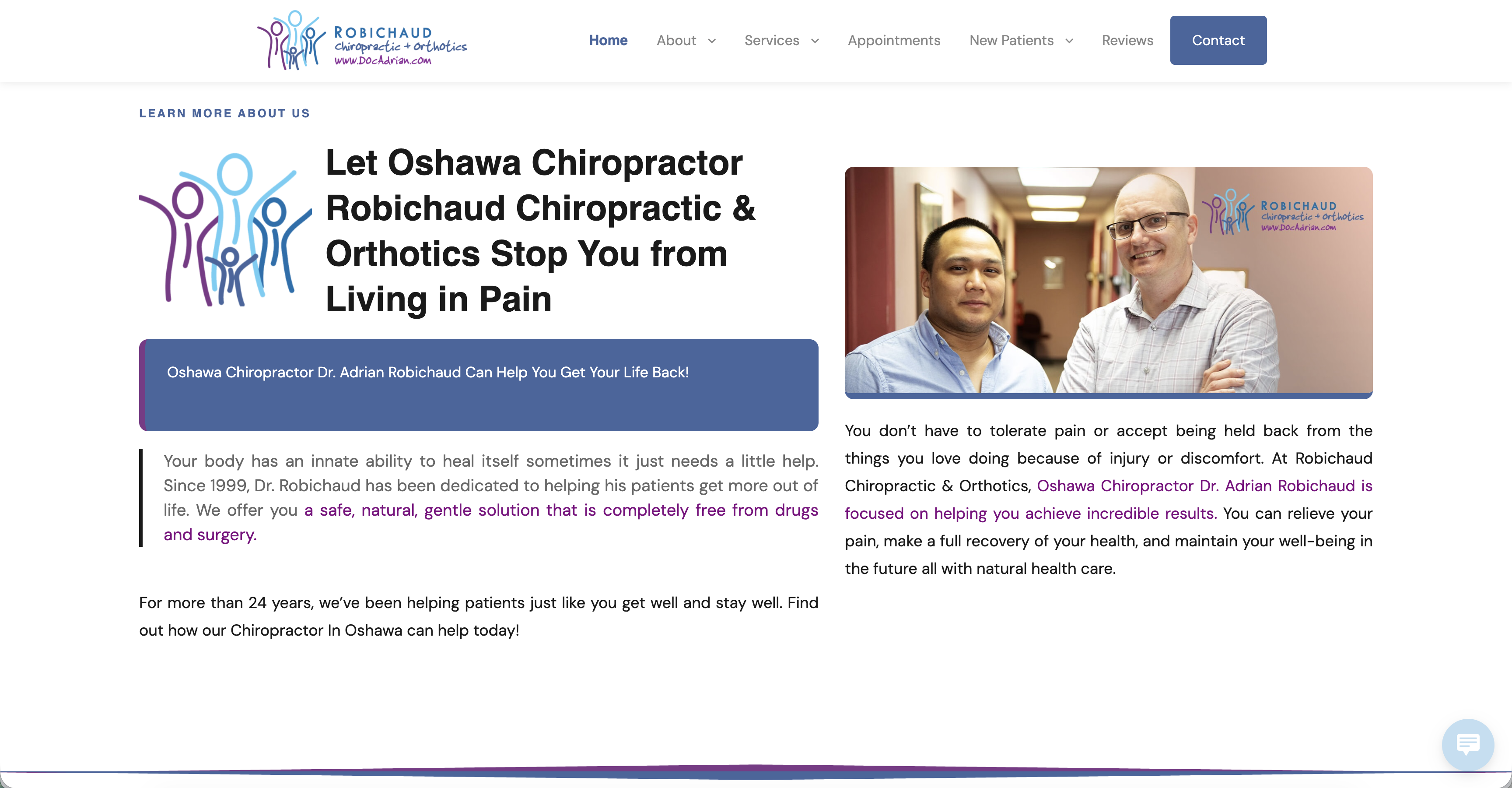
Screenshot 1
Screenshot 2
Click to upload up to 2 screenshots
Instagram Post Screenshots (optional, max 2)
Click to upload up to 2 IG post screenshots
Extract embellishments
Last extracted 2026-06-03T09:55
Brand Analysis
Last run 2026-06-03 09:54 ▼
3,277 chars
# ANALYSIS
## BRAND FOUNDATION
**Practice:** Robichaud Chiropractic & Orthotics
**Niche:** Chiropractic clinic (multidisciplinary — chiropractic, massage therapy, acupuncture, orthotics, laser therapy)
**Location signal:** Oshawa / Durham Region, Ontario, Canada
---
## FONTS (CLIENT OVERRIDE — LOCKED)
- **Headline font:** Montserrat
- **Body font:** Lato
Client override provided. Both fonts locked per instruction. No analysis of website or Instagram fonts performed.
---
## COLOUR
### STEP 1 — LOG
No colours were specified in the client override, so colours are built from the website. The website is a templated chiropractic site (Canva-sourced graphics, UserWay widget) with a clean, clinical, trust-forward palette. Logged colours as observed:
- `#1B6FA8` — primary medical blue (headings / nav / link highlights / CTA accents)
- `#3CA99C` — teal/green secondary (service icons / wellness accents / buttons)
- `#F4F6F8` — light grey-white (section backgrounds / surface)
### STEP 2 — BUILD
**COLOUR BANK**
- `#1B6FA8` — saturated medical blue / accent or surface (identity-carrying)
- `#3CA99C` — saturated teal / accent or surface (secondary identity)
- `#F4F6F8` — neutral / surface (lightest logged, off-white)
- `#13222B` — near-black / text (derived from blue hue, low saturation, ~15% lightness, faint blue undertone)
- `#FFFFFF` — reversed / light (white for text on dark or saturated surfaces)
- `#145880` — shade of brand blue / depth or second accent (optional)
**LIGHT SCHEME**
- Surface: `#F4F6F8` (or `#FFFFFF`)
- Text: `#13222B`
- Accent: `#1B6FA8` (with `#3CA99C` as secondary accent)
**DARK SCHEME**
- Surface: `#1B6FA8` (or `#13222B`)
- Text: `#FFFFFF`
- Accent: `#3CA99C` (teal pops cleanly on blue or near-black)
---
## T-AXIS (CONDITIONS TREATED)
T1 Back Pain
T2 Neck Pain
T3 Whiplash / Auto Injury
T4 Plantar Fasciitis
T5 Herniated Disc
T6 Sciatica
T7 Tension Headaches
T8 Knee Pain
T9 Joint Stiffness
T10 Pinched Nerve
T11 Shoulder Pain
T12 Poor Posture
---
## MODALITIES / TECHNIQUES
- Chiropractic adjustments (Diversified manual adjusting)
- Drop table adjusting
- Cox Flexion-Distraction technique
- Chiropractic Adjusting Tool (CAT)
- Custom-made orthotics (gait analysis, casting)
- Massage therapy (including deep tissue, hot stone)
- Acupuncture
- BioFlex laser therapy (low-level laser / photobiomodulation)
- Soft tissue work
- IFC / electrotherapy (electrical stimulation)
- Ultrasound
- Moist heat / ice
- Accu-o-matic
- Neuro Emotional Technique (NET)
- Remedial / corrective exercise prescription
---
## L-AXIS (BEHAVIOURS)
L1 Prolonged desk work and screen/phone posture ("text neck")
L2 Wearing unsupportive footwear or ignoring gait/foot mechanics
L3 Training load mismanagement and overuse in sport (martial arts, running, lifting)
L4 Ignoring early symptoms and delaying care after injury
L5 Prolonged standing on hard surfaces during long work shifts
---
## C-AXIS (SEGMENTS)
C1 Desk-bound professionals managing posture-related neck and back strain
C2 Recreational athletes and martial arts practitioners
C3 Auto-accident patients in recovery
---
## CONTACT DETAILS
CONTACT DETAILS:
Telephone: 905-571-0821
Website: https://docadrian.com
Email: info@docadrian.com
Location: Oshawa, Ontario, Canada
287 chars
CONTACT DETAILS:
Telephone: 905-571-0821
Website: https://docadrian.com
Email: info@docadrian.com
Location: Oshawa, Ontario, Canada
EMBELLISHMENTS
Corner treatment: moderate (8-12px)
Accent treatment: thin underlines, solid blocks
Overall register: clean clinical trust-forward wellness
Monthly Draw
Draw coordinates for this month. Coordinates are marked used immediately (before generation). 70% Treatments · 20% Lifestyle · 10% Clinic.
Draw History
| Date | Posts | Status | Draw ID | |
|---|---|---|---|---|
| 2026-06-03T09:55 | 10 | Posts developed | 4b17b9e7-f4af-44… | View draw → |